API Claws: Build Self-Improving AI Agents with a Single API

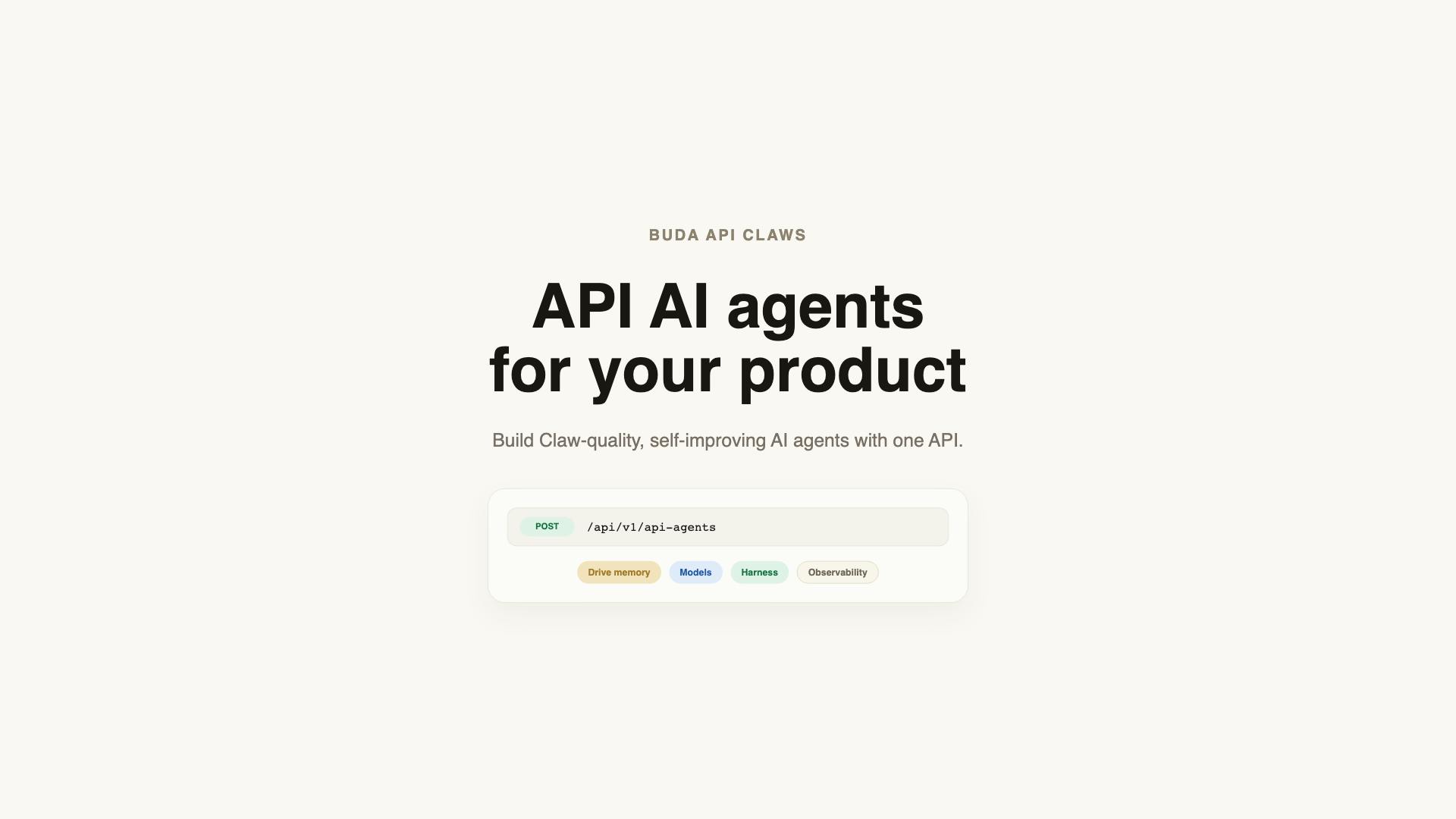
API Claws packages agent infrastructure — memory, routing, and runtime — into a single managed API with a self-improving harness.
API Claws is a managed Agent API by Buda designed to eliminate the infrastructure complexity of building AI agents. It bundles Drive memory, model routing, hosted runtime, observability, and session management into a single API, enabling developers to ship production-ready agents without building the underlying stack themselves. Its headline feature is a "self-improving agent harness" — using persistent memory and observability data to create a feedback loop that helps agents improve over time. The product earned 68 upvotes on Product Hunt, though the mechanics behind self-improvement remain undisclosed, and the Agent-infrastructure-as-a-service space is increasingly competitive.
When Agent Development Meets Infrastructure Challenges
Building a truly functional AI agent is far more complex than writing a few lines of prompts. Developers need to handle memory storage, model routing, runtime management, observability, session maintenance — and then integrate all of these capabilities into an actual product. Each one is an independent engineering challenge, and stacking them together often forces teams to spend the majority of their time on infrastructure rather than core business logic.
API Claws, built by Buda, targets exactly this pain point. Positioned as a developer-facing Agent API, it aims to let you build a self-improving agent harness using a single API — eliminating the need to roll your own full-stack agent infrastructure. The product launched on Product Hunt with 68 upvotes, ranking #13, under the tags API, Developer Tools, and Development.
What API Claws Offers
According to its official description, API Claws packages the core components required to run an agent into a managed service. By calling this API, developers gain access to the following capabilities:
Hosted Agent Runtime
At the core of the product is hosted AI agents, meaning the agent's execution environment is managed by Buda. Developers don't need to maintain servers, schedule jobs, or handle scaling — they can focus entirely on designing agent behavior.
Drive Memory and Model Routing
API Claws includes a built-in memory mechanism called Drive memory, which enables agents to retain context across sessions. This is the foundation for "self-improvement" — without persistent memory, an agent has no way to accumulate experience from past interactions. The accompanying model routing capability allows requests to be flexibly distributed across different models, making it possible to select a more suitable or cost-effective model for each task.
Memory is one of the core challenges in agent engineering. Common approaches fall into a few categories: short-term memory typically exists as the conversational context window and disappears when the session ends; long-term memory requires external persistence using vector databases (like Pinecone or Weaviate) or key-value stores to enable cross-session retrieval. The "Drive memory" naming suggests a persistent design analogous to an "external storage drive" — but beyond simple database writes, a truly valuable memory system must also address three questions: what's worth remembering, how to retrieve relevant memories, and how memories should influence future decisions. On the model routing side, mature tools like LiteLLM and OpenRouter already exist in the ecosystem. The core value lies in abstracting away the API differences between model providers through a unified interface, and dynamically routing requests based on task complexity, latency requirements, or cost constraints — for example, routing simple classification tasks to smaller, cheaper models and complex reasoning tasks to flagship models.
Observability and Session Management
Agents running in production environments require monitoring. API Claws provides observability and session management — the former helps developers track agent runtime status and behavioral performance, while the latter maintains continuity across multi-turn conversations. These two capabilities are key to moving from a "working demo" to an "operable product."
Embeddable Product Experiences
Beyond backend capabilities, API Claws also supports embeddable product experiences, allowing developers to integrate agents directly into their application interfaces and shorten the path from capability to shipped product.
The Appeal — and Open Questions — Around "Self-Improving"
The most compelling selling point of API Claws is the "self-improving agent harness." The term harness refers to the full coordination framework built around a model — memory, tool calls, routing, and monitoring together form the agent's "shell." And "self-improving" implies that this framework can continuously optimize agent performance based on runtime feedback.
Looking at the disclosed components, Drive memory combined with observability data does provide the technical prerequisites for self-improvement: agents can review past interactions, analyze successes and failures, and adjust their strategies accordingly. However, the official materials don't explain the specific implementation mechanism behind "self-improvement" — whether it relies on human feedback loops or autonomous online learning by the model remains unclear. For developers trying to assess its real value, this is a part that warrants further validation.
"Self-improvement" in the AI agent space has several distinct technical pathways, and understanding them helps evaluate the credibility of API Claws' promise. The first is an extension of Reinforcement Learning from Human Feedback (RLHF), where agents use explicit user ratings or implicit behavioral signals (such as task completion rates) as reward signals to periodically fine-tune the model or adjust prompting strategies. The second is automatic prompt optimization — frameworks like DSPy can iteratively improve prompt templates by evaluating output quality without changing model weights. The third is Reflexion-style agents, which prompt the model to generate a self-assessment report after each task and write the learnings into memory for future reference. The engineering complexity and effectiveness of these three approaches vary significantly. If "self-improvement" refers only to this last reflection mechanism, the implementation bar is relatively low; if it involves continuous learning at the model level, deeper challenges like catastrophic forgetting must be addressed.
Who Is It For
API Claws targets teams that don't want to build agent infrastructure from scratch, but need to ship AI capabilities into a product quickly. Compared to directly calling LLM APIs and assembling memory, routing, and monitoring modules yourself, it delivers these engineering layers as a managed service — theoretically capable of significantly shortening development cycles.
This category of "Agent Infrastructure as a Service" is becoming an increasingly crowded space, with multiple platforms already offering memory, orchestration, and observability. Whether API Claws can stand out depends largely on how well it delivers on its differentiated "self-improving" promise, as well as on practical details like pricing, model compatibility, and reliability. The product is currently in an early stage — with only 4 comments on Product Hunt, community feedback remains limited.
Summary
API Claws represents a clear trend in agent development: abstracting complex agent infrastructure into a single API so developers can focus on business logic rather than low-level engineering. It integrates the essential components — memory, model routing, runtime, observability, and session management — under the banner of a "self-improving agent harness." For teams building AI agent products, it's worth keeping an eye on. But the specific capabilities and real-world effectiveness of its "self-improvement" feature still need to be validated in production scenarios.
Related articles

Random Pruning of the DPO Computation Graph: 1.4x Training Speedup and Lower Peak Memory
DPO training too slow and memory-hungry? This paper proposes a random pruning framework for the DPO computation graph, sampling independently across position, sequence, and branch dimensions; branch pruning achieves a 1.426x step-time speedup and cuts training time by about 30%, with in-depth attribution of memory and time gains.

Why Does JEPA Underperform MLM in Longitudinal EHR Representation Learning?
New study compares JEPA and MLM for longitudinal EHR representation learning on MIMIC-IV: three JEPA variants train stably without collapse but underperform MLM; target size, not heterogeneity, drives prediction error.

Transfer Learning + Visible Light Communication: A New Approach to Energy-Efficient Indoor Positioning
A study proposes a transfer learning-based visible light communication indoor positioning method, achieving 47% accuracy improvement on the BOSCH factory dataset, 67.5% model efficiency under high noise, and introducing the ME composite metric for energy-efficient positioning in energy-constrained industrial IoT scenarios.