App Store Submission Pitfall Guide: Open-Source Tool Helps You Avoid 117 Rejection Patterns
Open-source project catalogs 117 app store rejection patterns with fixes, plus pre-submission guard, privacy checks, and regulatory deadline tracking.
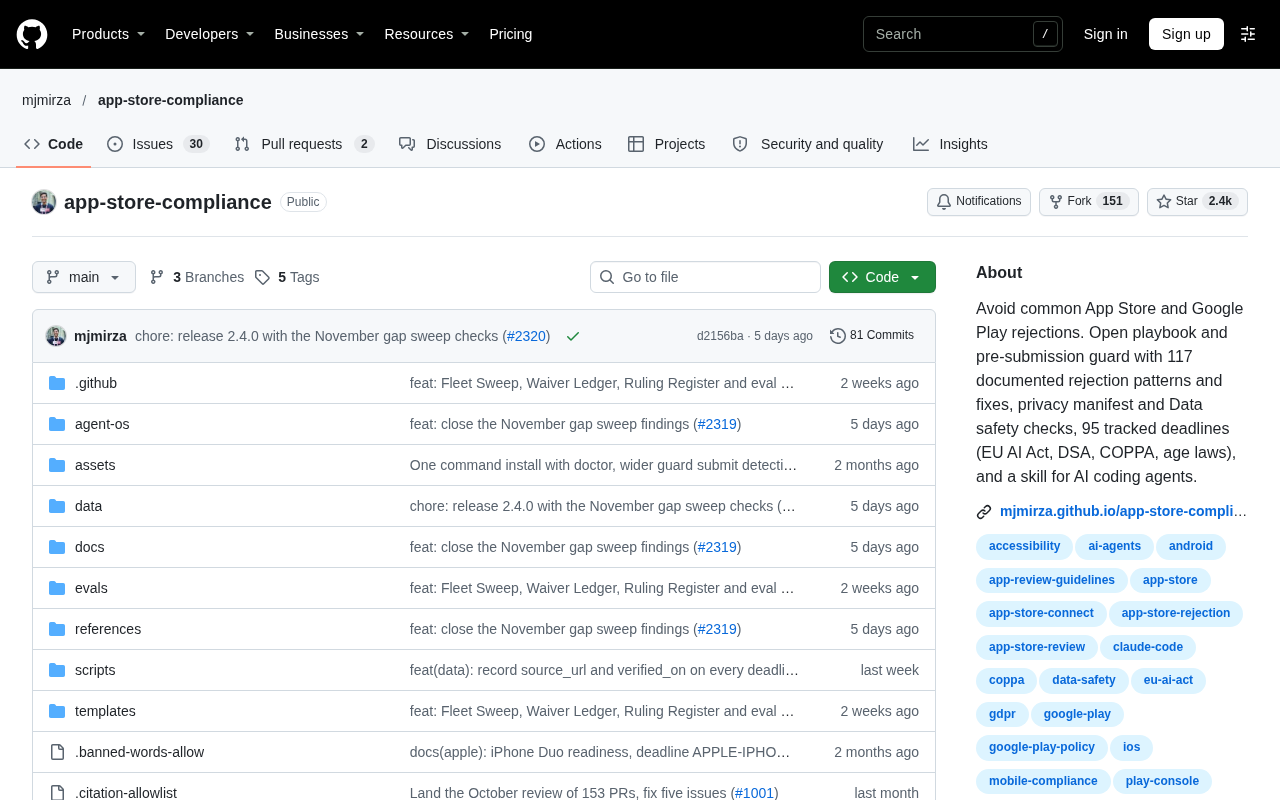
GitHub open-source project mjmirza/app-store-compliance systematically documents 117 App Store and Google Play rejection patterns and fixes, with over 2,300 stars and 377 new stars today. Beyond a static checklist, it includes a pre-submission guard, automated privacy manifest and data safety checks, and a skill module for AI coding agents. It also tracks 95 regulatory deadlines covering the EU AI Act, DSA, COPPA, and more, expanding scope from passing review to ongoing compliance. Developers can clone the repo and integrate it into CI pipelines, starting with the pre-submission guard, to reduce rejections and appeal time.
Why Do Your Apps Keep Getting Rejected? An Open-Source Solution Is Tackling This Pain Point
Every time developers receive a rejection email after submitting an app, they have to spend a lot of time guessing what went wrong. According to the GitHub project mjmirza/app-store-compliance, there are many recurring patterns among App Store and Google Play rejection reasons—the project has currently documented 117 rejection patterns and their corresponding fixes, and has gained over 2,300 stars, with 377 new stars today, indicating that this pain point resonates with many people.
The core idea of this open-source project is straightforward: systematically organize common rejection reasons into an actionable checklist so developers can self-check before submitting. It's not just a static document—it also includes a pre-submission guard, privacy manifest and data safety checks, and a skill for AI coding agents.
117 Rejection Patterns: From Vague Feedback to a Concrete Checklist
The project's core asset is those 117 rejection patterns. Each pattern documents the trigger conditions and fix methods, covering common landmines such as missing privacy policies, incomplete permission declarations, non-compliant metadata, and subscription mechanism issues. For individual developers and small teams, this is essentially a community-sourced "rejection mistake notebook."
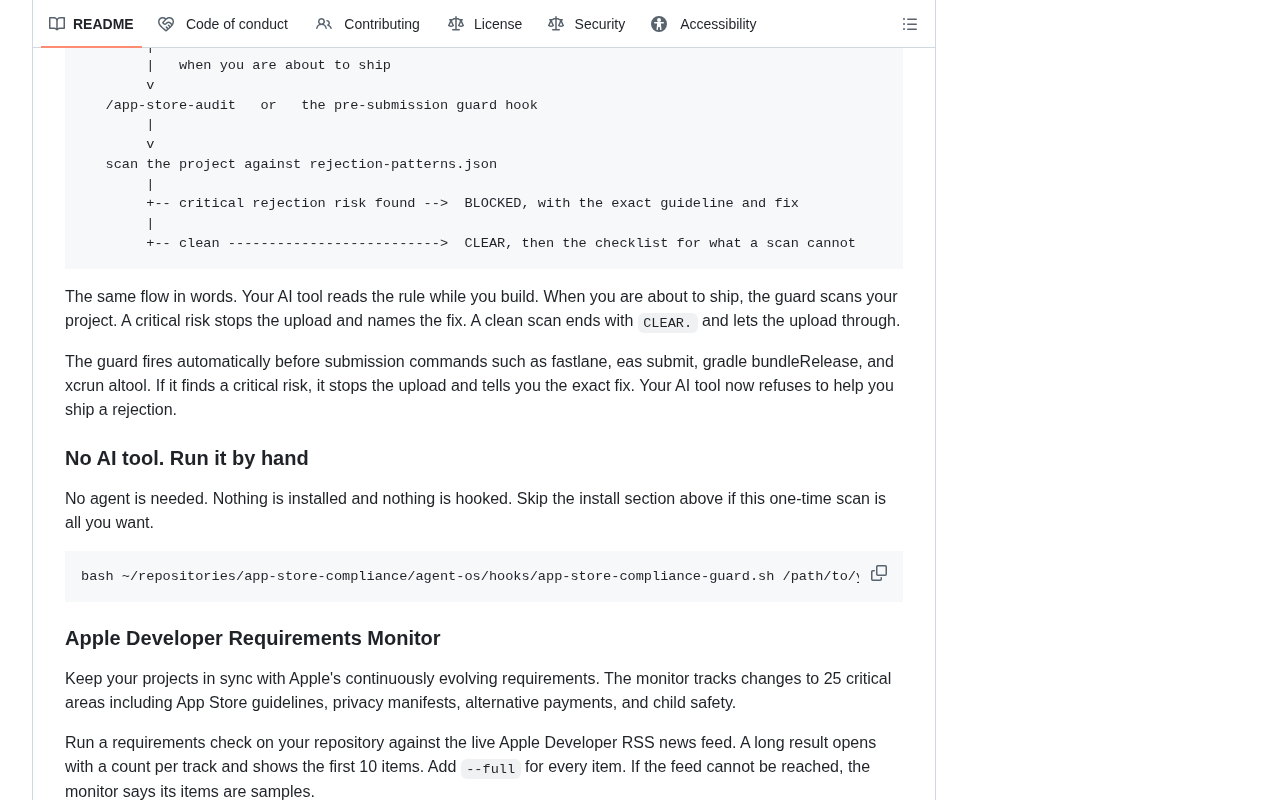
Interestingly, these patterns are not fabricated—they are compiled based on publicly available rejection cases and platform guidelines. The project also provides a pre-submission guard mechanism—automatically checking potential risk points before code submission, intercepting problems before upload. This "shift-left" strategy is far more efficient than appealing after the fact.
The project's current language is Shell, suitable for integration into CI pipelines.
Pre-submission guard is a mechanism that automatically executes compliance checks during the code commit or build phase, typically integrated as scripts or hooks into version control systems (such as Git pre-commit) or continuous integration (CI) pipelines. Its core idea is "shift left"—moving quality and compliance checks as early as possible into development, rather than exposing problems only at the app store review stage. In mobile app development, a pre-submission guard can automatically scan permission declarations, privacy manifest files, metadata configurations, etc., and block commits or issue warnings when items non-compliant with store guidelines are found. This approach can significantly reduce the probability of rejection due to low-level compliance errors and reduce the cost of back-and-forth communication between developers and review teams.
Privacy Manifest and Data Safety: Automated Compliance Checks
Privacy compliance has been a top priority in app store reviews in recent years. The project includes automated checks for Privacy Manifest and Google Play Data safety. Developers can use it to confirm whether their privacy declarations are complete and whether third-party SDKs disclose data collection behavior as required.
For apps involving user data, these checks can significantly reduce the risk of rejection due to "unclear privacy policy" or "incorrect data safety form completion." The project links these check items with the 117 rejection patterns to form a closed loop.
Privacy Manifest is a file (typically named PrivacyInfo.xcprivacy) that Apple has mandated since iOS 17, used to declare the types of data collected by the app and its third-party SDKs, the required reason APIs used, and tracking domains. Developers must fill it out accurately, otherwise the app may be rejected or removed. Google Play Data safety is a form in the Google Play Console that requires developers to disclose what user data the app collects and shares, whether data is encrypted in transit, whether users can request deletion, etc. Both are core checkpoints for privacy compliance in store reviews. This open-source project automates these two types of checks, helping developers verify whether declarations are complete and consistent with actual code behavior, thereby avoiding common rejections caused by "unclear privacy policy" or "incorrect data safety form completion."
95 Regulatory Deadlines: More Than Just App Stores
Beyond store reviews, the project also tracks 95 regulatory deadlines, involving the EU AI Act, the Digital Services Act (DSA), the Children's Online Privacy Protection Act (COPPA), and age-related laws in various regions. This means it expands its scope from "passing review" to "ongoing compliance."
For apps targeting European or child users, these deadline reminders are very practical. Developers can plan compliance changes in advance to avoid app removal due to regulations taking effect. The project binds these dates to specific check items to form an actionable timeline.
The EU AI Act is the world's first comprehensive regulation of artificial intelligence, effective in 2024, setting obligations for high-risk AI systems regarding transparency, risk management, data governance, etc., with different provisions applying in phases. The Digital Services Act (DSA) regulates content moderation, advertising transparency, and user protection for online platforms, applicable to app stores and platforms operating in the EU. The Children's Online Privacy Protection Act (COPPA) is a U.S. federal law requiring websites and apps that collect personal information from children under 13 to obtain parental consent and comply with principles such as data minimization. In addition, age-related laws (such as age verification requirements) are increasingly common in various regions. The project tracks 95 such regulatory deadlines and binds them to specific compliance check items, helping developers not only pass store reviews but also continuously meet the laws and regulations of their operating regions, avoiding app removal or fines due to regulations taking effect.
Skills for AI Coding Agents: Compliance Checks Can Also Be Automated
An interesting design is that the project provides a skill module specifically for AI coding agents. This means that when developers use AI assistants to write code, the agent can invoke this skill to check compliance issues—for example, automatically scanning permission declarations and reminding about missing privacy manifests.
This reflects that compliance tools are evolving from "manually consulting documents" to "embedding into the development process." Although the specific implementation details of this skill are not yet fully public, the direction is worth watching: letting AI consider store rules while generating code.
AI coding agents refer to AI systems that can understand natural language instructions and autonomously write, modify, and debug code, such as GitHub Copilot, Cursor, Claude Code, etc. They typically support "skill" or "tool calling" mechanisms, where the agent can invoke external predefined functions or scripts to complete specific tasks. The skill module provided by this project essentially encapsulates compliance checking capabilities into interfaces callable by AI agents, enabling the agent to proactively scan for issues such as permission declarations and missing privacy manifests when generating code. This marks the evolution of compliance tools from "manually consulting documents" to "embedding into the development process," letting AI consider store rules during the coding phase to reduce rework.
How to Get Started
The project is provided as Shell scripts, and you can clone the repository and integrate it into your local or CI environment. It's recommended to start with the pre-submission guard, then gradually integrate privacy manifest checks and deadline reminders. Since the project is open source on GitHub, developers can also contribute their own rejection cases to help improve the 117-pattern library.
For teams that frequently submit apps, adding this tool to the release process may save a lot of time arguing back and forth with review teams.
Related articles

Multi-Agent Collaborative Development: Task Card-Driven Practices for Medium-to-Large AI Projects
A Bilibili creator shares a task card-driven, PM-orchestrated multi-Agent collaboration model with local-first repository state, so any Agent tool can take over a project anytime.
Cursor vs Copilot vs Claude Code: How Laravel Developers Should Choose
Compare Cursor, GitHub Copilot, and Claude Code for Laravel development: an AI-first editor, a plugin for existing editors, and a terminal agent for multi-file tasks and testing — plus workflow-based recommendations.

AgentScope Java Edition: A Practical Guide to Enterprise-Level Agent Frameworks
An in-depth analysis of Alibaba's AgentScope Java enterprise agent framework: contrasting client-side AI and server-side AI, explaining Java's natural advantages in high concurrency and distributed state management, and outlining a complete learning path from core principles to multi-agent collaboration.