Apple Developer Services Hit by Sudden Outage, Status Page Becomes the Only Source of Truth
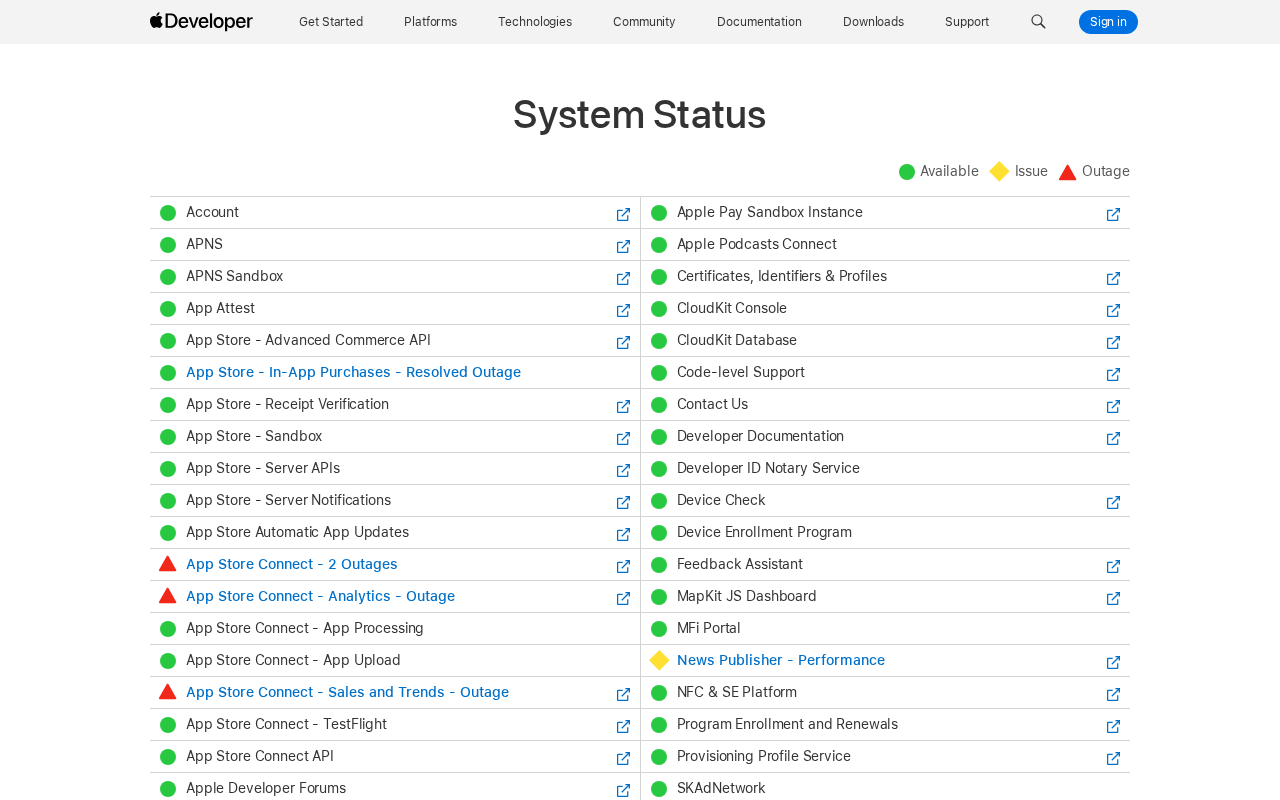
Apple developer services outage makes the status page the sole information outlet, sparking community scrutiny of platform transparency and availability.
Apple's online developer services experienced an anomaly with no official announcement, forcing developers to confirm the outage scope via the system status page under developer.apple.com. The lead gained traction in the tech community, with Hacker News discussion reaching 302 points and 178 comments—far above typical status updates. The article notes that certificate issuance, provisioning profile management, app uploads, and review queries in Apple's developer ecosystem are highly centralized with no alternatives, so a single-point failure directly stalls CI/CD and the release chain. The status page plays three roles—announcement, reassurance, and accountability trail—and its update frequency and wording precision are viewed as an implicit contract between platform and developers. The developer services status page and the public system status page are independent and do not disclose the same scope. The article recommends teams incorporate the status page into daily monitoring and prepare fallback plans for critical links.
Apple's online services for developers experienced an anomaly, and developers could only confirm the scope of the outage through the official system status page. This lead first gained traction in the tech community and then spread rapidly among developers.
An Outage With No Official Announcement
According to leads circulating in the developer community, the system status page under the Apple developer site (developer.apple.com) became the core information outlet for this incident. Unlike ordinary consumer services, when developer services are interrupted, what's affected is the build and release chain—app signing, certificate management, beta distribution, documentation lookups, and more—so the impact is felt directly in engineering teams' daily rhythm.
This event garnered 302 points and 178 comments on Hacker News, a discussion density far higher than typical service status updates. The tech community's reaction reveals one thing: developers' sensitivity to platform service availability is shifting from "I only pay attention when it affects me" to "the moment the status page shows any sign of trouble, everyone gathers to watch."
Why Developers Are So Sensitive to Status Pages
The Build Chain Has No Backup
The key links in Apple's developer ecosystem are highly centralized. Certificate issuance, provisioning profile management, app uploads, and review status queries almost all depend on the same backend. Once any one of these services becomes unavailable, teams often have no equivalent alternative and can only wait for official recovery. This single-point dependency magnifies every color change on the status page.
CI/CD pipeline refers to the automated process of Continuous Integration / Continuous Delivery: after code is committed, compilation, testing, signing, packaging, and distribution to test or production environments are triggered automatically. For iOS/macOS development, this chain typically requires calling Apple's certificate issuance, provisioning profile generation, and app upload APIs, so a platform service interruption directly stalls the pipeline, preventing teams from producing builds or distributing beta versions. This is also the technical reason developers are especially sensitive to backend single-point dependencies: CI/CD concentrates previously scattered manual operations into a single automated path with a hard dependency on external services, and any unavailable link brings the whole thing to a halt.
The Status Page Is Itself an Information Product
The system status page was designed to reduce communication costs, but in real outages it simultaneously plays three roles: announcement, reassurance, and accountability trail. Developers compare the status page's update times, impact scope descriptions, and historical records to judge whether this is a brief hiccup or an ongoing incident. When the status page is vague, community speculation fills the gap.
A status page is a page where a service provider publicly discloses the operational status of each subsystem, typically using different colors to indicate normal, degraded performance, partial outage, and full outage, and recording event updates along a timeline. It is essentially a one-way communication tool designed to reduce support requests and establish a traceable incident record. But a status page's credibility depends on two things: whether updates are timely and whether descriptions are specific. When wording is vague or updates lag, the status page instead becomes the starting point for speculation. Common industry improvements include: clearly listing affected sub-services, providing estimated time to recovery (ETA), publishing postmortem reports afterward, and offering subscribable status feeds or APIs so teams can integrate them into their own monitoring and alerting.
Three Signals from the Community Discussion
Judging from the scale of 178 comments on Hacker News, the discussion did not stay at the surface level of "can I use it or not." The tech community typically breaks an outage down into several layers: whether the failure affected CI/CD pipelines, whether there were regional differences, and whether the official response was timely. Although these discussions do not constitute official conclusions, they reflect developers' genuine expectations for platform transparency.
One detail worth noting is that the first landing point for this information was the developer system status page, not the public-facing Apple system status page. This shows that the monitoring and disclosure system for developer services is relatively independent—what ordinary users and developers see as "whether Apple services are normal" may not be the same picture.
Platform Availability Is Becoming Part of the Developer Experience
In the past, developers evaluating a platform looked at API design, documentation quality, and toolchain maturity. Now availability records are being factored into the same scorecard. An outage with no advance warning directly affects a team's long-term judgment of platform stability, especially when business build processes are deeply tied to that ecosystem.
For platform providers, the update frequency and precision of wording on the status page are becoming an implicit contract. Developers don't need lengthy incident reports, but they do need to know three things: what is affected, how long it will last, and how to detect it earlier next time. The high attention this event received in the community is essentially a collective demand for answers to these three questions.
Summary
The anomaly in Apple's developer services exposed not only the fragility of some backend component, but also the old problem of information asymmetry between developers and the platform. The status page is currently the most direct signal source, but the trust it can carry is limited. For teams that have bet their build chain on a single ecosystem, incorporating the status page into daily monitoring and preparing fallback plans for critical links is more practically valuable than watching the discussion after the fact.
One-line Summary
Apple developer services experienced an anomaly, with the status page becoming the only information outlet, prompting the community to collectively question platform transparency and availability.
Paragraph Summary
Apple's online developer services experienced an anomaly with no official announcement, and developers could only confirm the scope of the outage through the system status page under developer.apple.com. The lead gained traction in the tech community, with the Hacker News discussion reaching 302 points and 178 comments—far higher than typical status updates. The article notes that certificate issuance, provisioning profile management, app uploads, and review queries in Apple's developer ecosystem are highly centralized with no alternative paths, so a single-point failure directly stalls CI/CD and the release chain. In such events, the status page simultaneously plays three roles—announcement, reassurance, and accountability trail—and its update frequency and precision of wording are seen as an implicit contract between the platform and developers. The developer services status page and the public system status page are independent of each other and do not disclose the same scope. The article recommends that teams incorporate the status page into daily monitoring and prepare fallback plans for critical links.
Related articles

AI Teams Up with Mathematicians to Attack the Riemann Hypothesis: 17 Million Lines of Code Tear Open a 167-Year Gap
In November 2026, Anthropic mathematicians and Claude claimed to have discovered a proof of the Riemann Hypothesis, publishing 17 million lines of Lean formalized code that passed machine verification. This article analyzes the event's impact on mathematics and cryptography, and the deeper questions raised by the separation of discovery and understanding.

AI Claims Formal Proof of the Riemann Hypothesis — But Machine Verification Isn't a Mathematical Proof
In Nov 2026, Anthropic's Levent Alpöğe released a Riemann Hypothesis proof of 175,000 code files that passed machine formal verification. But machine verification isn't a mathematical proof: the kernel can't confirm the proposition is the Riemann Hypothesis humans understand, and there's no human-readable paper. This article breaks down how ζ function zeros determine prime-count deviation, and the core of the controversy.

Anthropic Raises Over $80 Billion in IPO, DeepSeek Secures $100 Billion in Funding: AI Weekly Roundup
This week in AI: Anthropic's Nasdaq IPO raises $93.5B in the largest ever, DeepSeek closes ~100B yuan round, AI claims formal Riemann proof, MiniMax breaks crypto candidates in seconds.