Apple Event Preview: Will a Touchscreen MacBook Become Reality?

Apple quietly iterates OLED iPad Mini and M6-chip Macs, paving the way for the touchscreen MacBook event.
Apple this week quietly updated two product lines via press release: an OLED screen for the iPad Mini on Monday and M6 chips for the MacBook Pro and iMac on Tuesday, both routine iterations with modest design and performance gains. The article argues these moves are making way for an upcoming dedicated touchscreen MacBook event. Industry views split between "integration is the trend" and "ergonomics are questionable," and Apple may adopt a compromise of touch as assistance rather than replacing keyboard and mouse, focusing on creative workflows and shortcuts. This reflects Apple's "dual-track" release strategy: silent iteration for mature products to maintain the base, and concentrated attention for innovative products. If the touchscreen MacBook lands, macOS apps will need to re-adapt to touch target sizes and gesture conflicts, and its success will depend on use-case positioning and differentiation from iPad.
Apple has been busy this week: on Monday it released a new iPad Mini with an OLED display, and on Tuesday it brought M6 chip upgrades to the MacBook Pro and iMac. These Mac products are typical iterative updates—the design is nearly identical to the previous generation, and the performance gains are modest. However, the real highlight may still be ahead: an event centered on a touchscreen MacBook is about to kick off.
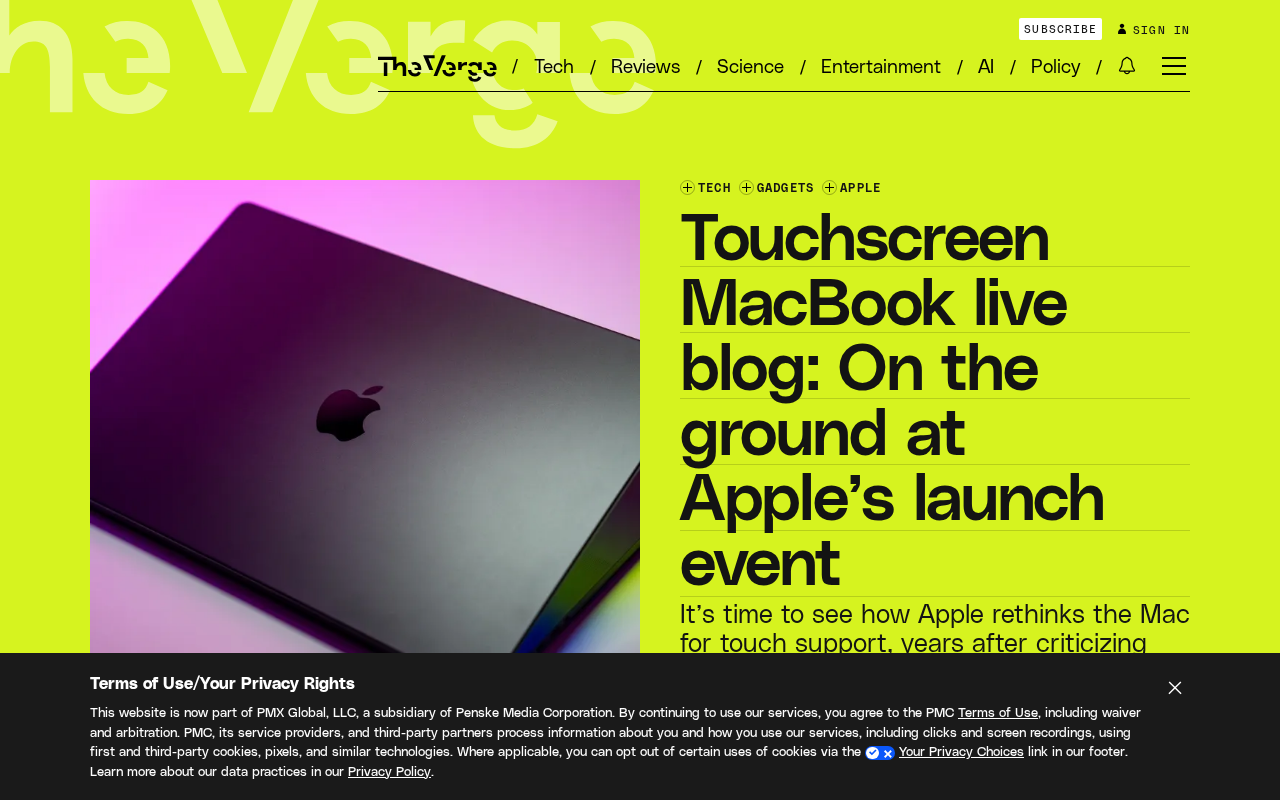
Apple's Pace This Week: From iPad Mini to M6 Chips
On Monday, Apple quietly updated the iPad Mini lineup, equipping it with an OLED display. This upgrade significantly improves color performance and contrast, marking an important leap in display quality for a small-sized tablet. Then on Tuesday, the MacBook Pro and iMac received the M6 chip. Judging by the naming and positioning, M6 is a routine annual iteration, with performance gains expected to be similar to past generations, while the external chassis fully carries over the previous design.
Both updates were rather low-key, released via press release rather than a major event. This may be making way for a more significant product—after all, rumors of a touchscreen MacBook have circulated for years, and if it were to land now, it would be enough to carry the full attention of a standalone event.
OLED (organic light-emitting diode) displays differ fundamentally from traditional LCD screens in how they work: each pixel in an OLED can emit its own light, so it can produce true blacks, achieving near-infinite contrast, while also offering faster response times and wider viewing angles. For small devices like the iPad Mini, OLED can also bring thinner display modules and lower power consumption. However, cost control and lifespan management of OLED on large panels have long been industry challenges, which is why Apple previously adopted OLED widely only on iPhone and Apple Watch while progressing more slowly on the iPad line. This time, the iPad Mini's switch to OLED means Apple now has sufficient maturity and production capacity guarantees in the supply chain for small- and medium-sized OLED panels.
Touchscreen MacBook: Where Rumors Meet Reality
Regarding a touchscreen MacBook, two schools of thought have long existed in the industry. One side believes that Apple's years-long strategy of "clear division of labor between Mac and iPad" is loosening, and that with iPadOS growing stronger in productivity, the integration of touch and desktop-class operating systems is an inevitable trend. The other side points out that Apple executives have repeatedly publicly questioned the ergonomics of touchscreen laptops, arguing that vertical touch is uncomfortable during prolonged use.
Judging from the signs before this event, Apple may be trying to offer a compromise: touch is not meant to replace keyboard and mouse, but to exist as an auxiliary interaction, similar to how Apple Pencil is positioned on iPad. If this guess holds, the experience focus of a touchscreen MacBook will land on creative workflows and shortcut operations, rather than fully embracing touch-first.
The term ergonomics here refers to the comfort and strain on various body parts (especially the arms, shoulders, neck, and wrists) when interacting with a device. The core reason Apple executives previously questioned touchscreen laptops is the "Gorilla Arm" phenomenon: when users hold their arms up for long periods to touch a laptop screen vertically, the shoulders and arms quickly fatigue, and this posture is difficult to sustain ergonomically. By contrast, the iPad is usually used tilted or laid flat, with the arms supported, making touch more natural. This difference explains why Apple tends to position touch as an "auxiliary" rather than "primary" interaction method—it needs to provide a supplementary means for specific scenarios (such as shortcut operations and creative drawing) without undermining the comfort of prolonged desktop work.
The Strategic Logic Behind the Iterations
Looking at the three updates this week together, the rhythm of Apple's product line reveals a clear signal: conventional products follow a silent iteration path to maintain market heat and the sales base, while products with genuine form-factor innovation are saved for dedicated events to be released in a concentrated manner. The OLED iPad Mini and M6-chip Macs belong to the former, while the touchscreen MacBook most likely belongs to the latter.
This "dual-track" release strategy is not uncommon in Apple's history. On one hand, it ensures stable updates to mature product lines and prevents users from churning while waiting; on the other hand, it reserves enough stage and attention resources for innovative products. For developers and power users, the release of a touchscreen MacBook will be far more compelling than any chip upgrade—because it may mean an entirely new interaction paradigm and adaptation requirements.
What It Means for Developers and Users
If the touchscreen MacBook becomes reality, the most direct impact will fall on app adaptation. macOS apps need to rethink touch target sizes, gesture conflicts, and interface layouts. For developers who have already accumulated touch experience on iPadOS, this may be a smooth migration; but for pure desktop developers, it means additional adaptation costs.
At the user level, acceptance of a touchscreen MacBook will depend on how Apple defines its use cases. If positioned as an auxiliary tool for creative professionals, the premium and form-factor changes are still acceptable; if it tries to push it as a mainstream primary device, it must answer a key question: why wouldn't users simply choose an iPad plus a keyboard?
Regardless, the direction of this event will profoundly influence the form-factor evolution of Apple's computing devices over the next few years. The M6 chip iteration is just the appetizer; the touchscreen MacBook is the main course.
Touch target size is a core parameter in touch interface design, referring to the minimum clickable area of interactive elements such as buttons and icons. Industry-standard human interface guidelines generally recommend touch targets no smaller than 44×44 points (Apple HIG standard) or 48×48dp (Android standard) to ensure fingers hit accurately. Desktop macOS apps have long been designed around cursor precision, and controls are often far smaller than this size, so once a touchscreen MacBook lands, developers will need to re-examine the size and spacing of toolbars, menu items, and list rows. In addition, gesture conflicts are another adaptation challenge: existing macOS trackpad multi-finger gestures, scroll inertia, and the newly added direct screen touch need clear differentiation, otherwise misoperations are easy to cause. This adaptation work is relatively smooth for teams with existing iPadOS touch experience, but constitutes additional design and testing costs for pure desktop developers.
One-line Summary
Apple quietly iterates OLED iPad Mini and M6-chip Macs, paving the way for the main event: the touchscreen MacBook launch.
Paragraph Summary
This week Apple quietly updated two product lines via press release: on Monday it gave the iPad Mini an OLED screen, and on Tuesday it brought M6 chips to the MacBook Pro and iMac—both routine iterations with modest design and performance gains. The article argues these moves are making way for an upcoming dedicated touchscreen MacBook event. Around the touchscreen MacBook, two industry views exist: "integration is the trend" and "ergonomics are questionable." Apple may adopt a compromise of touch as assistance rather than replacing keyboard and mouse, focusing on creative workflows and shortcut operations. This rhythm reflects Apple's "dual-track" release strategy: silent iteration for mature products to maintain the base, and concentrated attention for innovative products. If the touchscreen MacBook lands, macOS apps will need to re-adapt to touch target sizes and gesture conflicts, and its success will depend on use-case positioning and differentiation from iPad.
Related articles

Vaani Developer Platform: Build Human-Like Voice AI Agents with Zero Code
Vaani Developer Platform tops Product Hunt with 175 upvotes, offering zero-code construction of human-like voice AI agents with flow design, tool and knowledge base connections, real phone deployment, and structured call data output.

Knocket AI: A Lightweight Tool That Lets Visitors Chat with Zero Friction
Knocket AI is a lightweight tool that lets visitors start real-time chats via a website or link without registering, targeting founders, creators, and small teams.

XWiki Launches Open-Source MCP Server: Let AI Read Your Wiki
XWiki's open-source MCP Server extension connects your Wiki knowledge base to AI agents like Claude Code and GitHub Copilot, supporting Q&A, page editing, and structured data—self-hosted to keep data control.