Knocket AI: A Lightweight Tool That Lets Visitors Chat with Zero Friction

Knocket AI lets visitors start real-time chats via website or link with no registration required.
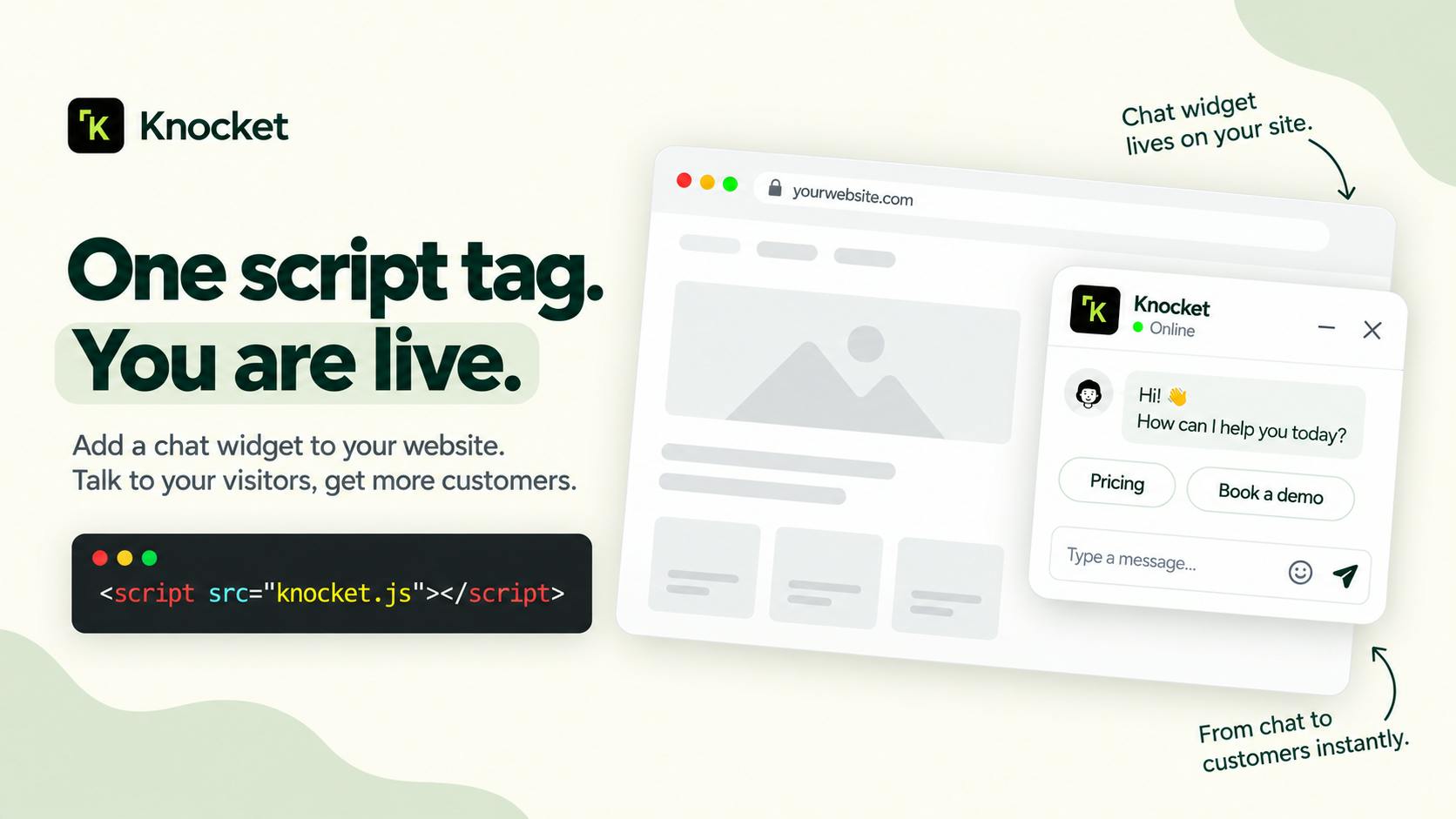
Knocket AI is a lightweight communication tool ranked second on Product Hunt's daily leaderboard. It combines a free real-time chat widget with a conversational bio link contact page, letting visitors start a conversation without registering, filling out forms, or being redirected to third-party customer service. It targets indie developers, content creators, and early-stage startup teams with limited budgets and short decision chains, emphasizing "getting the conversation started" rather than replacing professional customer service systems. The article notes clear functional boundaries in multi-agent routing, CRM integration, and conversation history analysis, and that low friction may also bring spam and low-quality inquiries; anti-abuse mechanisms and paid conversion paths remain unclear. With 151 votes, 42 comments, and a second-place daily ranking on PH, the concept resonates, but retention and actual usage depth remain an information blind spot.
Why Does Visitor Communication Always Fall Short?
Visitors to a website or social profile often have the intent to engage, but get stuck in the cumbersome process of signing up, filling out forms, or being redirected to third-party customer service. Knocket AI, ranked second on Product Hunt, tries to solve this gap: it allows visitors to start a real-time conversation with the operator directly through a website or link, without needing to register. This positioning targets founders, creators, and small teams — people who typically don't have the budget to deploy heavy customer service systems but still need a more immediate way to connect than email.
Core Features: Chat and Bio Link Contact Page Combined
Knocket AI's product logic revolves around two entry points: first, embedding a free real-time chat window into a website or app; second, transforming a bio link into a conversational contact page. Visitors can simply click and start talking, skipping account creation entirely.
This design puts "reducing friction" first. For creators, a bio link usually serves only a display function; Knocket AI adds a layer of interactivity. For small teams, the chat widget on a website can serve as a lightweight channel for pre-sales inquiries or user feedback, without needing to integrate a full customer service ticketing system.
Bio link is a lightweight landing page format from the social media era: creators aggregate multiple links onto a single page and place that page's URL in their profile bios on platforms like Instagram, TikTok, and X, bypassing the restriction most platforms impose of allowing only one external link. Tools like Linktree and Beacons represent this category, with the core value of "one link carrying all entry points." Traditional bio links are mainly for display and redirection; users often leave the current page after clicking. Knocket AI embeds real-time chat capability into this scenario, essentially turning the bio link from a "static navigation page" into an "instant-interaction reception desk" — this is the key design that distinguishes it from ordinary link aggregation tools.
Who Should Use It, and Who Might Want to Think Twice
Based on the official description, Knocket AI's target user profile is clear: indie developers, content creators, and early-stage startup teams. What these groups share is a short decision chain, cost sensitivity, and the need to quickly validate the effectiveness of a communication channel.
But lightweight also means functional boundaries. If a business needs multi-agent routing, complex routing rules, deep CRM integration, or full conversation history analysis, this type of tool may only be a transitional solution. Its value lies in "getting the conversation started," not in replacing a professional customer service platform.
Product Signals from Product Hunt Feedback
Knocket AI received 151 votes and 42 comments on Product Hunt, ranking second for the day, categorized under Productivity, Customer Success, and Customer Communication. This vote count is mid-to-upper range for a PH daily leaderboard, suggesting the concept resonates to some degree but hasn't yet generated large-scale discussion.
A ratio of 42 comments to 151 votes is relatively high, which usually means the comment section saw substantial interaction or questions — a positive signal for an early-stage product, as users are willing to spend time giving feedback rather than just clicking a like and leaving. However, PH data alone cannot determine retention or depth of actual usage — an information blind spot that all launch-stage products face.
Product Hunt is a global platform for launching and discovering new products. Many teams launch products there daily, and users express support through upvotes and comments. The platform generates a daily leaderboard based on votes received that day, and the No. 1 spot often brings enormous exposure — so "ranking second" is itself a meaningful signal. However, voting behavior on Product Hunt is strongly community- and socially-driven; vote counts reflect more whether a concept catches the eye and whether the launch timing is right, rather than actual retention and willingness to pay. The industry generally views PH daily leaderboard performance as a starting point for customer acquisition, not the endpoint. The truly valuable metrics — activation rate, retention rate, and conversion data in the weeks following launch — are usually not made public.
The Competitive Logic of Lightweight Chat Tools
Knocket AI's lane isn't empty: traditional online customer service software, website chat plugins, and bio link tools are all competing for the same attention. Its differentiation isn't in feature depth but in merging the "chat" and "link page" scenarios while minimizing friction on the visitor side.
The risk of this strategy is that low-barrier chat can easily attract spam or low-quality inquiries, and whether the product has built-in filtering or management mechanisms cannot be confirmed from the available materials. On the other hand, a free strategy helps with rapid customer acquisition, but how to convert to paid long-term and sustain team development is a challenge that similar tools have repeatedly faced. For users, treating it as a low-cost experimental channel at this stage is reasonable, but it shouldn't be the sole communication infrastructure.
"Multi-agent routing" and "CRM integration" are two hallmark capabilities of professional customer service systems. Multi-agent means multiple support staff share one inbox, with the system assigning visitor conversations to the right agent based on rules (such as round-robin, skill groups, or load). CRM (Customer Relationship Management) integration syncs conversation records, visitor identities, and historical tickets to systems like Salesforce or HubSpot, forming a complete customer view. These two capabilities typically come with ticket workflows, SLA (Service Level Agreement) monitoring, and conversation quality inspection, constituting the full loop of enterprise-grade customer service. Lightweight tools like Knocket AI deliberately avoid these in exchange for fast deployment, low cost, and zero friction for visitors — but this also means that once the business scales up and needs team collaboration and data analysis, users will likely migrate to heavier platforms.
A Product Direction Worth Watching
Knocket AI represents a "counter-heavy customer service" mindset: rather than pursuing tickets, SLAs, and omnichannel integration, it first aims to increase the probability that a conversation happens. For small teams with modest visitor volumes but a desire to promptly capture every potential collaboration or feedback, this type of tool has practical relevance. Whether it can move from a PH debut to stable usage depends on how quickly it fills gaps in message management, notification delivery, and anti-abuse.
Related articles
DeepSeek Open-Sources DeepInfer: What Is an Inference Framework Actually For?
DeepSeek open-sources its inference framework DeepInfer under Apache 2.0, supporting DeepSeek V4.1 Flash offline inference. This article explains its request scheduling, FlashMLA/DeepGEMM compute optimization, DSPark speculative verification acceleration, and what it means for developers and ordinary users.
Open-Source AI Learning Agent: A Full Workflow Experience from Topology Graphs to Exam Generation
Explore an open-source AI learning agent: built on DeepSeek API, it constructs knowledge systems via topology graphs, with automatic document generation, notes, super documents, and exams. Learn about its Agent workflow and design highlights.

DeepSeek Whale Girl Open-Source MV Meme: AI Industry Coded Slang About Pivoting to Closed Source
Bilibili's DeepSeek Whale Girl rap MV uses fictional memes to tease the AI open-source vs. closed-source debate, with lyrics full of industry slang. This article explains the meme culture, the Whale Girl symbol, and the open/closed tension.