Apple Home Collection Hands-On: Six New Smart Home Devices

Apple partners with LG and Schneider to launch Home Collection smart home hardware, shifting from platform provider to product maker.
At its "Welcome Home" event, Apple launched the Apple Home Collection smart home line with six devices covering home security and environmental control, co-developed with LG Electronics and Schneider Electric. Hands-on experience showed smooth iPhone and Apple TV integration, simple setup, and HomeKit Secure Video with end-to-end encryption. The LG smart lock is priced at $349. The article sees this as Apple's exploratory shift from smart home platform provider to hardware product maker.
Apple officially unveiled its new smart home product line — Apple Home Collection — at Tuesday's "Welcome Home" event. We got hands-on with the new lineup on site, including six devices spanning video doorbells, security cameras, smart locks, and thermostats.
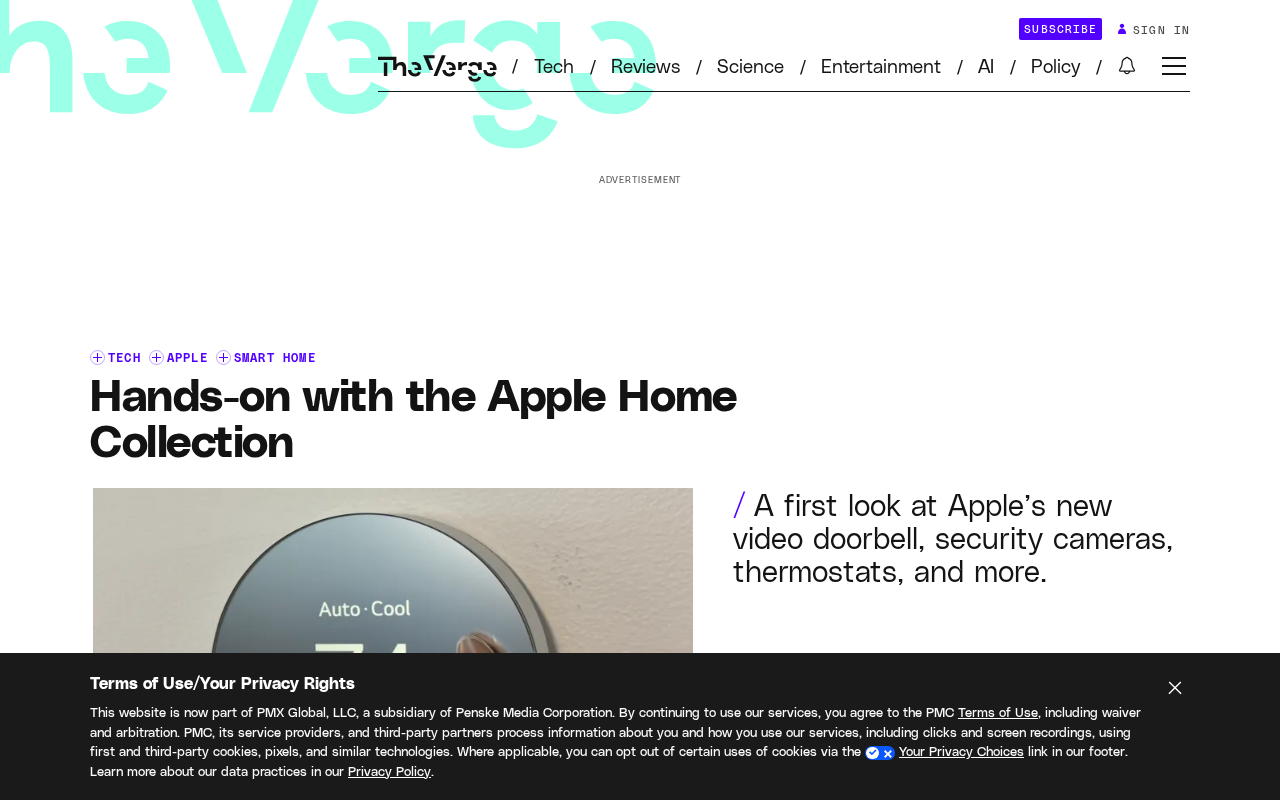
Co-developed with LG and Schneider
These products weren't built by Apple alone — they were developed jointly with LG Electronics and Schneider Electric. Apple handled the core HomeKit integration and software experience, while LG and Schneider provided support in hardware manufacturing and electrical infrastructure, respectively. This kind of partnership model is unusual for Apple's previous smart home strategy — in the past, Apple relied more on third-party manufacturers joining the HomeKit ecosystem rather than getting directly involved in hardware definition.
From the hands-on experience, the build quality carries Apple's signature standard, with materials and color schemes leaning toward a minimalist style that fits into modern home environments.
HomeKit is the smart home framework Apple launched in 2014. It isn't a hardware product itself, but a protocol and certification system that lets third-party devices be controlled uniformly through iPhone, iPad, Apple TV, and HomePod. Devices must pass Apple's MFi certification to join, and pairing data is managed with local encryption on iOS devices. HomeKit's core features include scene automation, cross-device coordination, and the later addition of HomeKit Secure Video — which allows cameras to upload recordings to iCloud with end-to-end encryption, so Apple cannot decrypt the content. Understanding HomeKit's positioning is key to understanding why Apple is shifting from "platform provider" to "product maker" this time: in the past, Apple only set the protocol and let third parties build hardware, leading to uneven experiences; by getting directly involved in hardware definition, Apple can control the full chain of both software and hardware.
Product lineup and pricing
The six new devices cover two core scenarios: home security and environmental control:
- Video doorbell: Supports HomeKit Secure Video, can identify visitors and display footage directly on Apple TV
- Security camera: Available for both indoor and outdoor coverage, supports end-to-end encrypted storage
- Smart lock: The LG version is priced at $349, supports multiple unlock methods
- Thermostat: Co-developed with Schneider Electric, emphasizes energy efficiency management
The LG smart lock's $349 price tag places it in the mid-to-high-end segment, close to premium models from brands like August and Yale, but its deep integration with the Apple ecosystem is its differentiating selling point.
Matter is a smart home interoperability standard jointly promoted by Apple, Google, Amazon, and Samsung, officially released in 2022, with the goal of letting devices from different ecosystems communicate with each other. Apple is one of Matter's primary initiators, and HomeKit devices are gradually becoming Matter-compatible. This means users can theoretically use Apple devices to control lights, plugs, and other devices originally belonging to Google or Amazon ecosystems. However, in categories like cameras and door locks that demand high bandwidth or high security, manufacturers often still prefer to retain deep features specific to their own ecosystems (such as HomeKit Secure Video's end-to-end encryption), and Matter currently only covers basic control capabilities. So Apple launching its own hardware doesn't conflict with Matter's open direction — rather, it layers a more controllable self-developed product on top of the open protocol.
Hands-on impressions and initial assessment
In actual use, the devices coordinate very smoothly with iPhone and Apple TV, and the network setup process is simpler than most third-party HomeKit devices. Video latency on the doorbell and camera is kept within acceptable limits, and HomeKit Secure Video's end-to-end encryption is a clear plus for privacy-conscious users.
That said, whether the $349 door lock price tag will get mainstream consumers on board still depends on the completeness of future software features and the depth of ecosystem coordination. For now, Apple Home Collection looks more like Apple's exploratory move from "platform provider" to "product maker" in the smart home space.
End-to-End Encryption refers to data being encrypted at the sender's end and decrypted only at the receiver's end, with no intermediary (including the cloud service provider itself) able to read the plaintext. In smart home scenarios, this is particularly important: cameras record footage inside the home, and once the cloud can decrypt it, there's a risk of misuse or leakage. Apple's HomeKit Secure Video encrypts recordings and stores them in the user's iCloud account, with decryption keys kept on the user's own devices, while Apple's servers only store ciphertext. This is why the original article calls it a "clear plus" — compared to most competitors that rely on manufacturer cloud platforms with the manufacturer holding the keys, this design creates a substantive difference in privacy, especially appealing to users who care about data security.
Market significance
Apple getting directly into smart home hardware means its level of commitment to this market is rising. The partnership with LG and Schneider leverages the supply chain capabilities of traditional appliance and electrical manufacturers while ensuring consistency in the software experience. If this model works, more categories of Apple Home Collection products could appear in the future.
One-line Summary
Apple partners with LG and Schneider to launch Home Collection smart home hardware, shifting from platform provider to product maker.
Paragraph Summary
At its "Welcome Home" event, Apple launched the new smart home line Apple Home Collection, comprising six devices including video doorbells, security cameras, smart locks, and thermostats, covering home security and environmental control. The products were co-developed by Apple with LG Electronics and Schneider Electric: Apple handled HomeKit integration and the software experience, while LG and Schneider provided hardware manufacturing and electrical infrastructure support. Hands-on experience showed smooth coordination with iPhone and Apple TV, simple setup, and support for HomeKit Secure Video's end-to-end encryption. The LG smart lock is priced at $349, positioned in the mid-to-high-end segment. The article views this as an exploratory move by Apple from smart home platform provider to hardware product maker, and if the partnership model succeeds, more product categories could emerge in the future.
Related articles

Amphibious Transforming Drone: Beyond 100x Power Savings, What Are the Real Needs?
Is the amphibious transforming drone just a gimmick? Starting from the 100x power difference of the M4 Morphobot, explore real application scenarios and thesis topic ideas, analyzing boundary conditions where pure drones and pure ground robots both fail.

Warhound Raises $200 Million: Genetically Engineered "War Dogs" Paired with Anduril Gear
Warhound raises $200M, backed by Ben Lamm and Palmer Luckey, to genetically engineer dogs for military and law enforcement use and equip them with Anduril gear. This article analyzes its technology direction, funding logic, and ethical controversy.

Claude API Comes to Google Cloud: IAM Integration and SDK Access Guide
Anthropic hosts the full Claude API on Google Cloud with IAM-controlled permissions and unified billing. This guide covers the Vertex AI and Anthropic-hosted entry points, IAM role configuration, and SDK access.