Apple HomePod Mini 2 Now Available for Preorder: Powered by S10 Chip

The HomePod Mini 2 gets its first update in six years, featuring the S10 chip, priced at $149, and launching October 30.
After nearly six years, Apple has updated its HomePod Mini lineup. The new HomePod Mini 2 is now available for preorder at $149 and will officially launch on October 30. The key upgrade is the S10 chip, which debuted in the Apple Watch Series 10, significantly boosting on-device computing power to support more complex computational audio algorithms, optimized Siri responsiveness, and smart home hub scheduling. The $149 price matches the previous generation, signaling Apple's strategy of defending its ecosystem entry point rather than pursuing per-unit profit. The product remains primarily aimed at users already deeply invested in Apple devices, differentiating itself from Amazon Echo and Google Nest through ecosystem integration.
Nearly six years later, Apple has finally updated its HomePod Mini lineup. The new HomePod Mini 2 is now available for preorder at $149 and will officially go on sale on Friday, October 30. For users who have been waiting for Apple to refresh its entry-level smart speaker, the key highlight of this update centers on the chip.
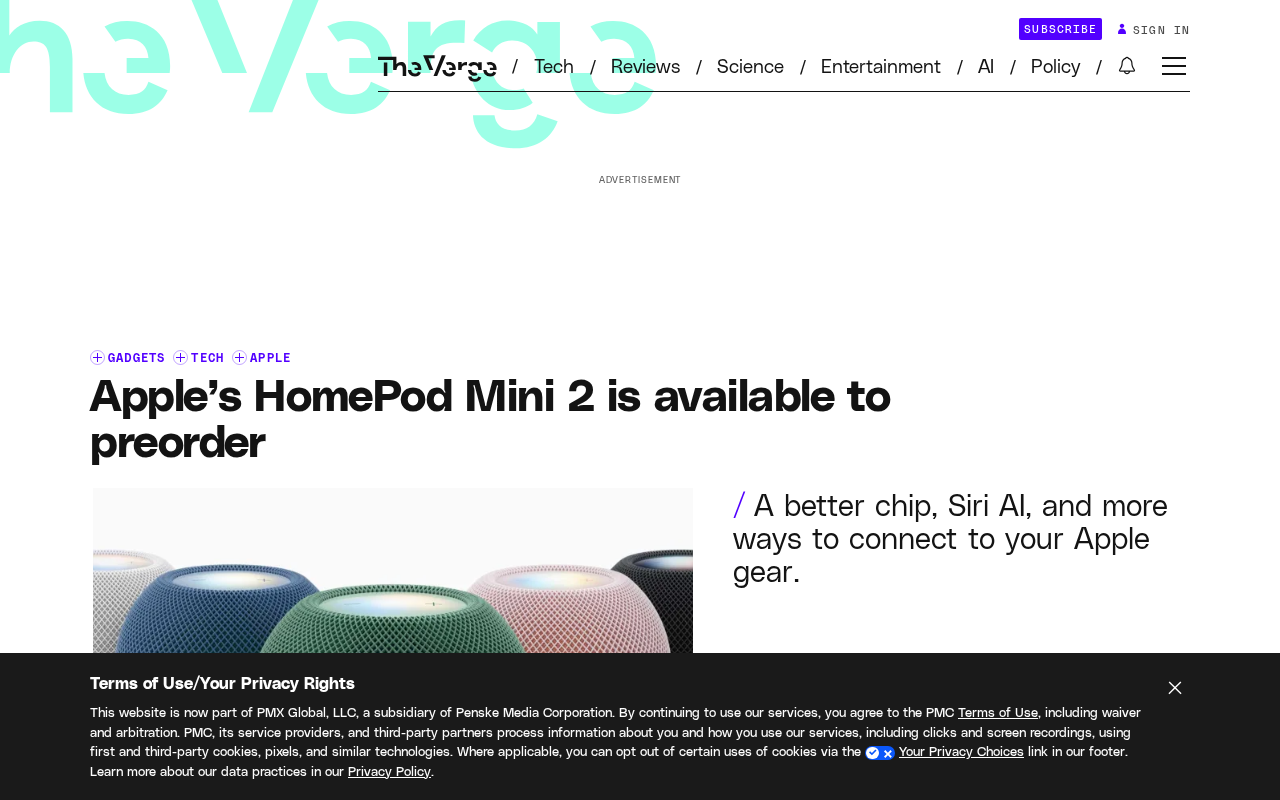
Key Upgrade: The S10 Chip Trickles Down
The biggest change in the HomePod Mini 2 is the inclusion of the S10 chip. This chip previously debuted in the Apple Watch Series 10 and is one of the newer members of Apple's custom silicon family. Bringing the S10 to the smart speaker lineup means the HomePod Mini 2 gains a significant boost in on-device computing power.
From a technical standpoint, the addition of the S10 chip is more than just a spec bump. Greater processing power can support more complex audio processing algorithms, more responsive voice wake-up, and smoother cross-device coordination. Apple has always emphasized the concept of "computational audio" in its smart speakers, and chip performance directly determines the ceiling of that capability.
Interestingly, it has been nearly six years since the previous-generation HomePod Mini was released. During that time, the smart speaker market has undergone a repositioning from "voice assistant entry point" to "smart home hub." Apple's delay in updating this product line had raised questions about whether it was abandoning the entry-level market. This update at least shows that Apple still considers the HomePod Mini an important part of its smart home ecosystem.
On "Computational Audio": This is a technical approach Apple has repeatedly emphasized in its audio products. It refers to not relying solely on the physical quality of speaker drivers, but instead using real-time chip computation to dynamically adjust the sound field. Specifically, the speaker first captures the room's reflected sound through microphones, then the chip models and calculates a compensation curve, and finally corrects the output frequency response and phase in real time. This process is extremely sensitive to both computing power and latency — the higher the sampling rate and the more precise the correction, the greater the chip's floating-point performance requirements. The original HomePod relied on the A8 chip to accomplish this task, and subsequent chip generations have directly determined the product's audio ceiling. The trickle-down of the S10 means the entry-level model gains computational audio bandwidth approaching that of flagship models for the first time.
On "Smart Home Hub": In Apple's ecosystem definition, the HomePod does more than just play music. It also serves as a Thread Border Router for Matter and Thread networks, responsible for connecting low-power smart home devices to the home network. Matter is a cross-brand smart home interoperability standard, while Thread is the low-power mesh networking protocol it relies on at the foundation. A hub device needs to stay online continuously, respond with low latency, and coordinate command forwarding across multiple devices. This places high demands on the chip's standby power consumption and scheduling capabilities, which is one reason why Apple's delay in upgrading the entry-level chip could affect its smart home strategy.
Pricing and Market Positioning Analysis
The $149 price point is consistent with the previous-generation HomePod Mini. Against the backdrop of inflationary pressure and widespread increases in component costs, maintaining the original price is itself a noteworthy signal. It suggests that Apple's strategy for this product leans more toward "defending the entry point" rather than "pursuing per-unit profit."
From a competitive standpoint, this price segment faces intense competition from the Amazon Echo and Google Nest series. Apple's differentiated advantage has always been deep integration with its own ecosystem — if you're already using an iPhone, Apple Watch, and Apple TV, the coordination experience of the HomePod Mini 2 is difficult for other brands to replicate.
On the other hand, $149 is still on the higher side for the smart speaker category. For non-Apple ecosystem users, this price is unlikely to be attractive enough. The target user profile for the HomePod Mini 2 remains clear: consumers who are already deeply invested in Apple devices.
On the Smart Speaker Market Landscape: Amazon Echo relies on the Alexa voice assistant and extremely low hardware prices (some models are frequently discounted to the $30-$50 range) to hold a shipment volume advantage. Its business model uses hardware subsidies to secure an entry point for voice shopping and services. The Google Nest series is tied to Google Assistant and the Android ecosystem, with prices also lower than the HomePod Mini. Apple clearly lags in shipment volume, but its strategy is not to compete for market share — rather, it defines the HomePod as an "ecosystem accessory," using exclusive features like Handoff, Apple TV audio return, and Find My network to increase switching stickiness among existing Apple users. Therefore, the pricing logic behind $149 is not benchmarking against competitors, but benchmarking against Apple's own ecosystem value.
What Real-World Experience Improvements Does the S10 Chip Bring?
Chip upgrades ultimately need to translate into user experience. According to currently available information, the S10 chip "can power a range of features," but specific feature details have not yet been fully disclosed.
Based on reasonable speculation, the improvements brought by the S10 could manifest in several areas: the response speed and offline processing capability of the Siri voice assistant, the real-time computational precision of spatial audio, and the multi-device scheduling efficiency when serving as a smart home hub. For a product that was released nearly six years ago, improvements to these foundational capabilities may be more meaningful than adding a specific new feature.
Apple's choice to release this product in the fall also aligns with its consistent product cadence. The October 30 release date follows closely after Apple's fall new product season, and the HomePod Mini 2 may form accessory-level pairings with other new devices.
Purchase Advice
If you're already within the Apple ecosystem and need a smart home hub or desktop speaker, the HomePod Mini 2 is currently the most sensible choice. The addition of the S10 chip means this product won't quickly become outdated due to insufficient performance in the coming years.
If your needs for a smart speaker are limited to voice control and basic playback, and you don't have a strong dependence on the Apple ecosystem, there are still more cost-effective alternatives on the market. The value of the HomePod Mini 2 lies not in its hardware specs themselves, but in its position within the Apple ecosystem.
Related articles

Gaussian Process Bandit Optimization: Exploration Strategies and Inference Regret Guarantees
Cumulative regret guarantees in Bayesian optimization fail to reflect final recommendation quality. This article examines a new study that provides inference regret guarantees for Gaussian process bandit optimization through exploration query strategies and fill distance analysis, validated on hyperparameter optimization and control tasks.

The Most Detailed Codex Guide on Bilibili: From Installation to Real-World Practice
The most detailed Codex guide on Bilibili: from app store installation to daily work mode configuration, with a real coffee shop project demonstrating file organization, data extraction, dashboard creation, and other practical tasks. Learn to use Plan Mode and desktop pets to leverage Codex efficiently.

Appearance Compensation in Volume Rendering: Why RGB Accuracy Cannot Guarantee Density Correctness
Volume rendering research reveals that volumetric data perfectly reproducing external RGB views may still contain density errors: appearance compensation can double central density and keep external rays unchanged even when L2 error exceeds 14.52%. Density recovery depends on appearance capacity, spatial resolution, and measurement design.