Apple HomeView Adds Another Threat: The Survival Struggle of Online Recipe Writers

Apple's HomeView enters the home through the kitchen, intensifying zero-click and eroding recipe creators' traffic.
Apple released an ad for its HomeView smart display focused on a chaotic kitchen scene, signaling its intent to penetrate real family life. The article notes that voice Q&A on smart screens lets users get recipe steps without clicking into recipe sites, intensifying the "zero-click" trend—not Apple's invention, but one that may further change distribution given Apple's ecosystem stickiness and privacy narrative. Large media groups can license their way onto platforms, but independent recipe writers lack bargaining power as SEO value and ad revenue are diluted. Creators are advised to pivot to personal stories and flavor judgments machines can't replace, and to build direct subscription channels and communities.
Title
Apple HomeView Adds Another Threat: The Survival Struggle of Online Recipe Writers
Meta Description
Apple's HomeView smart display uses the kitchen as its selling point, with voice Q&A directly providing cooking steps, intensifying the "zero-click" trend and dealing a new blow to online recipe writers' traffic and ad revenue.
Article Content
When Apple launched the HomeView smart display, it aired a rare "un-Apple" ad: the camera focused on a chaotic, hurried morning in a family of five, rather than spotless rooms and sleek devices. HomeView sits right at the center of the kitchen chaos. The message was clear—Apple wants to penetrate the real scenarios of family life, and the kitchen is the next battleground.
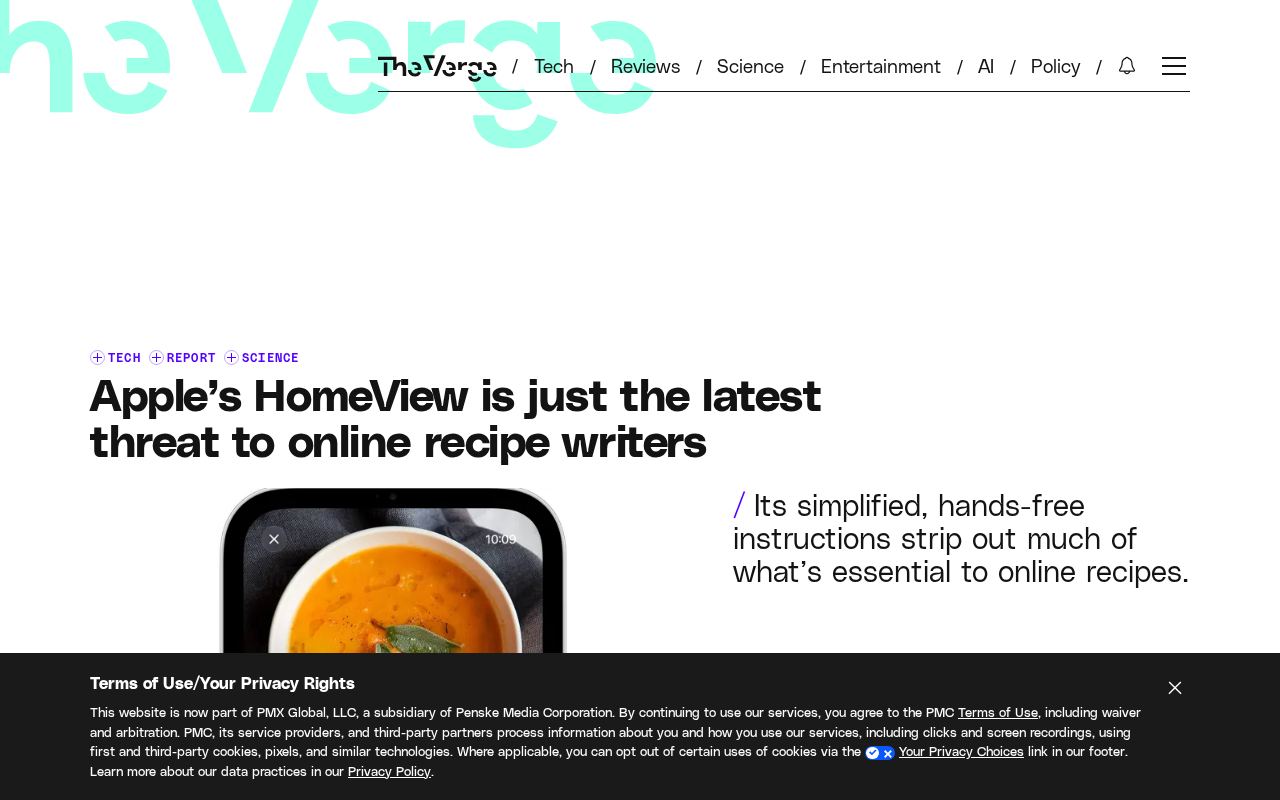
How Smart Screens Are Rewriting Recipe Consumption
One of the core use cases of smart speakers with screens like HomeView is "hands-free" information access in the kitchen: users knead dough while asking "what's next," and the screen automatically scrolls below the ingredient list. For Apple, this is a natural extension of its hardware ecosystem; for online recipe writers, it's yet another shift in the traffic gateway.
Over the past decade, recipe creators have relied on search engines and social media to reach readers. Google's featured snippets, Pinterest's image cards, Instagram's short video tutorials—each platform rule change has reshaped their way of survival. Now smart screens deliver answers directly through voice Q&A, and users no longer need to click into blog pages, causing ad impressions and brand awareness to erode.
Structured data (schema markup) is a standardized markup language embedded in web pages, using tags to tell search engines and smart devices the type and attributes of page content. For recipes, for example, Schema.org defines the Recipe type, which can mark up fields such as ingredients, cooking time, temperature, steps, and nutritional information. Screen-equipped smart speakers rely on this structured data to break down web recipes into instructions that can be read step by step and navigated by voice. For recipe writers, this means content must not only be written for humans to read, but also written so machines can parse it accurately. However, the more complete the structured data, the more independently devices can deliver information, and the less necessary it becomes for users to visit the original web page—this creates a paradox: optimizing markup so content gets indexed by smart devices actually accelerates the loss of one's own traffic.
The Creator Economy Devoured by "Zero-Click"
This kind of threat isn't Apple's invention. Amazon Echo Show has long supported step-by-step cooking guidance, and Google Nest Hub has also partnered with recipe platforms. What's different about Apple is its ecosystem stickiness and privacy narrative—HomeView emphasizes on-device processing, which may attract data-sensitive kitchen users, but this actually makes it harder for third-party recipe sites to gain traffic through personalized recommendations.
What creators should be wary of is the acceleration of the "zero-click" trend. When users get used to directly asking devices "what temperature should I roast chicken at," the SEO value of recipe blogs is further diluted. Large media groups can still enter platforms through licensing agreements, but independent writers lack bargaining power and can only passively adapt to the new round of distribution rules.
"Zero-click" refers to the behavior pattern in which users obtain answers directly on search results pages or information feeds without clicking into the original website. This phenomenon was first triggered by search engines' "featured snippets" feature: Google displays answers extracted from web pages directly at the top of the results page, so users don't need to visit the source. Voice assistants and smart screens have further reinforced this trend—users ask "what temperature should I roast chicken at," and the device directly reads out the answer, without even needing to look at the screen. For content creators, zero-click means exposure is decoupled from traffic: content is cited, but no one visits the page, and ad impressions and subscription conversions disappear along with it. Industry research firm SparkToro once estimated that about half of Google searches end with zero clicks. This is prompting creators to rethink their business models, shifting from relying on platform traffic to directly cultivating reader relationships.
Possible Paths Forward for Creators
In the short term, recipe writers need to shift their content focus from "machine-readable steps" to parts that machines can hardly replace: personal stories, failure experiences, and flavor judgments. HomeView can answer temperature and time, but it can't tell you "why my grandmother's stew needs a spoonful of sugar." In the long term, building direct subscription channels and community relationships is more sustainable than chasing every new hardware gateway.
Apple has not yet announced the list of recipe partners for HomeView, but the choice of a kitchen setting for the ad already shows its coveting of this high-frequency demand. For online recipe writers, this is neither the first threat nor will it be the last.
One-line Summary
Apple's HomeView enters the home through the kitchen scenario, and smart screen voice Q&A intensifies the zero-click trend, eroding recipe creators' traffic.
Paragraph Summary
Apple released an ad for its HomeView smart display focused on a chaotic kitchen scene, sending a clear signal of penetrating real family life. The article analyzes that one of the core use cases of screen-equipped smart speakers is hands-free information access in the kitchen, where users obtain recipe steps directly through voice Q&A without clicking into recipe web pages. This "zero-click" trend isn't Apple's invention—Amazon Echo Show and Google Nest Hub have had similar features for a while—but Apple, with its ecosystem stickiness and privacy narrative, may further change the distribution landscape. Large media groups can still enter platforms through licensing agreements, but independent recipe writers lack bargaining power, and their SEO value and ad revenue continue to be diluted. The article suggests creators shift toward personal stories and flavor judgments that machines can hardly replace, and build direct subscription channels and community relationships to reduce dependence on platform gateways.
Related articles

uGAP: An AI Platform Unifying 100+ African Geospatial Datasets
uGAP is an African geospatial AI platform by a University of Cape Town team, unifying 120+ African datasets with a Python SDK for discovery, processing, and model training, already used in cyclone flood mapping.

Cursor Can Now Control Your Computer: AI Agents Can Drive Desktop Apps for Testing
Cursor adds desktop control: AI agents can drive desktop apps like the iOS Simulator to test their own features. We analyze the impact on dev workflows, possible technical approaches, and reliability concerns.

Vibecoding a Custom Inference Engine: High Hopes, Harsh Reality
A Reddit developer shares the real experience of vibecoding a custom inference engine: running GGUF Q4 models in the browser with WebGL2 and GLSL, only to fall into tokenizer debugging hell. This article analyzes the engineering challenges of browser-side LLM inference and why cloning llama.cpp is the more rational choice.