Apple HomeView Code Leak: Smart Home Hub May Add Security Camera Features

Reddit user found in HomeView code that Apple's smart home hub may add security camera features.
Reddit user pdfu discovered hidden strings related to security cameras in the HomeView 27.2 code, describing a complete feature set covering motion detection, live streaming, recording options, and privacy controls. The article argues that if implemented, this feature would strengthen the security link in Apple's smart home ecosystem, reduce dependence on third-party devices, and complement HomeKit; privacy features could become a core selling point distinguishing it from other security solutions. However, the source is single, and code traces do not equal a product launch; official confirmation is needed, and overinterpretation should be avoided.
Apple's smart home strategy may be getting a feature expansion. Reddit user pdfu discovered hidden strings related to security cameras in the HomeView 27.2 code, hinting that Apple may add camera-based security capabilities to its smart home hub product. Although the finding has not been officially confirmed, the feature descriptions appearing in the code are quite specific and worth paying attention to.
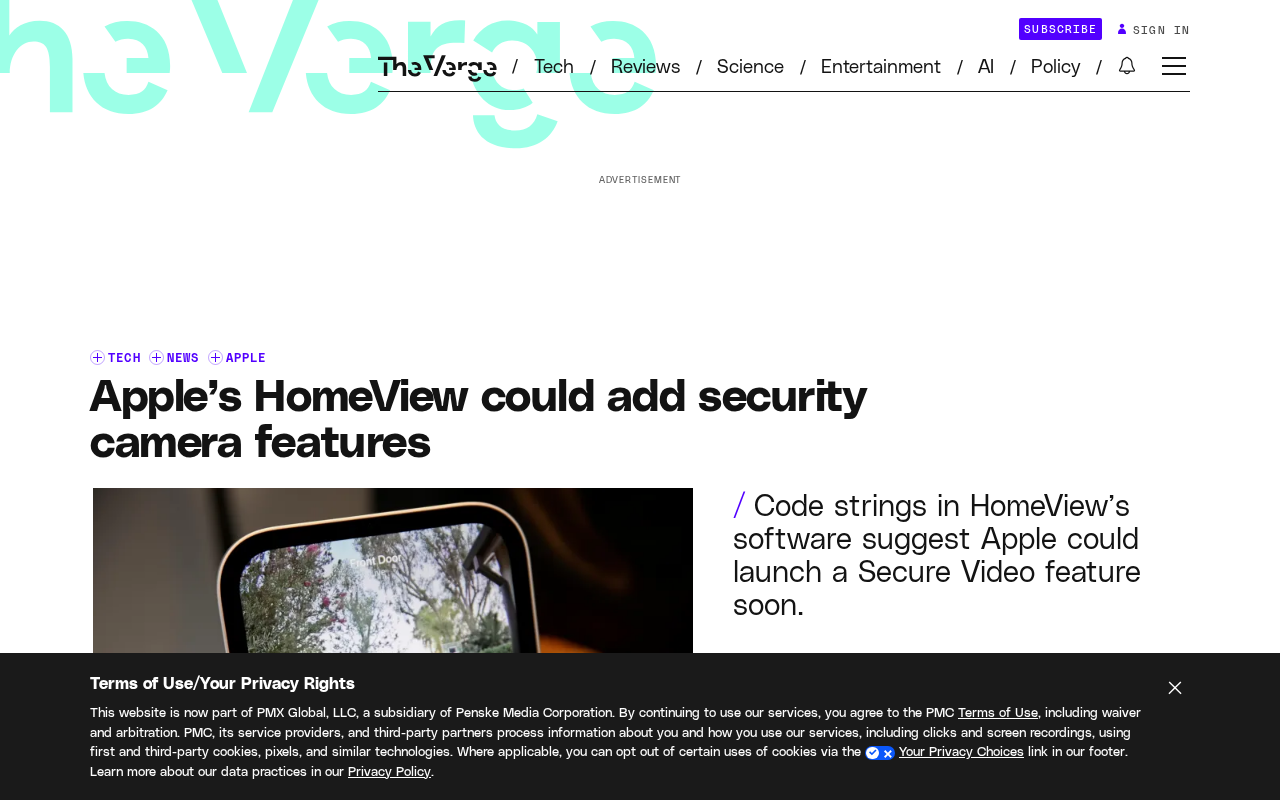
What's Hidden in the Code: From Motion Detection to Privacy Protection
According to pdfu, the code strings in HomeView 27.2 describe a complete security camera mode covering motion detection, live streaming, and recording options, while also including privacy-related features. In one more detail worth noting, the code contains a settings page whose contents clearly point to the configuration flow for camera functionality.
Judging from the feature list, this solution covers the basic capabilities of a security camera: motion detection triggers alerts, live streaming lets users view footage remotely, and recording options provide playback support. The presence of privacy features indicates that Apple has taken users' sensitivity about home privacy into account in its design, consistent with Apple's long-standing brand positioning of emphasizing privacy protection.
One thing worth mentioning is that code strings can only show that Apple has taken some action at the development level; they do not necessarily mean the final product will definitely be released. It is not uncommon for software projects to contain leftover code for unactivated features, and some features may be shelved or substantially adjusted after testing.
Why Security Cameras Matter Greatly to Apple's Smart Home
The core value of a smart home hub lies in connecting and controlling devices, and security is a high-frequency, essential part of the home scenario. If HomeView really adds camera functionality, Apple will be able to bring security capabilities into its own ecosystem loop and reduce users' dependence on third-party security devices.
This direction also complements Apple's existing HomeKit ecosystem. As the data entry point for home security, if the video streams and event records generated by cameras can flow seamlessly between Apple devices, the practicality of the entire smart home system will be significantly improved. For users, a security solution uniformly managed by Apple may be more attractive in terms of ease of use and privacy control than piecing together devices from multiple brands.
From a competitive perspective, there are already many players in the smart home security track. Apple's entry is more likely to involve deep software-hardware integration rather than simply launching a standalone camera product. As a hub, HomeView is more reasonably positioned to take on the role of coordination and management.
HomeKit is a smart home framework Apple launched in 2014. It provides third-party manufacturers with a unified device access protocol covering categories such as lights, door locks, and sensors, and enables centralized control through the Home app. However, HomeKit has long lacked Apple's own hub hardware and camera products. Users often need to pair an Apple TV or HomePod as a home hub, while security cameras almost entirely rely on third-party brands. Although this model ensures ecosystem openness, it makes it difficult for Apple to achieve an end-to-end experience in device coordination, data flow, and privacy control. If Apple integrates camera capabilities into the smart home hub, it would essentially fill in a key link in HomeKit's evolution from a "connectivity standard" to a "complete solution."
Privacy Features Are the Key Differentiator
The privacy-related strings appearing in the code deserve separate discussion. Home cameras inherently involve sensitive imagery, and users' concerns about where data goes are an important factor hindering the adoption of security devices. If Apple can provide clear privacy control options at the system level, such as local processing, encrypted storage, or access permission management, this would become a core selling point distinguishing it from other security solutions.
The information disclosed so far does not explain how these privacy features would be implemented, so it is impossible to determine whether Apple would use on-device processing or a cloud-based approach. However, considering Apple's continued investment in on-device AI and privacy computing, localized processing is a relatively likely direction.
On-device AI and privacy computing are important background for understanding Apple's design thinking. On-device processing means data is computed locally on the device without needing to be uploaded to the cloud. Typical examples include semantic photo recognition on iPhone and local voice wake on HomePod. Privacy computing covers technologies such as differential privacy and homomorphic encryption, allowing analysis to be completed without exposing raw data. For devices such as home cameras that continuously generate sensitive video streams, localized processing can significantly reduce the risk of data leakage, but limited by chip computing power and storage space, it usually needs to be combined with cloud-based solutions. Apple's self-developed Neural Engine and Secure Enclave provide the hardware foundation for balancing functionality and privacy in security scenarios, which is also why outsiders speculate that it may prioritize local processing.
Information Is Still Limited, Caution Is Needed
All the basis for this discovery comes from Reddit user pdfu's reverse engineering analysis of the HomeView 27.2 code. It is a single-source technical dig and has not yet been independently verified by other developers or media outlets. Interpretations of code strings can also vary, and some descriptions may correspond to internal naming for existing features rather than entirely new capabilities.
Before Apple officially releases related features, outsiders can only treat these code clues as directional references. It is logically plausible for a smart home hub to add security camera functionality, but there is still a long way from code traces to product launch. For users following Apple's smart home developments, this discovery provides a signal worth watching, but it should not be overinterpreted.
One-line Summary
Reddit user discovered in HomeView code that Apple's smart home hub may add security camera features.
Paragraph Summary
Reddit user pdfu discovered hidden strings related to security cameras in the HomeView 27.2 code, describing a complete feature set covering motion detection, live streaming, recording options, and privacy controls. The article argues that if implemented, this feature would strengthen the security link in Apple's smart home ecosystem, reduce dependence on third-party devices, and complement HomeKit; privacy features could become a core selling point distinguishing it from other security solutions. However, the source is single, and code traces do not equal a product launch. Official confirmation is needed, and overinterpretation should be avoided.
Related articles

AI Can Read Neural Network Weights Directly: Do Models Already Exceed Expectations?
A Reddit developer experiment shows language models can directly read neural network weights and infer their function. Astra, Opus 5.5, and Muse Spark 1.3 all passed the test, sparking discussion on model generalization and training sources.

India's Microdrama Market Explodes: EloElo Secures $80M Investment from NBCUniversal
EloElo secures $80M from NBCUniversal to boost StoryTV, its microdrama platform with over 33M monthly active users, as India's microdrama market draws global capital.

Acoustic Detection of Multi-Rotor UAVs: Fusing Handcrafted Features with Pre-Trained Embeddings
Study reveals data leakage from random splits in UAV acoustic detection, proposes source-disjoint protocol with stacked ensemble of handcrafted features and YAMNet embeddings, achieving 95.29% accuracy for low-cost drone detection.