Apple May Return to Server Market With M8 Chip and Nvidia Networking Technology
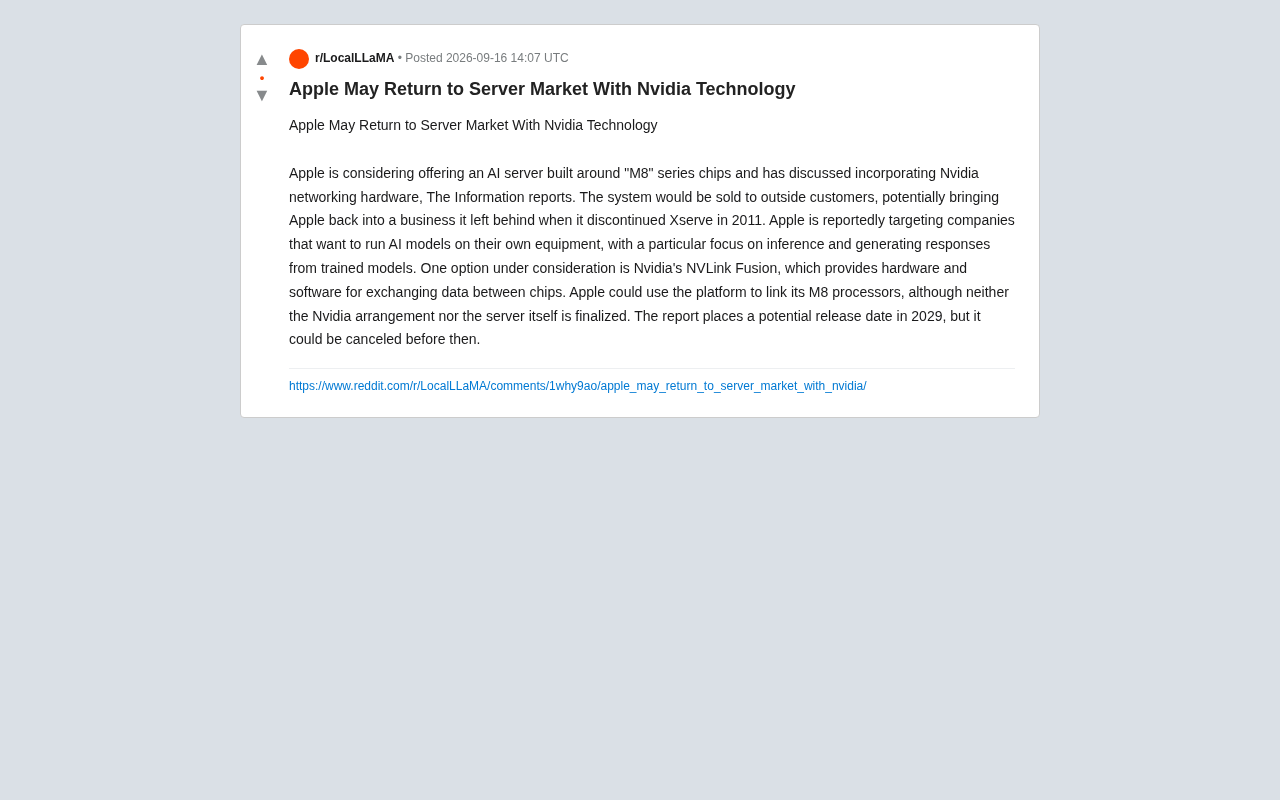
Apple may return to servers in 2029 with M8 chips and Nvidia NVLink Fusion, targeting enterprise AI inference.
According to The Information, Apple is exploring an AI server product built around its in-house M8 chip series, aimed at enterprises wanting to run AI models on their own infrastructure, and potentially using Nvidia's NVLink Fusion technology to interconnect multiple processors into larger compute units. This would mark Apple's first return to the server market since it discontinued the Xserve in 2011. Unlike the current focus on model training, Apple's entry point is AI inference — a workload where energy efficiency matters most, playing directly to the M-series chip's strengths. A potential launch is pegged at 2029, though the report notes the project is not finalized and could be canceled.
According to tech media outlet The Information, Apple is considering launching an AI server product for external customers, built around its in-house "M8" chip series and potentially incorporating Nvidia networking hardware. If this comes to fruition, Apple would be re-entering a market it abandoned long ago — the company exited the server business in 2011 when it discontinued the Xserve.
Apple's Server Comeback Plan
Apple's target customer base is fairly well-defined: enterprises that want to run AI models on their own infrastructure. Rather than competing in the compute arms race around model training, Apple is focusing on inference — using already-trained models to generate responses. This is a strategically significant positioning, as the inference market is expanding rapidly alongside AI adoption, and typically demands higher energy efficiency and deployment flexibility than raw peak compute performance.
Apple's in-house chips are well known for their exceptional performance-per-watt ratio, something the M series has already demonstrated on laptops and desktops. Bringing that same efficiency advantage to the server context could theoretically give Apple a differentiated edge in the inference segment. However, the report also emphasizes that neither the Nvidia partnership nor the server product itself has been finalized.
Inference vs. Training are two fundamentally different phases of AI computation. The training phase requires repeatedly adjusting model parameters using massive datasets, demanding enormous compute — often hundreds or thousands of GPUs running in parallel for weeks or months. Nvidia's high-end GPUs like the H100/H200 are built for exactly this. The inference phase uses an already-trained model to make predictions or generate responses from new inputs. Individual compute loads are far smaller than training, but the demands on latency, throughput, and energy efficiency are much stricter — enterprises may need to handle millions of inference requests per day, and electricity and hardware depreciation costs directly impact business viability. This is why the inference market is far more sensitive to "performance per watt" than the training market — a sweet spot for Apple's M-series unified memory architecture, where the CPU, GPU, and Neural Engine share high-bandwidth memory.
Why Partner with Nvidia
The potential nature of Apple's collaboration with Nvidia is particularly noteworthy. The report mentions that Apple is considering adopting Nvidia's NVLink Fusion technology — a hardware and software platform for high-speed data exchange between chips. Apple could potentially use this platform to interconnect multiple M8 processors, enabling the construction of larger-scale compute units.
This detail is significant. Apple and Nvidia have never had a particularly close relationship in the industry, and the two have had friction in areas such as graphics chips in the past. Apple's consideration of Nvidia's interconnect technology for its own servers reflects a practical reality: when building large-scale AI systems, high-bandwidth, low-latency chip-to-chip interconnect is an unavoidable requirement, and Nvidia has a mature, widely validated solution for this.
In other words, Apple can focus on what it does best — chip design — while handing off the system-level interconnect layer to the industry-leading solution. This is a pragmatic division of labor. It also illustrates that even Apple finds it difficult to be fully self-sufficient across every layer of AI infrastructure.
NVLink Fusion is an open interconnect initiative launched by Nvidia in 2025. Its core idea is to allow third-party CPU or custom chip vendors to connect directly to Nvidia GPUs or switch chips via the NVLink protocol, enabling them to tap into Nvidia's mature high-speed interconnect ecosystem. Unlike previous versions of NVLink limited to Nvidia's own GPUs, the Fusion variant is open to heterogeneous computing scenarios, giving non-Nvidia processors access to near-NVSwitch-level chip-to-chip bandwidth (on the order of hundreds of GB/s per link). For Apple, if it wants to combine multiple M8 processors into larger compute nodes within a server, inter-chip memory access latency and bandwidth become unavoidable engineering challenges. Adopting NVLink Fusion means Apple can skip the lengthy process of developing its own high-speed interconnect protocol and instead use an already industry-validated solution to rapidly prototype and bring a product to market.
A Distant and Uncertain Timeline
The report cites a potential launch timeframe of 2029 — a very distant horizon. Given the pace of iteration in the tech industry, that kind of time span implies significant uncertainty. The report itself acknowledges that the project could easily be canceled before it ever launches.
For early-stage product plans like this, a measured perspective is warranted. Large tech companies run numerous exploratory projects simultaneously, and only a fraction ever reach the market. There is often a long road of evaluation, prototyping, and strategic deliberation between Apple "considering" something and Apple "committing" to it.
What This Means for the Industry
Even while the plan remains on paper, Apple's intent to re-enter the server market sends a signal: enterprise-grade AI inference is becoming a fiercely contested space. A growing number of enterprises, driven by data privacy concerns, compliance costs, or latency requirements, are leaning toward running AI models on-premises or on their own infrastructure rather than relying entirely on cloud APIs.
If Apple does enter this space, it would bring the efficiency advantages of its chips and the weight of its brand to a market that is already hotly contested — potentially adding a heavyweight player to a landscape currently dominated by Nvidia, with AMD and various custom chip vendors competing aggressively.
Until the project materializes, however, all of this remains speculative. For observers tracking the trajectory of AI infrastructure, this news is better read as a trend signal than a confirmed product roadmap.
Summary
Apple is exploring a return to the server market with M8 chips and Nvidia networking technology, targeting enterprise AI inference — a move that plays to its chip efficiency strengths while acknowledging the practical need to rely on industry solutions for system-level interconnect. But the distant 2029 timeline and the explicit caveat that the project may be canceled serve as reminders that this is still a highly uncertain early-stage plan. Its significance lies less in what Apple will do, and more in what it reflects: the AI inference hardware market is heating up fast.
Related articles

AI Agent Developer Job Hunt Guide: Four Hard Standards to Clear Before You Apply
A practical guide for landing AI Agent developer roles: four measurable standards — project runs, problems debuggable, solution explainable, interviews survivable.
Multi-Agent Development Guide: From Monolithic AI to Team Collaboration in Practice
A beginner's guide to multi-agent development covering core advantages, common learning pain points, enterprise tech stacks, and engineering methodology for AI developers.

Agent Skill Routing: Retrieval vs. LLM vs. Two-Stage Architecture Compared
Retrieval or LLM for Agent skill routing? Compare coarse-filter vs. fine-select architectures on latency, accuracy, and cost — with 4 key production considerations.