Apple Recruits AI Agent Engineer: A New Ace After Siri?

Apple recruits engineers to build an agentic AI team, aiming to create an AI assistant that executes tasks across apps.
Based on job postings discovered by Bloomberg, the article points out that Apple is recruiting an engineer to lead the creation of an "agentic AI assistant" that can browse the web, work across apps, write code, and invoke services. It analyzes that this is fundamentally different from Siri's single-command mode, aiming at autonomous agents with multi-step planning and tool calling. Apple's move is intended to make up for its lag in the generative AI race and to leverage device and ecosystem advantages. Technically, privacy architecture and on-device compute are core challenges, and Apple may continue its path of on-device models plus Private Cloud Compute. The article concludes that Apple's system-level distribution capability could accelerate AI agents toward the mass market, but recruitment is only the starting point.
Apple is quietly assembling a new AI team aimed squarely at AI agents capable of executing tasks across applications. According to job postings discovered by Bloomberg, Apple is recruiting an engineer to lead the creation of an "agentic AI assistant" that can browse the web, work across apps, write code, and invoke services.
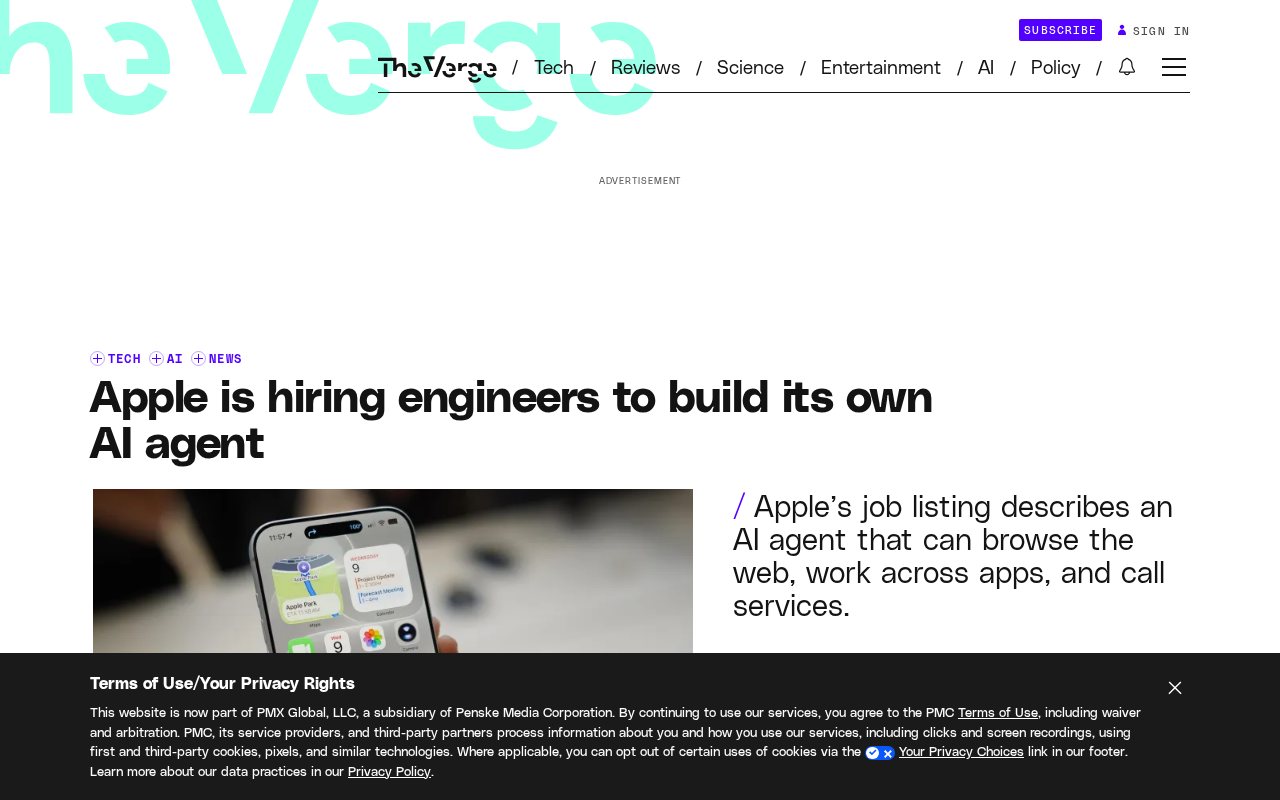
Apple's AI Agent Ambitions
The job posting reveals quite a lot. Apple isn't looking for a voice assistant that just chats — it wants an AI agent that can actually "take action": autonomously browsing the web for information, moving between different apps to complete tasks, and even writing code and calling external services.
This is fundamentally different from Siri's current positioning. Siri is more of a single-turn command executor, whereas an agentic AI assistant needs multi-step planning, tool calling, and contextual understanding. Judging from the job description, Apple is aiming for something along the lines of autonomous agents that complete a series of连贯 operations on the user's behalf.
You may not have noticed, but this is a "lead the creation" level position, which shows Apple isn't just testing the waters — it plans to build a complete agentic AI product line from scratch.
Agentic AI refers to AI systems that can autonomously plan, execute step by step, and invoke external tools to accomplish complex goals, as distinct from conversational assistants that merely respond to single commands. Its core technologies include task decomposition (breaking user intent into executable sub-steps), tool calling (using browsers, apps, code execution environments, etc., via APIs or interface operations), and self-correction during execution. Representative products often cited in the industry include OpenAI's Operator, Anthropic's Computer Use, and Google's Project Astra. The maturity of agentic AI depends on model reasoning reliability, the degree of standardization of tool interfaces, and permission governance mechanisms — these three points happen to be the difficulties Apple needs to coordinate at the system level.
Why Apple Must Build AI Agents
Apple has long been considered slow in the generative AI wave. Siri's intelligent upgrades have been repeatedly delayed, while competitors have already gained ground on the AI agent track. Google's Gemini is being deeply integrated into Android and Workspace, OpenAI's Operator-class products have demonstrated the possibility of AI operating browsers, and Microsoft's Copilot is also attempting cross-app task orchestration.
If Apple continues to treat AI as just a feature button in the system rather than an agent layer that can proactively complete tasks, its gap in user experience will only widen. The recruitment of an AI agent lead can be seen as Apple's formal bet on the judgment that "AI is not a feature, but an interaction paradigm."
Another practical consideration is ecosystem stickiness. Apple has a vast app ecosystem and device matrix, and an AI agent that can work across apps on iPhone, iPad, and Mac would precisely amplify this ecosystem advantage — a barrier that companies merely building models find difficult to replicate.
Tool/Function Calling is a key capability of agentic AI: the model outputs structured instructions to call external functions, APIs, or app interfaces according to task needs, and then incorporates the returned results into subsequent reasoning. It expands AI from "generating text" to "executing actions," such as querying calendars, sending messages, and retrieving web pages. The reliability of tool calling directly determines whether an agent can complete multi-step tasks; common problems include parameter errors, broken call chains, and permission overreach. For Apple, if it wants an agent to work across apps, it needs to establish unified tool interfaces and permission models for system apps and third-party apps — this is both a technical engineering and an ecosystem governance issue.
Technical Challenges and Apple's Path Choice
The technical difficulty of agentic AI is far higher than that of chatbots. It requires reliable tool calling capabilities, accurate decomposition of user intent, error recovery mechanisms during execution, and most critically — privacy and security boundaries.
Apple has always marketed privacy protection as a selling point. An AI agent that can browse the web, operate across apps, and invoke services means it will come into contact with large amounts of user data and third-party services. How to allocate computing between on-device and cloud, and how to design permission models, will be questions Apple must answer. Judging from the "work across apps" and "invoke services" in the job description, Apple seems inclined to give the agent a relatively broad permission scope, which places higher demands on its privacy architecture.
Apple's likely path is to combine on-device models with Private Cloud Compute, continuing its consistent approach to the privacy narrative. But the complexity of agentic tasks far exceeds simple text generation, and whether on-device compute can support multi-step planning remains unknown.
Private Cloud Compute is a cloud inference architecture Apple introduced in 2024 alongside Apple Intelligence: complex requests are sent to dedicated servers running Apple-designed chips for processing, the servers do not retain user data, and their software images are available for review by third-party security experts. This design aims to combine cloud computing power with on-device privacy commitments. For agentic AI, the significance of Private Cloud Compute lies in handling multi-step planning and long-context reasoning that are difficult to complete on-device, while maintaining the "data never leaves" narrative. However, whether it can support the low latency and high concurrency of agent tasks still depends on server compute scale and scheduling efficiency.
What It Means for the Industry
The biggest variable in Apple's entry into AI agents is not the technology itself, but distribution capability. Apple's device installed base and system-level entry points mean that once an agentic assistant is launched, it could become the most widely covered AI agent product.
For developers, a system-level AI agent could change the entry logic of app interaction — users would no longer open apps one by one, but complete tasks through the agent. This is both an opportunity and a challenge. For competitors, Apple's entry will accelerate AI agents from concept demos to the mass market.
Of course, a job posting is only the starting point. From hiring to product launch, there is still a long engineering and refinement process. But the direction is clear: Apple does not intend to be just a bystander in the AI agent era.
One-line Summary
Apple recruits engineers to build an agentic AI team, aiming to create an AI assistant that executes tasks across apps.
Paragraph Summary
Based on job postings discovered by Bloomberg, the article points out that Apple is recruiting an engineer to lead the creation of an "agentic AI assistant" that can browse the web, work across apps, write code, and invoke services. The article analyzes that this is fundamentally different from Siri's single-command mode, aiming at autonomous agents with multi-step planning and tool calling capabilities. Apple's move is intended to make up for its lag in the generative AI race and to leverage its device and ecosystem advantages to build barriers. Technically, privacy architecture and on-device compute are core challenges, and Apple may continue its path of on-device models plus Private Cloud Compute. The article concludes that Apple's system-level distribution capability could accelerate AI agents toward the mass market, but recruitment is only the starting point, and product launch will still take time.
Related articles

Hark Pro Hands-On Test: Three Tasks, Zero Input — Can AI Really Take Over Everyday Chores?
A YouTube creator tests Hark Pro on three everyday tasks: clearing an inbox with a billing sheet, a full DoorDash order, and a self-built dashboard. No keyboard, three wins — we analyze this operational AI's capabilities and concerns.

The Katseye Dilemma: How Long Can the Idol Industry's High-Speed Engine Keep Running?
Using Katseye's recent team struggles and One Direction members' reflections on grueling tour and promo schedules, this analysis examines the idol industry's structural 'tour—album—promo' cycle and what operational changes a group needs to turn things around.

Hugging Face Inference Routing Fully Moves to OpenRouter
Hugging Face fully migrates inference routing to OpenRouter, automatically selecting the best inference provider. Open-weight models account for 81% of calls, Pro accounts get $2/month (~150M tokens), no markup, with provider filtering and spending limits.