Apple Reference Image: A New Paradigm for Verifiable Photography
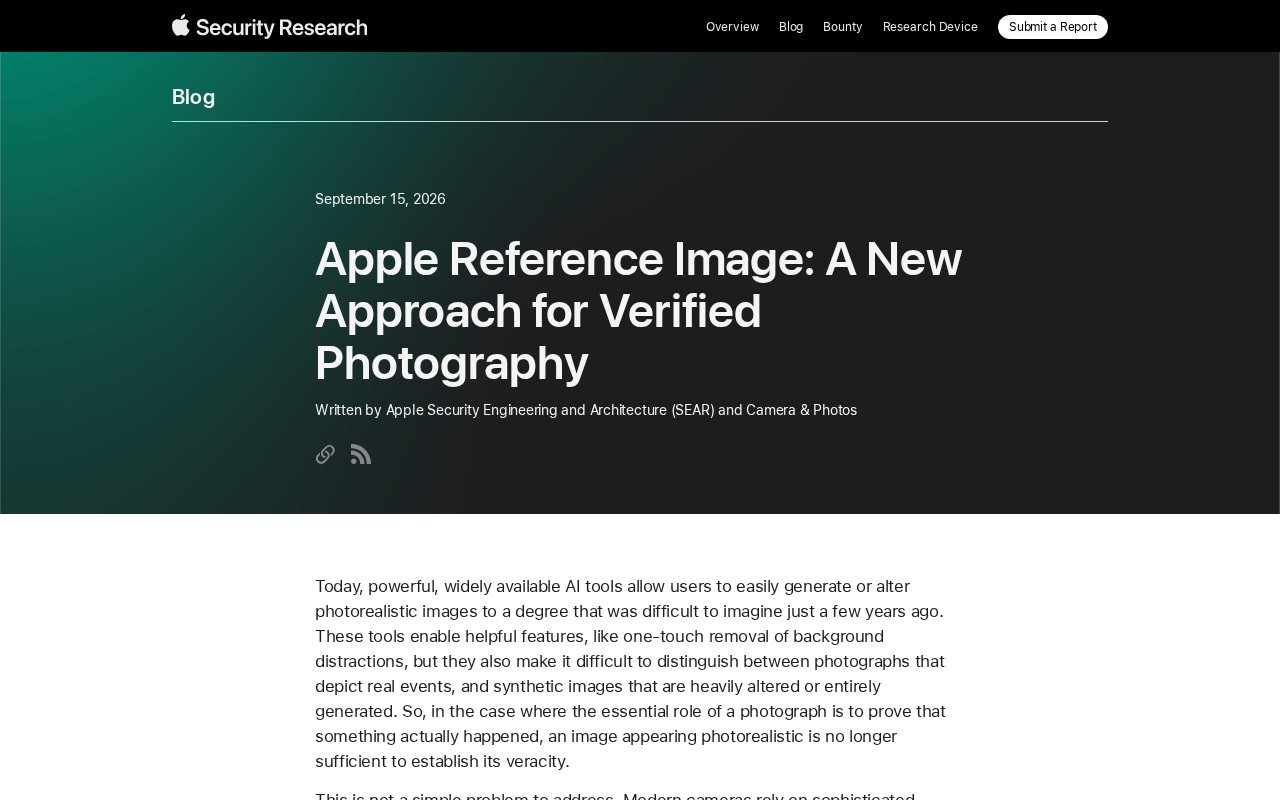
Apple proposes signing images at the hardware level to rebuild trust in photography during the AI era.
Apple's Reference Image proposal marks a shift from "detecting fakes" to "proving authenticity" at the source. Leveraging hardware like the Secure Enclave, it cryptographically signs images on-device to create a trusted chain from sensor to final photo. While aligned with C2PA and Content Credentials standards, Apple's vertical hardware-software integration offers a stronger root of trust. Key challenges remain: centralized verification raises privacy concerns, defining "legitimate editing" is technically complex, and fragmented vendor standards risk undermining interoperability.
In an era where generative AI has made "seeing" no longer synonymous with "believing," it's becoming increasingly difficult to tell whether a photo was genuinely captured or synthetically generated. Apple recently published a proposal on its security blog for Apple Reference Image — a technical framework aimed at providing a foundational solution for "Verified Photography." The post quickly climbed to the top of Hacker News, earning 272 points and nearly 200 comments, reflecting the industry's intense focus on content authenticity.
The Root Problem: Authenticity Is Collapsing
As diffusion models and image generation technologies have matured, synthetic images have reached a level of realism that's nearly indistinguishable to the naked eye. This doesn't just threaten fields with high authenticity requirements — like photojournalism and forensic evidence — it's also eroding ordinary users' basic trust in visual content.
The industry once tried to tackle this with an "AI-detection" approach, but that path has a fundamental flaw: detectors and generators are locked in an arms race, and any detection method can potentially be circumvented by newer generative models. Apple's approach flips the script entirely. Rather than trying to prove an image is "fake," it aims to prove from the source that an image is "real" — establishing a trustworthy chain from the capture device to the final image.
The Core Idea Behind Reference Image
The fundamental concept of Apple Reference Image is to create a verifiable "reference baseline" for genuinely captured photographs. In essence, at the moment an image is captured, a secure on-device mechanism records and signs the relevant information, allowing anyone to later verify whether the image came from a trusted capture process and whether it has been tampered with.
This approach moves the anchor of trust upstream to the source of image creation, rather than relying on after-the-fact content analysis. It aligns conceptually with industry-driven provenance standards like Content Credentials and C2PA, both of which emphasize using cryptographic methods to stamp content with an unforgeable "certificate of origin." Thanks to Apple's end-to-end control over hardware, operating systems, and security chips, it theoretically holds a unique advantage in implementing this kind of trusted capture.
C2PA (Coalition for Content Provenance and Authenticity) is an open technical standard jointly promoted by Adobe, Microsoft, BBC, Sony, and others, designed to establish traceable provenance for digital content. Its core mechanism embeds cryptographically signed metadata manifests in media files like images and videos, recording information about creation tools, capture devices, and editing history. Content Credentials are the user-facing layer of the C2PA standard — essentially a "nutrition label" for content — letting viewers confirm where an image came from and what processing it has undergone. Unlike Apple's proposal, C2PA is a purely software-level standard that relies on tools to append signatures after the fact, and cannot guarantee the originality of an image at the hardware level the moment it was captured. If Apple's approach could achieve compatibility with C2PA, it would provide a far more solid hardware root of trust for the entire standards ecosystem.
Why It Makes More Sense Coming From Apple
Deploying a verifiable photography solution is heavily dependent on a hardware-level Root of Trust. Apple's Secure Enclave, device identity authentication system, and vertical integration of the full hardware-software stack make it far more credible than purely software-based solutions in achieving a complete trusted chain "from sensor to signature."
In other words, a trustworthy verification system must ensure that image data is never maliciously tampered with — from the moment it's captured by the optical sensor, through processing, to signing and encapsulation. This is precisely what manufacturers like Apple, which control both the chip and the operating system, are best positioned to deliver.
The Secure Enclave is a dedicated security coprocessor Apple introduced starting with the A7 chip. Physically isolated from the main processor, it has its own encrypted storage and random number generator. Even if the main operating system is compromised, private keys stored in the Secure Enclave cannot be extracted — it's where Face ID biometric data and device keys are stored. A Root of Trust is the starting point of a cryptographic chain of trust: a hardware or software module that is assumed to be trustworthy by default, upon which all subsequent verification operations are built layer by layer. In a verified photography context, if a device's security chip can compute a hash and sign the image sensor data before it ever reaches the main processor, it becomes possible to cut off — at the hardware level — any opportunity for external programs to inject forged images. This is a security level that purely software-based signing solutions simply cannot achieve.
Controversies and Open Questions
Despite broad recognition of the direction, discussions on Hacker News have surfaced real-world challenges facing this approach.
The primary controversy centers on privacy and centralized trust: does tying authenticity verification to a device manufacturer effectively hand over the power to define "what is real" to a single company? If verification depends on Apple's services or key infrastructure, that itself creates a new concentration of trust — something worth scrutinizing carefully.
The second issue is the boundary of legitimate editing. Photography is almost never unprocessed — cropping, color correction, and noise reduction are all standard operations. A rigorous verification system must distinguish "reasonable editing" from "malicious manipulation," which is a genuine technical design challenge. Too strict, and the system becomes unusable in practice; too permissive, and the verification loses its meaning.
There's also the question of ecosystem interoperability. If every manufacturer builds its own siloed standard, verification frameworks will be incompatible, and the ultimate beneficiary may only be users within closed ecosystems — not the broader problem of content authenticity. This is precisely why alignment with open standards like C2PA matters so much.
The "legitimate editing boundary" challenge is not technically unsolvable — the industry has several promising directions worth watching. One approach involves hash commitments with selective disclosure: only the original RAW data is signed, and subsequent standardized processing steps like JPEG compression and color space conversion are declared through a predefined "permitted transforms list," with verification replaying the same transform chain to check the result. Another approach draws from C2PA's edit history mechanism: each editing operation appends a signed record rather than re-signing the entire image, creating an auditable operation log. Both approaches face practical difficulties, however: the former requires complete consistency in standardized processing pipelines, while the latter struggles to enumerate all operation types in complex creative editing scenarios. Finding the right balance between usability and rigor remains an open problem for both academia and engineering.
Implications for the Industry
Apple Reference Image represents a pragmatic shift in how the industry approaches deepfake problems: moving from "detecting fakes" to "proving authenticity." Against the backdrop of synthetic content proliferation, this "forward provenance" approach may prove more sustainable than an endless detection arms race.
For fields like journalism, legal forensics, and insurance claims, verifiable photography — once standardized — could dramatically reduce the cost of authenticity verification. But to truly deliver value, it needs to transcend vendor barriers and become an open, interoperable, privacy-respecting industry infrastructure, not a proprietary feature of any single platform.
The step Apple has taken looks less like a finished solution and more like a question posed to the entire industry: in the age of AI, how do we rebuild trust in visual imagery?
Related articles

From Enterprise Practice to a Reusable Template: Lessons from Building an AI Agent
A developer shares an open-source AI Agent template built from an enterprise project, covering natural language data Q&A, analysis, auto-generated PPTs, and email distribution.

Nintendo's Open-World Design Evolution: Breaking Down Fire Emblem Fortune's Weave
Nintendo brings the open-world design philosophy of Breath of the Wild to Fire Emblem with the massive Switch 2 title Fortune's Weave. Here's what it means.

AI-Generated Food Photos Are Ruining Menus: How the Uncanny Valley Kills Appetite
AI-generated food images are flooding restaurant menus and delivery apps, but uncanny details kill appetite instead of sparking it. Here's why the uncanny valley effect hurts brands.