Apple's Dual-Track AI Strategy: In-House Development and External Leverage in Parallel

With in-house chips and on-device AI at its core and leveraging the external ecosystem, Apple has achieved a non-cash-burning path to AI competition.
Apple's latest earnings report shows it achieved the best fiscal-year revenue and EPS in its history, with iPhone revenue up 17.5% year over year. In the AI wave, Apple has adopted a distinctive dual-track strategy: developing its own chips and on-device AI to embed AI capabilities across all product lines, while actively integrating third-party AI technology to address gaps in general-purpose large models. Unlike competitors such as Microsoft and Google, which spend tens of billions on AI infrastructure, Apple takes an asset-light approach, avoiding large-scale capital expenditure while maintaining margins. This steady path offers a reference for AI competition without massive cash burning, though it has limits in frontier model training investment.
Apple delivered the best fiscal year in its history in its latest earnings report, but what's more noteworthy is its distinctive stance in the AI wave: it is fully advancing in-house AI development while openly leveraging the external ecosystem, yet unlike its competitors, it is not burning cash recklessly on infrastructure.
Financial Performance: Steady Growth Amid the AI Dividend
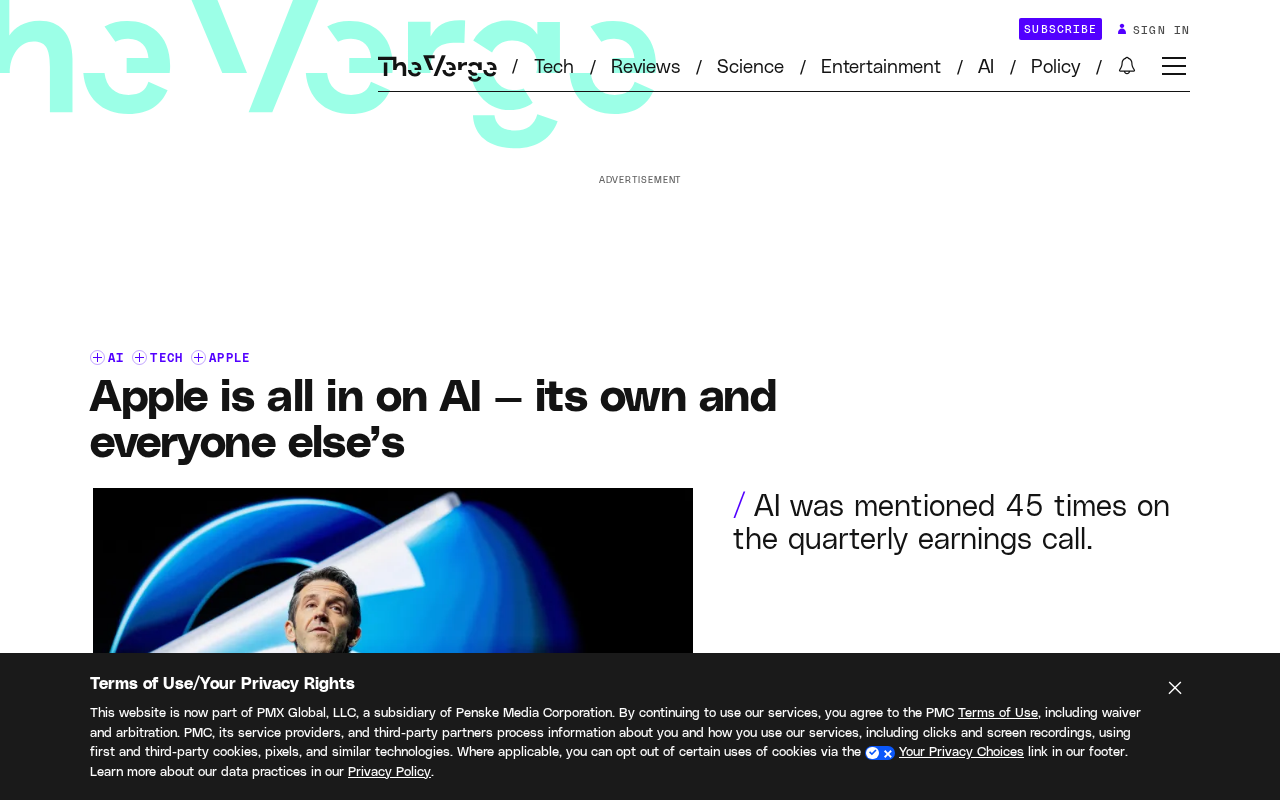
Apple's latest earnings report shows the company achieved the best fiscal-year revenue and earnings per share in its history. iPhone and Mac sales continued to grow strongly in the fourth quarter, with iPhone revenue up 17.5% year over year. This result stands out especially against the backdrop of the tech industry as a whole facing pressure on AI investment returns.
Unlike competitors such as Microsoft, Google, and Meta, which invest tens of billions of dollars in AI infrastructure, Apple has chosen a more restrained capital expenditure strategy. It has not built data centers at scale or rushed to buy up GPUs; instead, it shares in the AI growth dividend through in-house chip development and ecosystem integration. This "asset-light" approach allows Apple to stay at the forefront of the AI wave while maintaining its profit margins.
In-House AI: The Foundation of Chips and On-Device Intelligence
One of the cores of Apple's AI strategy is its in-house chip capability. From the A series to the M series, Apple's accumulated on-device compute allows it to deploy AI features directly on devices, reducing reliance on cloud inference. This not only lowers operating costs but also reinforces the brand narrative around privacy protection.
Analysts believe that Apple's "all-in" in AI does not simply mean developing its own large models, but rather embedding AI capabilities across all product lines. From iPhone image processing to Mac professional workflows, AI is becoming the underlying support for the hardware experience. This strategy allows Apple to avoid consuming too many resources in the cloud arms race while still monetizing through hardware sales and services revenue.
The difference between on-device AI and cloud AI: On-device AI refers to running AI models directly on user devices (such as phones and computers) rather than uploading data to cloud servers for processing. Its advantages include low latency, offline availability, privacy protection (data never leaves the device), and savings on cloud inference costs; its disadvantage is that it is limited by device compute and memory, making it difficult to run very large-scale models. Thanks to the Neural Engine in its A-series and M-series chips, Apple has a significant advantage in on-device AI, which is also the technical foundation that enables it to participate in AI competition in an "asset-light" way.
Leveraging External Partners: A Pragmatic Choice for an Open Ecosystem
Apple's "all-in" on AI also includes embracing external AI achievements. According to industry observations, while maintaining in-house development, Apple is also actively integrating third-party AI technology to make up for its shortcomings in areas such as general-purpose large models. This dual-track strategy is relatively rare among tech giants—it neither relies entirely on external partnerships like some companies nor insists on developing everything in-house like others.
From a business logic perspective, this pragmatic attitude helps Apple control R&D risk while quickly delivering mature AI capabilities to users. For developers, the diversity of AI tools in Apple's ecosystem may also bring more choices.
General-purpose large models and vertical AI capabilities: General-purpose large models (such as GPT and Gemini) possess broad knowledge and reasoning capabilities, but training and inference costs are extremely high; vertical AI capabilities are optimized for specific scenarios (such as image processing and speech recognition) and are usually more lightweight. Apple has invested relatively limitedly in developing its own general-purpose large models, so it chooses to integrate third-party general AI technology (such as partnering with OpenAI to bring ChatGPT to Siri) while strengthening its in-house vertical AI capabilities (such as photo search and real-time transcription), creating complementarity. This strategy allows Apple to quickly offer cutting-edge AI features while avoiding excessive resource consumption in the general-purpose large-model arms race.
Industry Implications: AI Investment Does Not Have to Equal Burning Cash
Apple's case provides an important reference: competing in AI does not necessarily require massive capital expenditures. Through in-house chip development, on-device deployment, and ecosystem integration, companies can remain competitive in the AI era while maintaining financial discipline.
Of course, this strategy also has its limits. In the field of frontier model training that requires hyperscale computing power, Apple's investment is relatively limited, which may affect its iteration speed in certain AI capabilities. But for a company centered on hardware and user experience, the current balance point has clearly been carefully calculated.
Apple's "all-in" is not a single-point breakthrough but a systematic layout—in-house development and external leverage in parallel, with hardware and software working in concert. At a time when debates about an AI bubble continue, this steady approach may be worth emulating for more companies.
Capital expenditure and AI infrastructure: Tech giants' capital expenditure (CapEx) in AI mainly refers to hardware investments such as building data centers and purchasing GPUs (such as NVIDIA H100). Companies such as Microsoft, Google, and Meta have in recent years invested tens of billions of dollars annually in AI infrastructure to train and run large models. Although this asset-heavy model can support frontier research, it also brings enormous depreciation pressure and profitability challenges. Apple's capital expenditure is far lower than that of its competitors, and instead it reduces reliance on cloud compute through in-house chip development and on-device deployment, thereby participating in AI competition while maintaining financial discipline.
One-line Summary
With in-house chips and on-device AI at its core and leveraging the external ecosystem, Apple has achieved a non-cash-burning path to AI competition.
Paragraph Summary
Apple's latest earnings report shows it achieved the best fiscal-year revenue and earnings per share in its history, with iPhone revenue up 17.5% year over year. In the AI wave, Apple has adopted a distinctive dual-track strategy: on one hand, it develops its own chips and on-device AI, embedding AI capabilities across all product lines; on the other hand, it actively integrates third-party AI technology to make up for shortcomings in general-purpose large models. Unlike competitors such as Microsoft and Google, which invest tens of billions of dollars in AI infrastructure, Apple chooses an asset-light approach, avoiding large-scale capital expenditure while maintaining profit margins. This steady path offers a reference for AI competition that does not depend on massive cash burning, though it also has limits in frontier model training investment.
Related articles

Qwen 3.8 Beats Opus at Coding—But Can Your Mac Run It?
Open-source Qwen 3.8 beats Opus 4.6 at coding at just 18GB, but how much Mac memory do you need? 24GB crashes; 32GB is the sweet spot. Full config guide inside.

Claude Code + Agent: Building a Fully Automated AI Testing Loop
Bilibili course breakdown: how test developers can use Claude Code terminal-based Agents to build a fully automated AI testing loop. Compares permission boundaries of terminal vs. device Agents, explains why enterprise projects choose Claude Code over Open Claude-type tools, and outlines the Node.js environment setup and DeepSeek model integration path.

Working with AI Agents Requires Nerves of Steel
The more autonomous AI agents become, the heavier the user's psychological burden. Drawing from a Hacker News discussion, this article analyzes black-box anxiety, behavior drift, and monitoring fatigue in agent collaboration, and offers practical approaches like sandbox isolation, permission control, and task granularity management to reduce cognitive load.