Apple's New Mac App Harbor: Local AI Inference and Thunderbolt 5 Clustering
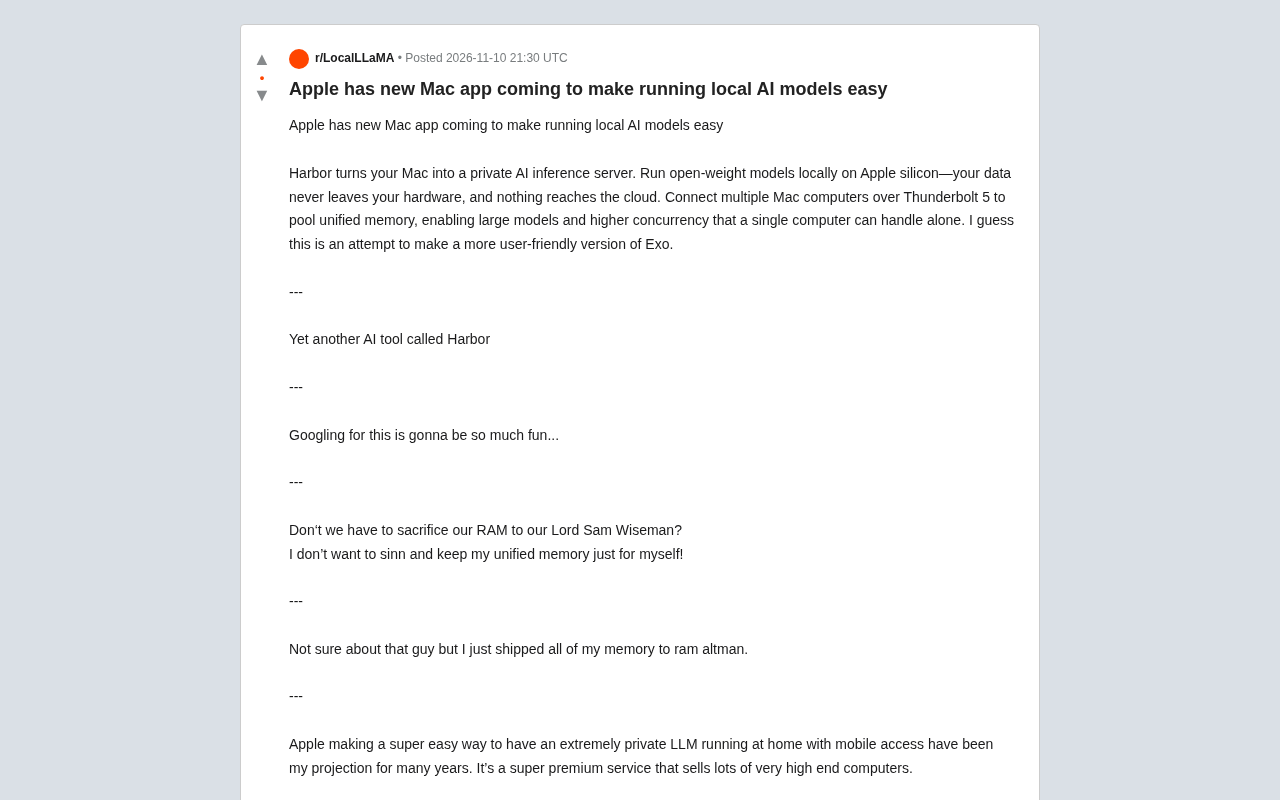
Apple is reportedly developing Harbor, letting Macs run AI models locally with Thunderbolt 5 multi-machine clustering.
According to Reddit community leaks, Apple is developing a new Mac app called Harbor to turn Macs into private AI inference servers, with models running locally on Apple Silicon and data staying on-device. Harbor's core differentiation is connecting multiple Macs via Thunderbolt 5 and pooling unified memory to run large models a single machine cannot handle and support higher concurrency. But Thunderbolt 5 on the Mac mini is supported only by M5 Pro and higher chips, and the mini's memory bandwidth is lower than the Mac Studio, potentially a cluster bottleneck, seen by some as a hardware upgrade strategy. Community opinions are split: supporters say Apple making private LLM deployment consumer-grade can drive high-end Mac sales; skeptics say existing tools like LM Studio are already convenient enough, and Apple's entry may be more cumbersome and lock in its ecosystem. Official details are not yet announced.
Apple is developing a new Mac app called Harbor, aiming to make running local AI models as simple as opening ordinary software. According to discussions in the Reddit community, Harbor will turn a Mac into a private AI inference server—models run locally on Apple Silicon, and data never leaves the hardware or passes through the cloud.
What Harbor Is: Turning a Mac into a Private Inference Server
Harbor's core positioning is an out-of-the-box entry point for local inference. When users run open-weight models, data always stays on their own hardware; there is no need to upload prompts or documents to any cloud service. For individuals and enterprises handling sensitive materials, this privacy model is more attractive than cloud APIs.
Community discussions point out that Harbor attempts to be the easy-to-use version of Exo. Exo is a distributed inference solution previously circulating among developers; it is powerful but has a fairly high configuration barrier. If Apple makes Harbor a system-level app, it means ordinary users no longer have to wrestle with the command line and network configuration.
Open-weight Model refers to AI models whose parameters are publicly available for download and use, such as the Llama, Mistral, and Qwen series. Unlike fully open-source models, open-weight models may not disclose training data and complete training code, but they allow users to freely run, fine-tune, and deploy them on local hardware. These models are the core object of local inference—after users download weight files, they can use an inference framework to generate text, process documents, and more on personal devices, all without connecting to the internet or calling cloud APIs, making them the preferred solution for privacy-sensitive scenarios.
Thunderbolt 5 Clustering: Merging Unified Memory Across Multiple Macs
Harbor's most discussed capability is connecting multiple Macs via Thunderbolt 5 to pool their unified memory, thereby running large models that a single machine cannot handle and supporting higher concurrent requests.
According to analysis by Reddit users, this design has a practical constraint: on the Mac mini, Thunderbolt 5 is supported only by M5 Pro and higher chips, and the mini's memory bandwidth is lower than that of the Mac Studio, which may become a bottleneck in a multi-machine cluster. In other words, Apple is pushing users to buy higher-end models, which some commenters also view as a hardware upgrade strategy.
Across multiple sources of discussion, a consensus has formed on this point: Harbor's differentiation lies not in single-machine inference but in networking. Mature tools such as LM Studio and Unsloth Studio already exist for running local models on a single machine; Harbor's value only holds if it lands on multi-machine memory pooling.
Unified Memory is a core feature of the Apple Silicon architecture: the CPU, GPU, and Neural Engine share the same physical memory pool, with no need to copy data between processors. This allows a Mac, when running large language models, to use all memory for loading model weights, rather than being limited by VRAM capacity as with traditional discrete graphics cards. Model parameter counts are usually measured in billions (B); as a rough estimate, every 1 billion parameters requires about 2GB of memory at FP16 precision. Therefore, a Mac Studio with 128GB of unified memory can theoretically handle models at roughly the 60B parameter level. Memory bandwidth determines inference speed, and the Mac Studio's high-bandwidth advantage is especially critical in multi-machine clusters.
Comparison with Existing Tools: Ease of Use or Lock-In
Community opinions on Harbor are not unanimous. Supporters believe that Apple turning private LLM deployment into a consumer-grade experience, combined with mobile access, is a high-margin service that can drive sales of high-end Macs—a product direction that has been predicted for years.
Skeptics point out that existing apps can already index HuggingFace and download models with one click, making the workflow extremely short; Apple's own app may not be more streamlined and could even be more cumbersome. Other comments joke that the name "Harbor" clashes with a large number of projects of the same name, which will make searching confusing.
These disagreements reflect a real issue: competition among local AI tools is shifting from "whether it can run" to "how hassle-free it is to run." Apple's entry will raise the baseline for ease of use, but it may also lock users into its own ecosystem and specific hardware generations.
Exo is an open-source distributed AI inference framework that can cluster multiple heterogeneous devices (Mac, Linux, phones, etc.), automatically split model layers, and schedule computation across devices. Its technical highlights are peer-to-peer networking and dynamic partitioning, but users must manually configure the network, install dependencies, and tune parameters, which is not friendly to non-developers. If Harbor is integrated at the system level by Apple, it is essentially wrapping Exo-like distributed capabilities in an official experience, shifting configuration complexity to the system's lower layers—which is why the community calls it the "easy-to-use version of Exo." The key difference between the two is that Exo pursues cross-platform openness, while Harbor may be tied to Apple Silicon and the Thunderbolt interconnect standard.
What It Means for the Local AI Ecosystem
If Harbor launches in the form discussed, the hardware barrier for local inference will be raised in another way: not because compute is insufficient, but because the interconnect standard requires newer models. For users who already have Thunderbolt 5 devices, multi-machine clustering offers a low-cost path to expanding memory; for users of older models, this looks more like a signal to upgrade.
From an industry perspective, Apple packaging private AI inference as a premium service may accelerate the adoption of "local-first" in enterprise scenarios. The promise that data never leaves the hardware is more convincing in compliance-sensitive industries than the scale of model parameters.
At present, Harbor is still at the community rumor stage, and Apple has not officially announced details. Its functional boundaries, supported model formats, and the actual efficiency of multi-machine scheduling all need to be verified after an official release.
One-line Summary
Apple is reportedly developing the Harbor app, letting Macs run AI models locally with Thunderbolt 5 multi-machine clustering.
Paragraph Summary
According to Reddit community leaks, Apple is developing a new Mac app called Harbor, aiming to turn Macs into private AI inference servers, with models running locally on Apple Silicon and data never leaving the hardware. Harbor's core differentiation is connecting multiple Macs via Thunderbolt 5 and pooling unified memory to run large models that a single machine cannot handle and support higher concurrency. However, on the Mac mini, Thunderbolt 5 is supported only by M5 Pro and higher chips, and the mini's memory bandwidth is lower than that of the Mac Studio, which may become a cluster bottleneck and is viewed by some commenters as a hardware upgrade strategy. Community opinions are clearly divided: supporters believe Apple turning private LLM deployment into a consumer-grade experience can drive high-end Mac sales; skeptics believe existing tools such as LM Studio are already convenient enough, and Apple's entry may be more cumbersome and lock users into its ecosystem. Official details have not yet been announced.
Related articles
Anthropic's New Model Fable 5.2 Tested: Performance Surpasses Opus 5.5
Anthropic releases Fable 5.2, tested to outperform Opus 5.5. Higher per-token price but lower cost per task. Release highlights, public benchmarks, custom benchmarks, three hands-on tests, and model selection advice.

OpenAI on the Data Center PR Crisis and AI Regulation Through Self-Restraint
OpenAI executive interview: why AI data centers face a PR crisis, and why OpenAI supports a "speed limit" framework to regulate recursive self-improvement, stressing humans must control AI.
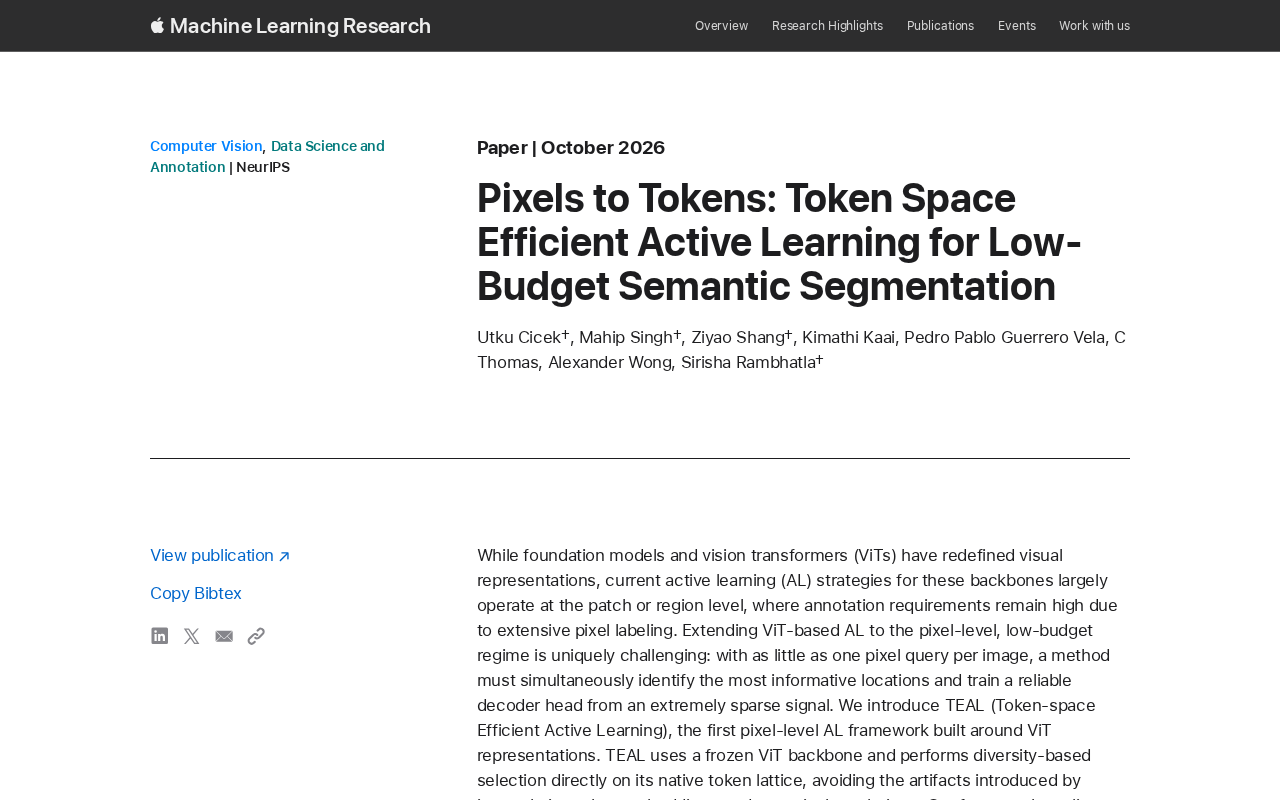
Token-Space Active Learning: TEAL, a New Method for Low-Budget Semantic Segmentation
TEAL introduces token-space efficient active learning for pixel-level low-budget semantic segmentation with ViT foundation models—one pixel query per image locates informative positions and trains the decoder, reducing annotation cost.