Token-Space Active Learning: TEAL, a New Method for Low-Budget Semantic Segmentation
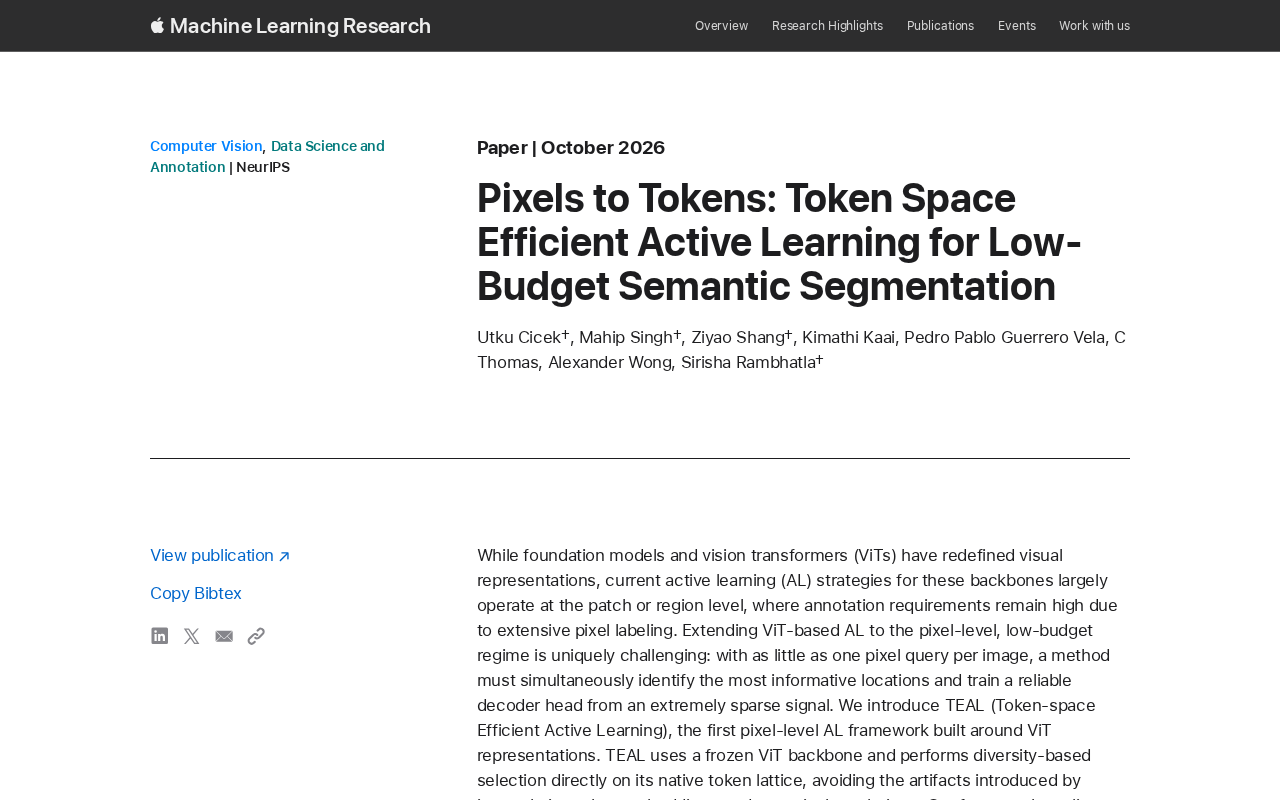
TEAL moves active learning decisions into token space, enabling low-budget semantic segmentation with one pixel query per image.
TEAL is an active learning method for low-budget semantic segmentation that addresses the tension between costly pixel-level annotation and existing ViT AL strategies that remain at the patch level. It moves the decision space from pixels or regions into ViT's token space, using token representations to evaluate informativeness and select query positions, aiming to simultaneously identify informative positions and train the decoder with only one pixel query per image. The article analyzes the challenges of pixel-level low-budget AL, explains TEAL's core idea and its relation to patch-level AL, and notes that it could significantly lower the annotation barrier, though specific criteria and experimental results await verification.
Token-Space Active Learning: TEAL, a New Method for Low-Budget Semantic Segmentation
The annotation cost of semantic segmentation has long been a bottleneck in deployment—pixel-by-pixel labeling is time-consuming and labor-intensive, and Active Learning (AL) attempts to leverage the greatest model gains with the least annotation. However, most current mainstream AL strategies remain at the image patch or region level, and their annotation demands remain high when facing foundation models such as ViT. A recent paper proposes the TEAL method, which advances active learning into the pixel-level low-budget regime: with only one pixel query per image, it can simultaneously locate the most informative positions and train the decoder.
Why Is Pixel-Level Low-Budget Active Learning So Difficult?
According to the paper, extending ViT-based active learning to a pixel-level low-budget mechanism faces unique challenges. Traditional AL operates at the image patch or region level, where annotation granularity is coarser and the number of required queries is relatively manageable. Pixel-level annotation, by contrast, means the model must learn from extremely sparse signals—each image provides a query budget of only one pixel, which requires the method to accomplish two tasks simultaneously: identifying the most informative positions and training a reliable decoder head from an almost negligible supervisory signal.
These two objectives are inherently in tension: the most informative position may not provide enough context to train the decoder, while sparse signals easily lead to decoder overfitting or underfitting. Existing methods are difficult to transfer directly because they are designed at the patch level and assume a more ample annotation budget.
Active Learning (AL) is a paradigm in which the model actively selects the most valuable samples for annotation. Its core is designing an acquisition function to evaluate the informativeness of unlabeled data, such as uncertainty sampling, diversity sampling, or expected error reduction. Traditional AL typically queries entire images or image patches as units, but in semantic segmentation the annotation granularity is pixel-level, so AL must decide "which pixel to annotate" rather than "which image to annotate." This shift in granularity from sample level to pixel level expands the query space from a discrete set of images to a high-dimensional pixel grid, sharply increasing search complexity. A low budget means the supervisory signal obtainable from each query is extremely limited, and the model must infer dense semantic boundaries from extremely sparse feedback—this is precisely the core difficulty of pixel-level low-budget AL.
TEAL's Core Idea: Efficient Active Learning in Token Space
The entry point of TEAL (Token-space Efficient Active Learning) is to move active learning from pixel space or region space into token space. ViT divides an image into patches and maps them into a token sequence, and token space naturally aggregates local and global information. Making selections in token space allows the representational capacity of ViT to be used to evaluate the informativeness of each position while maintaining computational efficiency.
The paper abstract does not disclose TEAL's specific selection criteria or decoder training details, but it clearly states the goal: under the extreme budget of only one pixel query per image, simultaneously accomplish informative-position identification and decoder training. This implies that TEAL likely designs a token-level scoring mechanism and pairs it with a lightweight decoder update strategy so that sparse supervisory signals can propagate effectively.
Vision Transformer (ViT) divides the input image into fixed-size patches, projects each patch linearly to obtain a token, and adds positional encoding to form a token sequence that is fed into the Transformer encoder. Token space is ViT's compressed representation of image content: each token aggregates the local information of its corresponding patch and fuses global context through self-attention. Compared with the original pixel space, token space has significantly lower dimensionality (for example, a 16×16 patch compresses 256 pixels into one token), and tokens already carry semantic features. Therefore, evaluating informativeness in this space avoids searching in an ultra-high-dimensional pixel space while using the representational capacity of a pretrained ViT to judge which positions are more valuable for the segmentation task. TEAL leverages exactly this property to move active learning decisions from the pixel level to the token level.
Relationship to Existing ViT Active Learning
Most current ViT-based AL strategies operate at the patch or region level, and their high annotation demand stems from still requiring a large number of pixel-level labels. TEAL refines the granularity to the pixel level but uses token space to reduce computational and annotation overhead. This represents a shift in thinking: no longer searching directly in high-dimensional pixel space, but making decisions on the token representations that ViT has already compressed.
The potential benefit of this shift is that token space has far lower dimensionality than pixel space, making search more efficient; at the same time, tokens carry semantic information that helps judge which positions are more valuable for the segmentation task. However, how token-level decisions map precisely back to pixel-level annotation remains an engineering detail that needs verification.
Semantic segmentation requires assigning a class label to every pixel in an image and is a pixel-level dense prediction task. Unlike image classification (one label per image), semantic segmentation annotation must be performed pixel by pixel, making it extremely costly. A typical application of active learning in semantic segmentation is: the model queries parts of unlabeled images, humans annotate these pixels, and then the model is updated. In low-budget settings, only one pixel per image may be queried, meaning the model must obtain maximum information gain in a single interaction. By selecting query positions in token space, TEAL essentially decouples "pixel-level annotation" from "token-level decision-making": informativeness is evaluated in token space and then mapped back to pixels for annotation. This decoupling allows sparse supervisory signals to propagate via ViT's global representations, thereby alleviating training instability under single-pixel supervision.
The Practical Significance of Low-Budget Semantic Segmentation
Semantic segmentation is in strong demand in fields such as autonomous driving, medical imaging, and remote sensing, but pixel-level annotation is expensive. If low-budget active learning can achieve usable accuracy with one pixel query per image, it will significantly lower the annotation barrier. TEAL's value lies in targeting a gap in AL in the era of foundation models: ViT and foundation models have reshaped visual representations, but AL strategies have not evolved in sync to pixel-level low-budget settings.
Of course, the paper abstract does not provide experimental data or accuracy comparisons, and the actual effectiveness still depends on the benchmark tests in the full paper. From a methodological perspective, TEAL proposes a direction worth attention—moving the battlefield of active learning from pixels to tokens, trading the efficiency of representation space for savings in annotation budget.
Open Questions and Outlook
The information currently public about TEAL is limited, and several key questions remain to be answered by the full paper: How is the token-level informativeness score designed? How can the decoder be trained stably under single-pixel supervision? On mainstream segmentation benchmarks, what accuracy can a one-pixel-per-image budget achieve? Compared with patch-level AL, how much is annotation efficiency improved? The answers to these questions will determine whether TEAL is a proof of concept or a practical solution.
For researchers and engineers focused on low-budget annotation and foundation model adaptation, TEAL offers a new perspective: the efficiency bottleneck of active learning may not lie in the selection algorithm itself, but in the space where selection occurs. Moving decisions into token space may be the key step to unlocking pixel-level low-budget AL.
One-line Summary
TEAL moves active learning decisions into token space, enabling low-budget semantic segmentation with one pixel query per image.
Paragraph Summary
TEAL is an active learning method for low-budget semantic segmentation, aimed at resolving the contradiction between the high cost of pixel-level annotation and the fact that existing ViT active learning strategies remain at the image patch level. The method moves the decision space of active learning from pixels or regions into ViT's token space, using token representations to evaluate informativeness and select query positions, with the goal of simultaneously accomplishing informative-position identification and decoder training under the extreme budget of only one pixel query per image. The article analyzes the unique challenges of pixel-level low-budget AL, explains TEAL's core idea and its relationship to existing patch-level AL, and points out that the method is expected to significantly lower the annotation barrier, although the specific selection criteria and experimental results remain to be verified by the full paper.
Related articles
Anthropic's New Model Fable 5.2 Tested: Performance Surpasses Opus 5.5
Anthropic releases Fable 5.2, tested to outperform Opus 5.5. Higher per-token price but lower cost per task. Release highlights, public benchmarks, custom benchmarks, three hands-on tests, and model selection advice.

OpenAI on the Data Center PR Crisis and AI Regulation Through Self-Restraint
OpenAI executive interview: why AI data centers face a PR crisis, and why OpenAI supports a "speed limit" framework to regulate recursive self-improvement, stressing humans must control AI.
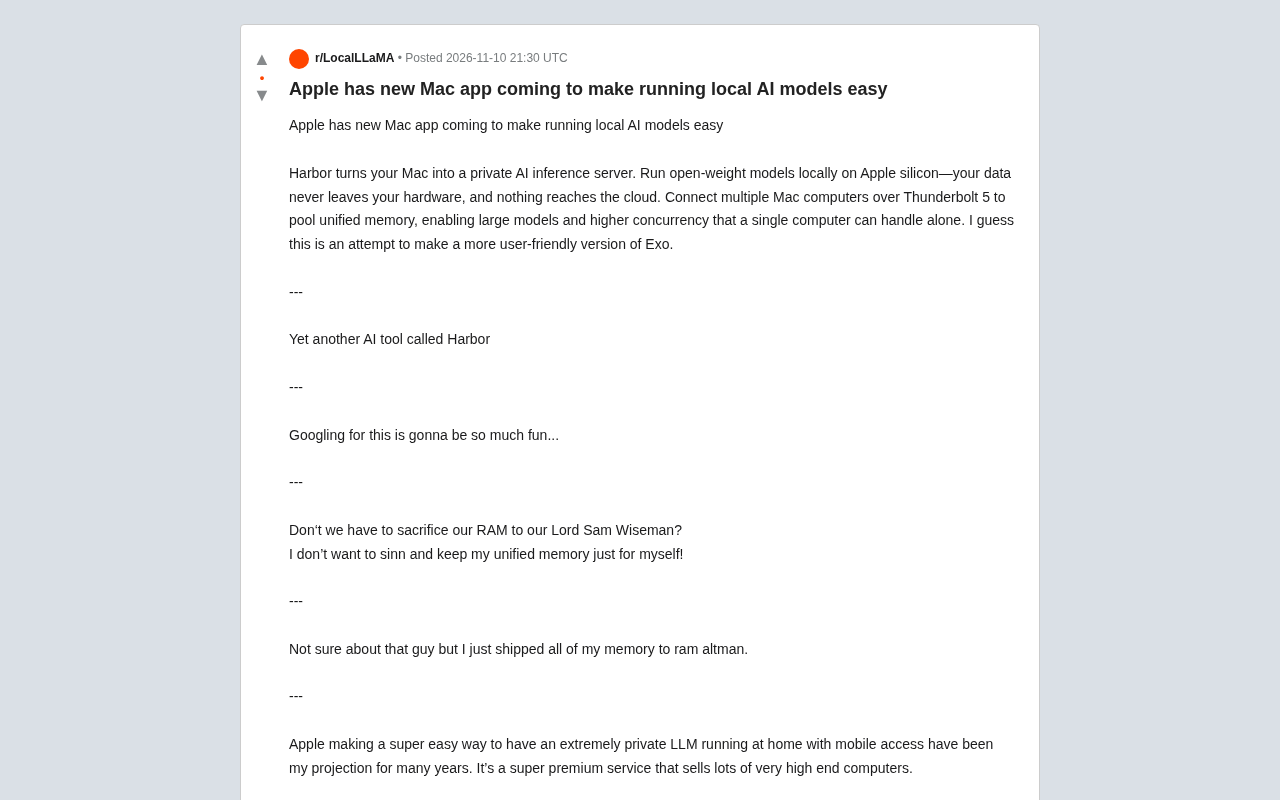
Apple's New Mac App Harbor: Local AI Inference and Thunderbolt 5 Clustering
Apple's new Mac app Harbor exposed: turning Macs into private AI inference servers, pooling unified memory across multiple Macs via Thunderbolt 5 to run large models. This article analyzes its features, differences from Exo and LM Studio, and impact on the local AI ecosystem.