Apple's Pro and Tell Event: Touchscreen MacBook Pro Leads the Week's Product Roundup

Apple launches the touchscreen MacBook Pro, marking an important shift in Mac interaction.
Apple wrapped up the week with its "Pro and Tell" event, officially launching the long-rumored touchscreen MacBook Pro as the finale product. The device belongs to the Pro line and targets professional creators. A touchscreen enables direct photo retouching, drawing, and video editing, blurring the line with iPad Pro. Apple had already announced several other device upgrades in the preceding days. The article views the touchscreen Mac as a response to the long-standing debate over touch on Mac, a limited compromise to market trends and user demand, while software adaptation, pricing, and impact on iPad Pro sales remain to be seen.
Apple wrapped up the week with an event called "Pro and Tell," officially unveiling the long-rumored touchscreen MacBook Pro. Although Apple saved its biggest update for last, it had already announced several device upgrades and refreshes in the days leading up to the event. This article rounds up all the new products Apple released this week and analyzes the product logic behind the touchscreen MacBook Pro.
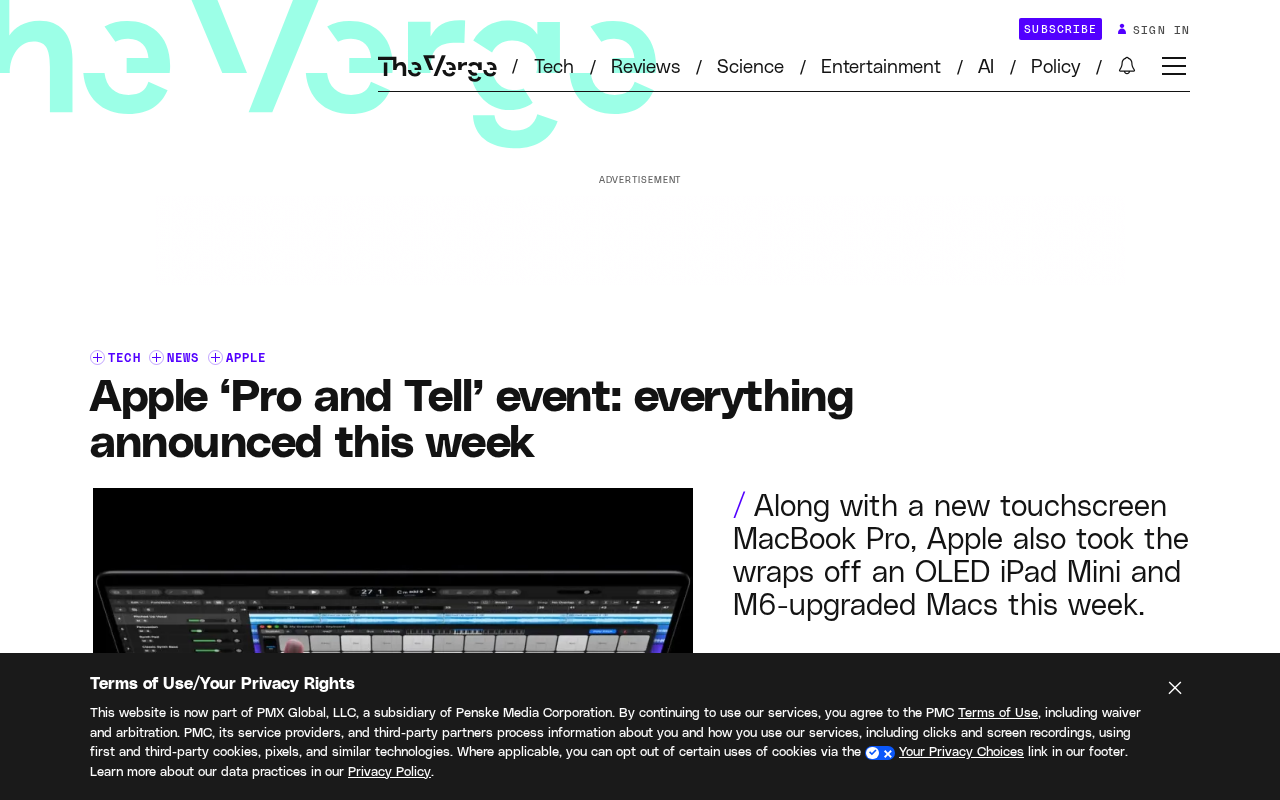
Touchscreen MacBook Pro: Apple Finally Takes the Step
At Wednesday's "Pro and Tell" event, Apple lifted the curtain on the touchscreen MacBook Pro. The product had been circulating in supply chain reports and patent filings for a long time, and now it has finally become reality. The addition of touch input marks a significant shift in the MacBook lineup's interaction model—Apple had previously stated publicly on multiple occasions that touch is not the best way to interact with a Mac, and this launch is clearly a renewed response to market trends and user demand.
In terms of positioning, the touchscreen MacBook Pro remains in the "Pro" line, aimed at professional creative users. The addition of a touchscreen makes it possible to retouch photos, draw, edit video, and perform other tasks directly on the screen, further blurring the boundary with iPad Pro. However, whether Apple will adjust macOS's interaction logic as a result remains unclear.
According to RSS source reports, Apple views this event as the week's "biggest and most exciting update," with the touchscreen MacBook Pro as the finale product.
macOS's Interaction Paradigm and Touch Adaptation
Since its inception, macOS has been designed around "indirect input": the mouse pointer provides precise hover positioning, the trackpad supports multi-finger gestures, and the menu bar and window management all assume the user is at some distance from the screen. A touchscreen introduces a "direct manipulation" paradigm—finger taps, drags, and two-finger pinch-to-zoom—which follows the same interaction logic as iOS/iPadOS. The problem is that macOS's existing control sizes, hover states, and context menus were not designed for finger touch. For the touchscreen MacBook Pro to be truly usable, Apple would need to enlarge tap targets at the system level, add a touch gesture layer, and perhaps even introduce an iPad-like touch mode. Historically, Apple has used Sidecar to turn an iPad into a secondary display for the Mac with touch support, but that was a peripheral solution; a built-in touchscreen requires system-level re-architecture. This is also why observers are watching to see whether macOS will fork or add a "touch mode" as a result.
Other Device Upgrades This Week: More Than One New Product
Before Wednesday's "Pro and Tell" event, Apple had already spent several days gradually announcing other device updates. The original material did not list specific models one by one, but explicitly mentioned "several other device upgrades and updates." Judging by the release cadence, Apple continued its strategy of releasing information gradually over multiple days, spreading attention across different product lines.
This "week-long rollout" model is not uncommon in Apple's recent launches. It helps maintain topic momentum and allows different audiences to get information at different times. As the finale product, the touchscreen MacBook Pro carried the biggest exposure burden.
The Strategic Significance of a Touchscreen Mac and Unresolved Questions
The launch of the touchscreen MacBook Pro is essentially a response to the long-running debate over "whether the Mac should have a touchscreen." Apple previously insisted that touch and mouse/trackpad are two different interaction paradigms, and forcing them together would compromise the experience. But as iPad Pro performance approaches laptop levels and touchscreen laptops become widespread in the Windows camp, the pressure on Apple has increased.
This launch can be seen as a limited compromise by Apple in response to touch demand while maintaining its Pro positioning. However, how well the software ecosystem adapts to the touchscreen MacBook Pro, its pricing positioning, and whether it will affect iPad Pro sales are all questions that need to be observed going forward. The original material did not provide specific configuration or pricing information, and these details await further disclosure from Apple.
Pressure from Both Sides: Windows Touchscreen Laptops and iPad Pro
The Windows camp has aggressively promoted touchscreen laptops since Windows 8. After years of iteration, 2-in-1 devices and touchscreen ultrabooks have become quite common in the thin-and-light laptop market, and users have been thoroughly educated to accept "laptops with touchscreens." Meanwhile, with M-series chips, iPad Pro performance is now approaching entry-level MacBooks, and with Magic Keyboard and Apple Pencil, it has become a lightweight creative tool for some professional users. These two forces squeeze MacBook's differentiation space from both ends: from below, iPad Pro takes away light-office and hand-drawing users; from above, Windows touchscreen laptops attract creators who need touch with more flexible usage forms. By launching a touchscreen MacBook Pro now, Apple is both responding to the product forms of the Windows camp and attempting to clarify the division of labor between Mac and iPad internally.
Conclusion
Apple's "Pro and Tell" event this week centered on the touchscreen MacBook Pro and, together with several device updates in the preceding days, formed an intensive product launch week. The debut of the touchscreen MacBook Pro marks an important shift in Apple's approach to Mac interaction, but its actual experience and market response still need to be tested after the product goes on sale.
Key Takeaways:
- Apple launched the touchscreen MacBook Pro at the "Pro and Tell" event as the week's finale product.
- The touchscreen MacBook Pro belongs to the Pro product line and targets professional creative users.
- In the days before the event, Apple had already gradually announced other device upgrades and updates.
- The launch of a touchscreen Mac responds to a long-standing market debate, but details such as software adaptation and pricing have not yet been announced.
One-line Summary
Apple launches the touchscreen MacBook Pro, marking an important shift in Mac interaction.
Paragraph Summary
Apple wrapped up the week with its "Pro and Tell" event, officially launching the long-rumored touchscreen MacBook Pro as the week's finale product. The product belongs to the Pro line and targets professional creative users. The addition of a touchscreen makes it possible to retouch photos, draw, and edit video directly on the screen, and also blurs the boundary with iPad Pro. In the days before the event, Apple had already announced several other device upgrades and updates, forming an intensive launch week. The article argues that the touchscreen Mac is a response to the long-running debate over "whether the Mac should have a touchscreen." Apple previously insisted that touch is not the best way to interact with a Mac; this launch can be seen as a limited compromise in response to market trends and user demand, but software ecosystem adaptation, pricing positioning, and the impact on iPad Pro sales remain to be seen.
Related articles

LLM Application Development: A High-Paying Career Guide for Ordinary People
LLM application development offers fresh graduates up to 35K/month, with SP offers reaching 600K. This article explains the core skills, how to break in, and how ordinary people can seize AI opportunities through learning by doing.

Say Goodbye to AI Influencer Faces: A Complete Guide to Creating Visual Assets for AI Comic Dramas from Scratch
Bilibili creator shares a full workflow for zero-basics AI comic drama visual assets: use Doubao Work skills with script-first, visual references, and real-person texture to escape AI influencer faces, then lock character and scene consistency with asset sheet layouts, weapon detail images, scene nine-grids, and cinematic color palettes.

The AI Production Pipeline Behind Great Videos: From Research to Agent Validation
AI video production isn't just a model race. This article breaks down a transferable four-step pipeline: researching professional workflows, organizing a skill checklist, configuring agents, and experimental validation—and explains how general-purpose LLMs like DeepSeek can replace paid tools to run the entire process.