Apple's Trade Secret Theft Lawsuit Against OpenAI Backfires: Leaked Communications Expose Management Failures

OpenAI's disclosed communications reveal Apple's offboarding failures, creating a dramatic twist in the trade secret lawsuit.
Apple sued OpenAI alleging former engineer Chang Liu stole hardware trade secrets, but OpenAI published internal communications showing Apple employees continued seeking technical help from Liu after his departure. The revelations expose serious offboarding management gaps and a procedural error involving a phone call that never happened, potentially undermining Apple's legal standing and credibility while the core theft allegations remain unresolved.
The Full Story Behind the Apple-OpenAI Hardware Secrets Dispute
Trade secret disputes between tech giants always attract attention, and the lawsuit between Apple and OpenAI is gradually evolving into a legal battle full of dramatic twists. The case originated from Apple's accusation that OpenAI stole its hardware trade secrets, with the finger pointed at a former Apple engineer named Chang Liu. However, a batch of internal communications recently disclosed by OpenAI has introduced an unexpected turn of events.
In the U.S. legal system, trade secret protection is primarily governed by the Defend Trade Secrets Act (DTSA) and various states' versions of the Uniform Trade Secrets Act (UTSA). To successfully bring a trade secret misappropriation lawsuit, the plaintiff must prove three core elements: that the information in question actually constitutes a trade secret (i.e., it has economic value and is reasonably kept confidential), that the defendant obtained the information through improper means, and that the plaintiff took reasonable measures to protect those secrets. The third point is particularly critical — if a company fails to demonstrate that it took adequate protective measures, courts may determine that the information in question does not constitute a protected trade secret.
According to information circulating on Reddit, the messages disclosed by OpenAI suggest that Apple continued to seek assistance from the engineer after his departure — a detail that could undermine Apple's moral standing in the litigation.
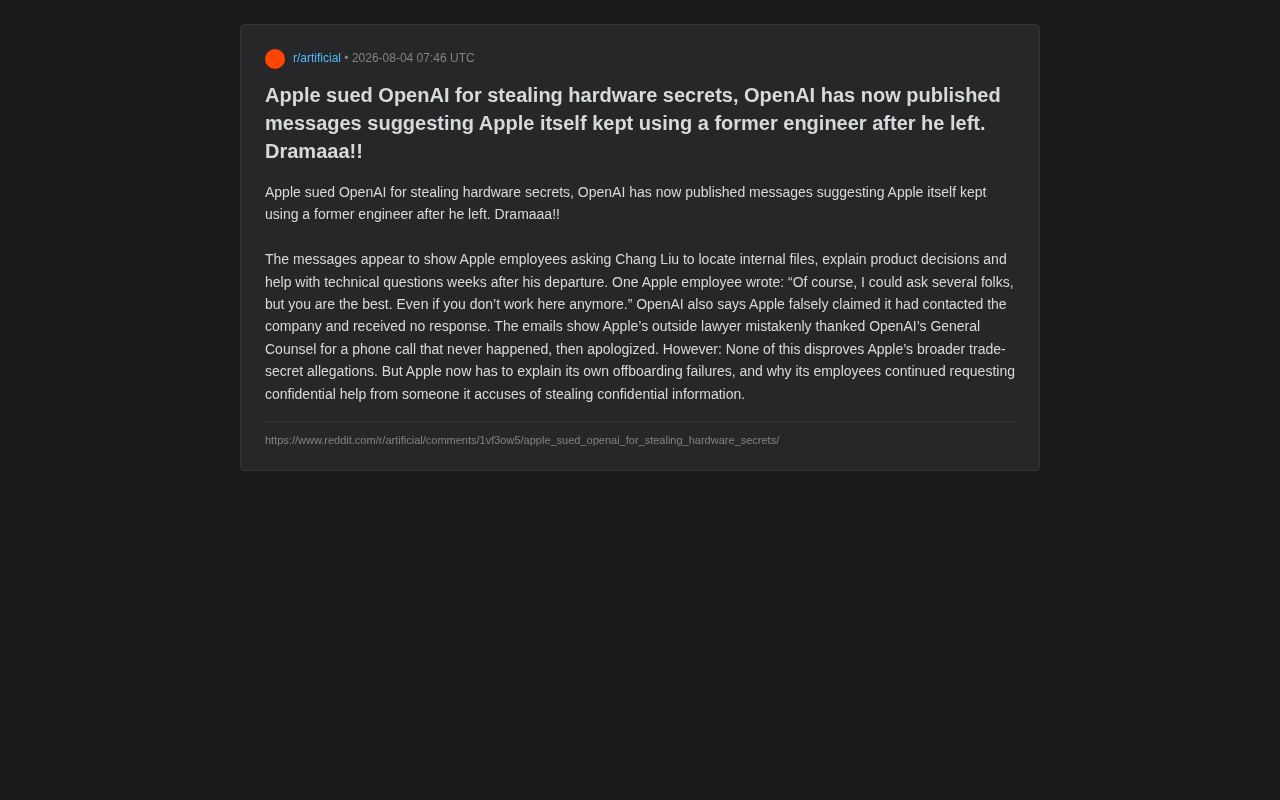
Key Evidence Published by OpenAI: Still Relied Upon by Apple After Departure
Apple Employees' Help Requests Exposed
According to the communications published by OpenAI, multiple Apple employees contacted Chang Liu weeks after his departure, asking him to help locate internal company files, explain product decisions, and even troubleshoot technical issues. One message from an Apple employee is particularly noteworthy:
"Of course, I could ask a few other people, but you're the best. Even though you don't work here anymore."
This seemingly casual workplace pleasantry takes on extraordinary significance in the context of litigation. If Apple is accusing the engineer of stealing confidential information while simultaneously seeking confidential technical help from him, then Apple's own behavioral logic presents an obvious contradiction.
It's worth noting that OpenAI has been accelerating its hardware ambitions in recent years. According to multiple reports, the company is exploring the possibility of developing its own AI chips and consumer hardware devices. In 2024, news of former Apple designer Jony Ive collaborating with OpenAI on AI hardware devices drew widespread attention. Meanwhile, Apple launched Apple Intelligence at WWDC 2024, officially integrating ChatGPT into Siri. This complex relationship of simultaneous cooperation and competition makes the talent competition and intellectual property disputes between the two companies in the hardware space even more sensitive, adding deeper industry competition context to this lawsuit.
Serious Gaps in Apple's Offboarding Process
These communications expose obvious failures in Apple's employee offboarding procedures. According to standard information security practices, after an engineer with access to core hardware secrets leaves the company, the organization should immediately cut off their access to internal systems and sensitive information, and cease all informal work interactions. The fact that Apple employees continued seeking internal files and technical support from a departed colleague demonstrates that internal processes were not being strictly followed.
In the tech industry, proper offboarding procedures typically encompass multiple layers: immediately revoking all system access (including VPN, code repositories, internal communication tools, etc.), reclaiming all company devices, conducting exit interviews to reiterate confidentiality obligations, and requiring signed confirmation letters stating that all confidential materials have been returned. Large tech companies also typically implement "Garden Leave" before an employee's departure — removing the employee from sensitive projects during the notice period while maintaining salary, creating an information "cooling-off period." The completeness of these measures often becomes critical evidence in subsequent litigation for whether a company can claim "reasonable protective measures." The management gaps Apple exposed in this case could potentially cause problems on precisely this legal requirement.
This provides powerful ammunition for OpenAI's defense: if Apple itself continued to "use" this engineer after his departure, then the accusation of "stealing" secrets appears untenable — or at least, difficult to justify on a common-sense level.
Procedural Flaws: A Phone Call That "Never Happened"
OpenAI's counterattack doesn't stop there. According to their published materials, Apple claimed to have contacted OpenAI but received no response. However, email records tell a different story — Apple's outside counsel mistakenly thanked OpenAI's General Counsel for taking a phone call that "never actually happened," and subsequently apologized for the error.
This detail may seem trivial, but it points to Apple's failures in litigation communication procedures and may even raise questions about the accuracy of its representations to the court. In legal proceedings, procedural flaws and inconsistencies in factual statements often become openings for attack by the opposing side and may affect a judge's assessment of a party's credibility.
Core Allegations Remain Unrefuted: Distinguishing Common Sense from Legal Principles
A Sober Analysis at the Evidence Level
Although OpenAI's disclosed materials have scored points in the court of public opinion, it's important to maintain perspective: this evidence cannot directly refute Apple's core allegation that trade secrets were misappropriated.
Apple's litigation claim is that hardware secrets Chang Liu accessed within the scope of his duties were improperly taken or leaked to OpenAI. The communications published by OpenAI primarily demonstrate Apple's own failures in offboarding management and litigation communications — these are issues on different levels. In other words, even if Apple employees did continue to contact this engineer after his departure, that cannot serve as direct evidence that the engineer "did not steal secrets."
However, in the common law system, "Unclean Hands" is an important equitable defense doctrine. This principle holds that if the plaintiff itself engaged in improper conduct or bad faith in the relevant matter, the court may refuse to grant equitable relief. OpenAI's publication of evidence showing Apple employees continuing to contact the departed engineer is a legal strategy aimed precisely at triggering this principle — suggesting that Apple is accusing someone of stealing secrets while simultaneously seeking access to those same secrets, creating inherent contradiction and impropriety in its own behavior. While whether this principle can be applied in this case still depends on the specific jurisdiction and case details, it does increase Apple's litigation risk.
The Dual Pressure Apple Faces
Nevertheless, this reversal has put Apple in an awkward position. It now must explain two issues:
- Why were its own employees continuing to seek confidential assistance from someone they were simultaneously accusing of stealing secrets?
- Why did a procedural error like a "fictional phone call" occur in litigation communications?
Both questions touch on the consistency and credibility of Apple's litigation conduct and could undermine its moral high ground before a jury or judge.
Lessons for the Tech Industry Behind This Case
The Legal Boundaries of Trade Secret Protection
This dispute once again highlights the trade secret protection challenges posed by talent mobility in the tech industry. Core technologies in the hardware field are often highly dependent on specific engineers' experience and knowledge. When these talents move between competitors, how to draw the line between "legitimately carrying away skills" and "illegally stealing secrets" remains a gray area in both law and business ethics.
There is an inherent tension between Silicon Valley's tradition of talent mobility and trade secret protection. California law explicitly prohibits the enforcement of Non-Compete Agreements, allowing engineers to freely move to competitor companies. However, this doesn't mean they can carry their former employer's confidential information with them. The legal distinction between "general skills and knowledge" and "specific trade secrets" is extremely blurry — a hardware engineer's design intuition and methodology are personal capabilities that can be freely carried away, while specific product specifications, undisclosed technical parameters, and supply chain information are protected trade secrets. This ambiguity is the fundamental reason why such lawsuits occur so frequently, from the early Google-Uber autonomous driving case (Waymo v. Uber) to recent AI chip talent battles — similar cases continue to emerge.
A Warning About Corporate Offboarding Management
For companies, this case serves as a profound warning: comprehensive offboarding procedures are not only an information security safeguard but also an important foundation for protecting one's position in potential future litigation. Any informal work interactions with former employees after their departure could become unfavorable evidence at critical moments.
The Interweaving of PR Warfare and Legal Warfare
OpenAI's choice to publicly release these communications is itself a public relations strategy. Before a formal ruling is made, shaping public perception by releasing favorable materials has become a common tactic in legal disputes between large tech companies. This battle will ultimately need to return to substantive evidence rulings in the courtroom.
Conclusion
The Apple-OpenAI lawsuit has evolved from the initial narrative of "Apple accuses OpenAI of stealing secrets" into a complex situation where both sides have vulnerabilities. OpenAI's published evidence successfully redirected some firepower toward Apple's own management failures, but the core question — whether trade secrets were actually stolen — remains unresolved.
Interestingly, the above information currently originates primarily from Reddit community leaks and has not been fully confirmed officially by either party — readers should maintain a cautious attitude. Regardless of the final outcome, this case will become a landmark example of talent mobility and trade secret protection in the tech industry, worthy of continued attention.
Key Takeaways
Related articles

Cursor Can Now Control Your Computer: AI Agents Can Drive Desktop Apps for Testing
Cursor adds desktop control: AI agents can drive desktop apps like the iOS Simulator to test their own features. We analyze the impact on dev workflows, possible technical approaches, and reliability concerns.

Vibecoding a Custom Inference Engine: High Hopes, Harsh Reality
A Reddit developer shares the real experience of vibecoding a custom inference engine: running GGUF Q4 models in the browser with WebGL2 and GLSL, only to fall into tokenizer debugging hell. This article analyzes the engineering challenges of browser-side LLM inference and why cloning llama.cpp is the more rational choice.

How High Are Anthropic's Early Investor Paper Returns Ahead of IPO?
Anthropic's early investor paper returns draw attention ahead of IPO. This article analyzes sources of book gains, capital structure, pre-IPO games and risks, and implications for the AI startup ecosystem.