Apple's Ultra Smart Home Robot Delayed to 2028, Software Shortcomings Come to the Fore
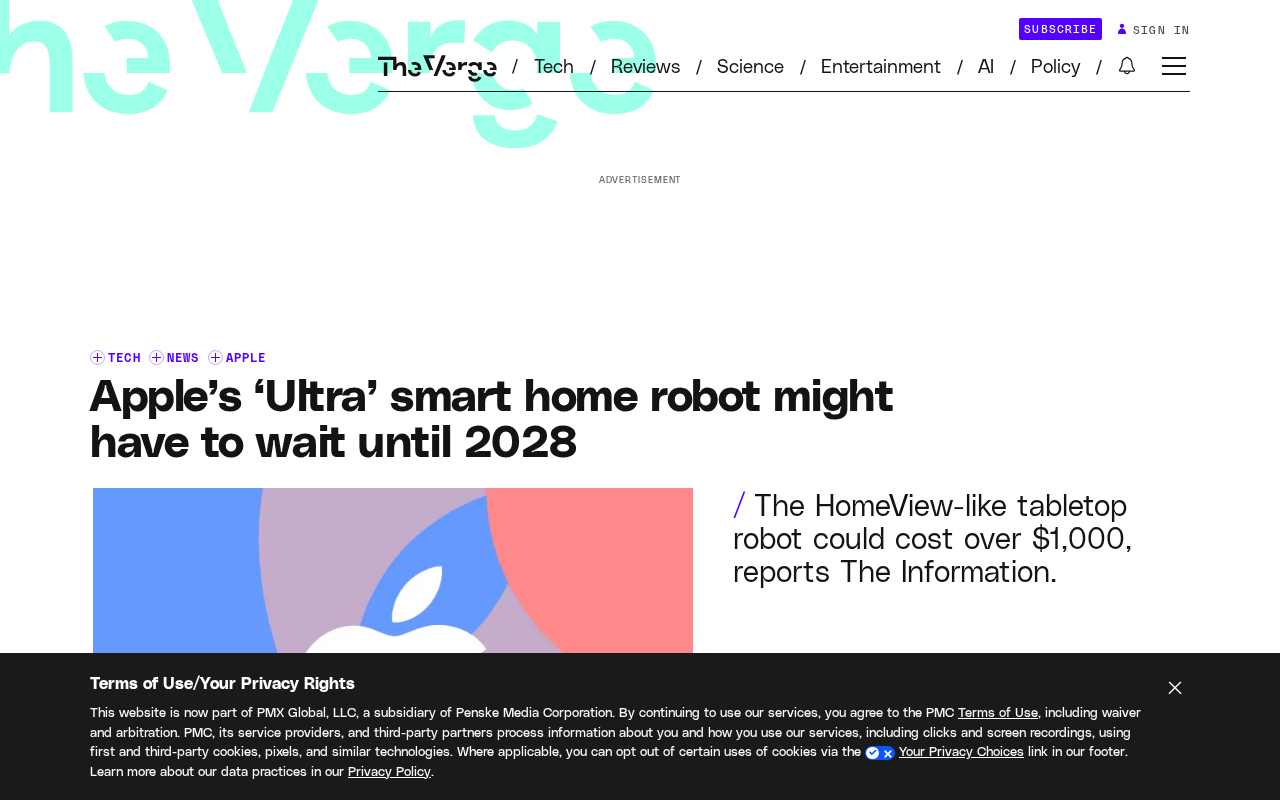
Apple's Ultra robot has been delayed to next year at the earliest, or 2028, because the software is not mature.
Apple's rumored smart home robot "Ultra" has had its hardware essentially ready for about two years, but the software team pushed hard for a delay, with launch now expected next year at the earliest and possibly as late as 2028. The report notes that the problem is not engineering or manufacturing, but the maturity of the intelligent experience—software capabilities such as interaction, perception, and autonomous decision-making have not yet met the bar. Apple has always insisted on an integrated hardware-software experience; if the software cannot match the hardware, a rushed launch would damage the brand. A two-year delay suggests that the software needs reconstruction rather than patching, involving multiple challenges such as AI model training, on-device inference, privacy and security, and generalization across home scenarios. This decision leaves a window for competitors, but it also reflects Apple's high standards for user experience and reminds the industry: hardware innovation is easy, software intelligence is hard.
Title
Apple's Ultra Smart Home Robot Delayed to 2028, Software Shortcomings Come to the Fore
Meta Description
Apple's rumored Ultra smart home robot has been delayed because the software is not ready, with launch now expected no earlier than next year or possibly as late as 2028. The hardware was completed two years ago, but the software team pushed for a delay, highlighting the software integration challenges of smart home robots.
Article Content
Apple's rumored smart home robot "Ultra" has slipped again. According to The Information, the device's hardware is essentially ready, but the software team pushed hard for a delay, meaning launch will come no earlier than next year and could even be pushed to 2028. Behind this is not just an adjustment to product timing, but also a reflection of Apple's deeper challenges in integrating AI and robotics software.
Hardware Mature Early, Software Holding It Back
The Information's report notes that the robot's hardware "has been done for about two years," but the software is not ready. The device software team's push for a delayed launch shows that the problem is not engineering or manufacturing, but the maturity of the intelligent experience.
For a high-end smart home robot, finalized hardware is only the starting point. Apple has always been known for its integrated hardware-software experience. If the software cannot match the hardware's capabilities, a rushed launch would only damage the brand's reputation. The software team's主动 request for more time reflects an internal high standard for user experience and also suggests that the current software still has unresolved difficulties in interaction, perception, or autonomous decision-making.
"Integrated hardware and software" (or "full-stack integration") refers to a single company controlling the entire chain of hardware design, operating system, core algorithms, and cloud services. Apple's typical model is that hardware and software teams collaboratively define the product from an early stage, rather than finalizing hardware first and outsourcing software later. The advantage of this model lies in experience consistency and performance optimization, but it relies heavily on software maturity—hardware can be finalized two years in advance, while software must continue iterating until launch. Therefore, when the software team judges that the experience does not meet the bar, even mature hardware cannot drive a launch. This also explains how "hardware completed two years ago" and "software holding things back" can both be true at the same time: hardware is a static engineering result, while software is a dynamic experience variable.
Delayed to 2028: Weighing the Timing Window
The report says the launch could be delayed to "next year at the earliest" or "2028." This span means Apple may be evaluating multiple technology milestones: the pace of iteration in AI model capabilities, progress in integrating the home ecosystem, and the coordination rhythm of the supply chain.
A two-year delay is unusual, especially when the hardware has already been idle for two years. This may indicate that the software layer needs reconstruction rather than simple patching. For Apple, the smart home robot is an entirely new category, and its software complexity far exceeds that of existing HomeKit devices. If launched before the software is mature, it could repeat the mistakes of early Siri or HomePod—excellent hardware but lagging intelligent experience.
HomeKit is Apple's smart home framework, mainly providing device interconnection, automation scenes, and Siri voice control, but it does not include the autonomous navigation, dynamic environment understanding, or complex task planning capabilities required by a robot. HomeKit devices are usually fixed-location sensors or home appliances with single functions, operating on preset rules. A smart home robot, by contrast, needs to perceive space in real time, avoid obstacles, recognize family members, and proactively execute multi-step tasks, which requires an entirely new software stack—including visual SLAM, on-device inference engines, and multimodal interaction layers. Therefore, directly migrating existing HomeKit capabilities to a robot is not feasible. Apple must build an independent software architecture for this new category, which is one of the core reasons for the delay.
Software Challenges of Smart Home Robots
Smart home robots need to integrate multiple capabilities such as computer vision, voice interaction, autonomous navigation, and task planning. Apple is not starting from zero in these areas, but integrating dispersed technologies into a smooth home assistant experience is extremely difficult.
The software team's push for a delay may involve multiple considerations such as model training, scenario adaptation, and privacy and security. Apple has always emphasized privacy protection, and the robot needs to process large amounts of sensor data locally, which places higher demands on the software architecture. In addition, home environments vary greatly, and the robot needs sufficient generalization ability, which requires extensive data accumulation and algorithm optimization.
On-device inference refers to AI models running directly on the device locally rather than uploading data to the cloud for processing. For smart home robots, on-device inference is crucial: it needs to respond in real time to sensor inputs (such as vision, lidar, and microphones) while avoiding leakage of private data. Apple has integrated the Neural Engine into its A-series and M-series chips, providing a hardware foundation for on-device AI. But the challenge in robotics scenarios is that models need to process multiple streams of high-dimensional data simultaneously under limited power consumption while maintaining low latency. This requires the software team to compress, quantize, and optimize task scheduling for models, and to adapt them for generalization across different home environments. The maturity of on-device inference directly determines whether the robot can run smoothly without cloud dependence, and this is also a key technical milestone behind the software delay.
Potential Impact on the Industry and Users
Apple's delay decision leaves a window for competitors. The smart home robot track is still in its early stages, and players such as Amazon and Google are also exploring. If Apple does not enter until 2028, the market landscape may have already changed. But Apple has always excelled at striking later and winning with experience.
For users, the wait may be worth it. A smart home robot with mature software is far more valuable than a hastily launched "half-finished product." Apple's caution also reminds the industry: hardware innovation is easy, software intelligence is hard. A true smart home robot requires deep collaboration between software and hardware, not simple assembly.
Conclusion
The delay of Apple's Ultra smart home robot appears to be a matter of timing, but is in essence a matter of software capability. In an era when AI is reshaping hardware, software has become key to a product's success or failure. Apple's choice shows that it would rather wait than compromise. Whether 2028 will arrive on schedule depends on whether the software team can overcome those unresolved challenges.
One-line Summary
Apple's Ultra robot has been delayed to next year at the earliest, or 2028, because the software is not mature.
Paragraph Summary
Apple's rumored smart home robot "Ultra" has had its hardware essentially ready for about two years, but the software team pushed hard for a delay, with launch now expected next year at the earliest and possibly as late as 2028. The report notes that the problem is not engineering or manufacturing, but the maturity of the intelligent experience—software capabilities such as interaction, perception, and autonomous decision-making have not yet met the bar. Apple has always insisted on an integrated hardware-software experience; if the software cannot match the hardware, a rushed launch would damage the brand. A two-year delay suggests that the software needs reconstruction rather than patching, involving multiple challenges such as AI model training, on-device inference, privacy and security, and generalization across home scenarios. This decision leaves a window for competitors, but it also reflects Apple's high standards for user experience and reminds the industry: hardware innovation is easy, software intelligence is hard.
Related articles

Qwen 3.8 Beats Opus at Coding—But Can Your Mac Run It?
Open-source Qwen 3.8 beats Opus 4.6 at coding at just 18GB, but how much Mac memory do you need? 24GB crashes; 32GB is the sweet spot. Full config guide inside.

Claude Code + Agent: Building a Fully Automated AI Testing Loop
Bilibili course breakdown: how test developers can use Claude Code terminal-based Agents to build a fully automated AI testing loop. Compares permission boundaries of terminal vs. device Agents, explains why enterprise projects choose Claude Code over Open Claude-type tools, and outlines the Node.js environment setup and DeepSeek model integration path.

Working with AI Agents Requires Nerves of Steel
The more autonomous AI agents become, the heavier the user's psychological burden. Drawing from a Hacker News discussion, this article analyzes black-box anxiety, behavior drift, and monitoring fatigue in agent collaboration, and offers practical approaches like sandbox isolation, permission control, and task granularity management to reduce cognitive load.