Apple Sues OpenAI for Trade Secret Theft, Google Rewrites Search Rules: A Complete Guide to Enterprise Visibility Strategy
Apple sues OpenAI for IP theft while Google's AI search overhaul slashes website clicks by 58% — the rules have already changed.
Apple has formally sued OpenAI for alleged industrial espionage involving hardware secrets, while Google has quietly replaced traditional search results with AI-generated answer pages — causing click-through rates to drop by 58%. Together, these shifts signal that the rules of digital visibility and competitive advantage have fundamentally changed, forcing businesses to rethink SEO strategy in the age of generative AI.
Two Events in One Week That Changed the Rules of Business
Two things happened in the tech world this week that may seem unrelated, but together they point to a clear signal: competition among AI giants has moved beyond products into a battle over talent, trade secrets, and the foundational rules of the internet. First, Apple formally sued OpenAI for alleged trade secret theft. Second, Google quietly rewrote how search results are displayed — with almost no official announcement.
For any business with a website, a content strategy, or a digital presence, this isn't a distant future trend. It's the reality happening right now.
Note: This article is based on a Reddit discussion thread. The lawsuit details and data cited are sourced from a single post. Some specifics (such as exact dates and job titles) have yet to be verified by authoritative media outlets, and readers should exercise their own judgment.
Apple Sues OpenAI: A War Over Talent and Trade Secrets
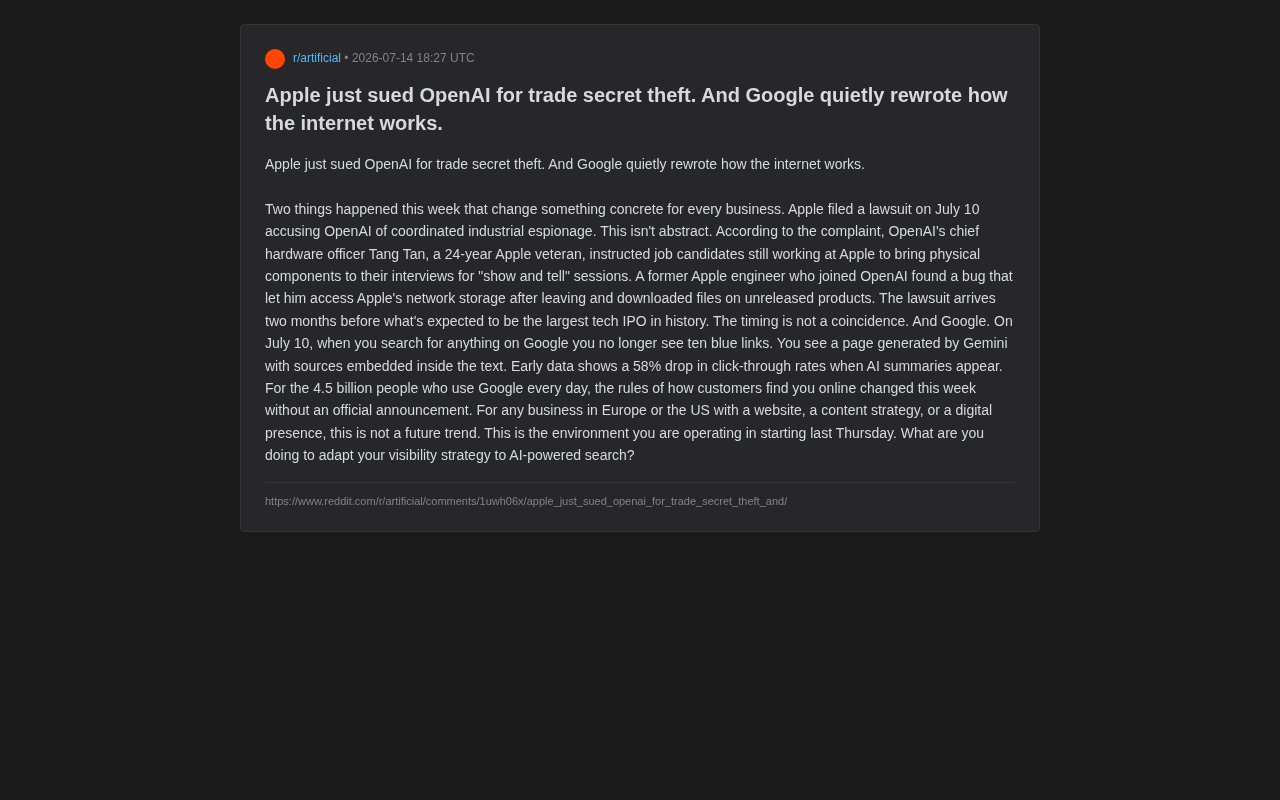
According to the thread, Apple filed a lawsuit on July 10, accusing OpenAI of conducting "organized industrial espionage." The accusations at the core of this case are not abstract competitive grievances — they are remarkably specific in their details.
Key Allegations in the Complaint
Based on the lawsuit content cited in the post, OpenAI's Chief Hardware Officer Tang Tan — a 24-year Apple veteran — allegedly asked job candidates who were still employed at Apple to bring physical components to interviews for a "show and tell" segment.
Even more seriously, a former Apple engineer who left to join OpenAI allegedly exploited a system vulnerability to continue accessing Apple's internal network storage after their departure, and downloaded confidential documents related to unreleased products.
[Background: The Boundaries of Trade Secret Law] Trade secret litigation is not uncommon in the tech industry, but the legal threshold for "industrial espionage" is quite high. In the United States, the Defend Trade Secrets Act (DTSA), which took effect in 2016, was the first legislation to bring trade secret theft under federal civil litigation. Under the Act, a plaintiff must prove three things: the information has independent economic value, reasonable measures were taken to keep it secret, and the defendant acquired it through improper means. If a hardware "show and tell" segment is found to have deliberately induced the disclosure of trade secrets, it could constitute "misappropriation" under the improper means clause. Talent mobility is rampant in the tech industry, and Silicon Valley has long struggled with enforcing non-compete agreements — California law explicitly prohibits broad non-compete clauses, forcing companies to rely on trade secret law rather than contractual restrictions to protect core intellectual property.
Why the Timing Is So Delicate
This lawsuit arrived approximately two months before OpenAI's anticipated IPO — an offering widely expected to be one of the largest in tech history. The post's author argues the timing is no coincidence.
[Background: The Capital Context of OpenAI's IPO] OpenAI's anticipated IPO has drawn intense interest from Silicon Valley's investment community, with its valuation trajectory serving as one of the most defining capital narratives of the AI era. In early 2023, OpenAI closed a funding round at a $29 billion valuation; by late 2024, that figure had climbed to $157 billion. If completed at that valuation, the offering would surpass Facebook's $104 billion IPO in 2012, making it one of the largest tech IPOs in U.S. history. Behind the headline valuation, however, lies significant financial pressure: OpenAI's compute costs are enormous, with reported net losses exceeding $500 million in 2023, and the daily inference costs of running ChatGPT estimated at millions of dollars at peak load. In this context, any legal event that undermines investor confidence — regardless of the ultimate outcome — could have a material impact on pricing and institutional demand. This is precisely why the timing of the lawsuit is being read as a strategic move.
From a business strategy perspective, filing a lawsuit against a rival during a critical capital-raising window — regardless of the final verdict — can meaningfully affect valuation expectations, investor sentiment, and the media narrative.
It's also worth noting that OpenAI has indeed poached a number of senior Apple talent in recent years, particularly in hardware and design, and the two companies have long been rivals in the wearables and smart hardware space. Talent mobility itself is not illegal, but where exactly the line between talent and secrets lies is precisely the question these lawsuits are meant to answer.
Google Quietly Rewrites "How the Internet Works"
If the Apple lawsuit is a public confrontation fought in the open, Google's recent change is a near-silent reconstruction of the internet's underlying logic.
From Ten Blue Links to AI-Generated Pages
According to the post, starting July 10, users searching on Google no longer see the traditional "ten blue links." Instead, they're presented with an answer page generated by Gemini, with sources embedded inline within the text.
[Background: The Technical Logic Behind AI Overviews] Google's AI Overviews feature didn't appear overnight — it represents the culmination of years of strategic investment. As early as 2023, Google launched the Search Generative Experience (SGE) in beta, rolling it out to select users. Powered by the Gemini model, the feature uses Retrieval-Augmented Generation (RAG): the system retrieves content from multiple authoritative web pages, then uses a large language model to synthesize a structured answer while preserving source citations. Unlike traditional Featured Snippets, AI Overviews can integrate information across multiple sources rather than relying on a single top-ranked page. This hits content websites dependent on long-tail keywords especially hard, since AI can now directly answer the specific questions that previously required users to click through to a page. Google itself faces a genuine dilemma: AI Overviews may cannibalize its ad click revenue, but failing to push forward risks being displaced by competitors like ChatGPT.
The significance of this change goes far beyond a UI update. For the past twenty-plus years, the fundamental logic of search engines has been "index → rank → redirect": users click a link to reach a website, and the website gains traffic, ad revenue, and business opportunity. The AI Overviews model breaks this chain: answers are delivered directly on the search page, and users no longer need to click through to the original source.
What a 58% Drop in Click-Through Rate Actually Means
Early data cited in the post shows that when AI Overviews appear, website click-through rates drop by an average of 58%. For the 4.5 billion people who use Google every day, the rules governing "how customers find you online" have been quietly rewritten — without any formal announcement.
If this shift continues, the impact on the broader content ecosystem will be profound:
- Media outlets and content platforms that depend on search traffic will be hit first, as traffic declines translate directly into lost ad and subscription revenue;
- E-commerce and local service businesses will see their discovery pathways reshaped — "being cited by AI" is becoming the new goal, replacing "ranking high for keywords";
- The SEO industry faces a paradigm shift, with traditional keyword optimization strategies giving way to a new central question: how to get your content adopted as a source by AI Overviews.
What This Means for Businesses: Rebuilding Visibility Strategy
Viewed together, these two developments paint a larger picture: AI is simultaneously reshaping both the supply side of competition (who controls core technology and talent) and the demand side (how users discover and access information).
From SEO to GEO: The Strategic Shift Is Urgent
The central question used to be "how do I rank number one on Google." Today, it has become: "how do I get AI to cite me when generating an answer?" The industry has begun using the term GEO (Generative Engine Optimization) to describe this new direction.
[Background: The Technical Logic and Practical Path of GEO] Generative Engine Optimization represents a fundamental reconstruction of the traditional SEO framework, with a markedly different underlying logic. Traditional SEO targets algorithmic ranking: influencing a crawler's assessment of page quality through signals like keyword density, backlink authority, and page load speed. GEO, by contrast, targets a language model's "citation preferences": LLMs tend to cite content that is highly structured, fact-dense, and exhibits E-E-A-T characteristics (Experience, Expertise, Authoritativeness, Trustworthiness). In practice, GEO optimization includes: using clear heading hierarchies and FAQ structures (to make it easier for models to extract snippets), embedding citable data and definitions within content, strengthening brand presence in knowledge graph sources like Wikipedia and Wikidata, and using Schema.org structured data to annotate page semantics. It's worth noting that the impact of GEO is currently difficult to quantify precisely, which creates greater uncertainty for businesses when allocating resources.
What businesses need to rethink is no longer just keyword density and backlink counts, but rather:
- Whether content is clearly structured and factually accurate enough to be extracted and cited by large language models;
- Whether the brand has sufficient presence in authoritative sources and knowledge graphs;
- Whether direct-access channels beyond search (email lists, communities, owned audiences) have been established to hedge against traffic risk.
The Risk of Over-Relying on a Single Platform
Whether it's the Apple-OpenAI trade secret dispute or Google's unilateral rewriting of search rules, both stories reveal the same lesson: business models that are overly dependent on a single platform or a single traffic channel are becoming increasingly fragile.
When a platform can rewrite its rules without any announcement, a company's true competitive moat must be built on assets it can control.
Conclusion: The Change Has Already Happened — Not "Coming Soon"
What makes these two developments most worth paying attention to is precisely their "fait accompli" nature. The lawsuit has been filed. The search pages have been redesigned. The click-through rate decline is happening in real time.
For businesses operating in the global digital economy, the question is no longer "will AI change the rules of the game." It's: "how do I rebuild my visibility strategy in an environment where the rules have already changed?" The time left for those sitting on the sidelines may be shorter than they think.
Related articles

Liang Wenfeng's Three Big Bets: Why Did DeepSeek Open-Source Its 82% Gross Margin?
Why did DeepSeek open-source DeepInfer, its 82% gross margin inference framework, and then launch a hundred-billion funding round? An analysis of Liang Wenfeng's three big bets and the open-source strategy.

Restoring 169 Episodes of a Classic TV Show with AI Super-Resolution: A 95-Hour Home PC Diary
A Bilibili creator used an RTX 3070 Ti home desktop and open-source AI super-resolution tools to restore 169 episodes of Growing Pains from DVD quality over 95 hours, costing only 20 yuan in electricity. The diary reveals real pitfalls in deinterlacing, model selection, and fully automated pipelines, plus lessons in AI collaboration.

Open-Source Desktop Pet of Murasame with 503 Voice Lines: Customizable and Cries 'Goshujin-sama' on Click
Bilibili developer turns Murasame from *Senren * Banka* into an open-source desktop pet with 503 TTS voice lines, click to hear "Goshujin-sama," supporting sequential/random/repeat modes, voice library management, and custom characters.