Apple Swift Student Challenge 2027 Opens Registration: First Time Supporting All-Platform Apps
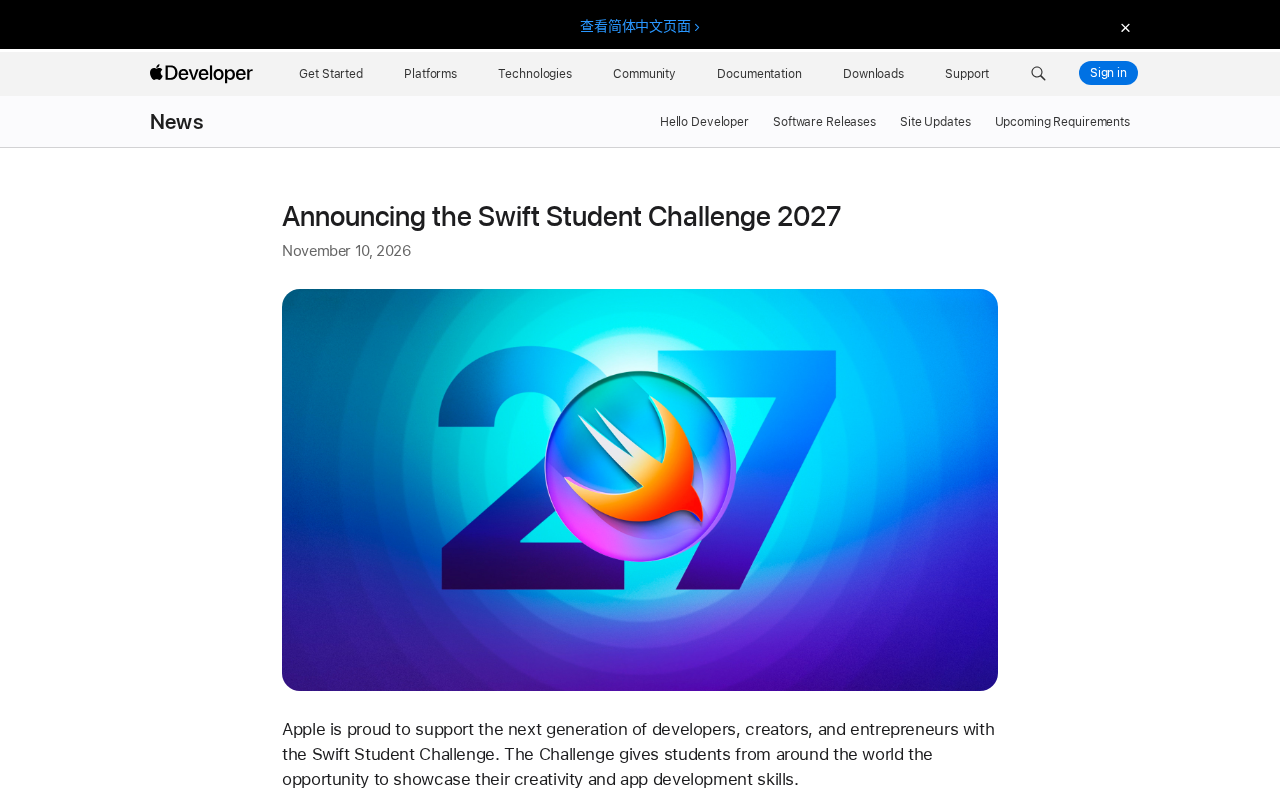
Apple launches the Swift Student Challenge 2027, allowing submissions for any Apple platform for the first time.
Apple announced the launch of the Swift Student Challenge 2027, with submissions open from February 8 to 28, 2027, lasting about three weeks. The competition is open to students worldwide and aims to support the next generation of developers, creators, and entrepreneurs, in line with Apple's long-term programming education strategy. The biggest change this year is that participants can submit app projects for any Apple platform, no longer limited to a specific device, giving students greater freedom in tech stack and interaction methods. The announcement did not disclose judging criteria or award settings, and related information is expected to be updated gradually on the developer.apple.com section. Interested participants should follow official channels as early as possible and plan their project direction.
Apple recently announced the launch of the Swift Student Challenge 2027, a programming challenge for students worldwide, with submissions open from February 8 to 28, 2027. Compared with previous years, the biggest change this year is that participants can submit app projects for any Apple platform, no longer limited to a specific device.
Event Positioning: Supporting the Next Generation of Developers
In its official announcement, Apple stated that the Swift Student Challenge aims to support the next generation of developers, creators, and entrepreneurs. The challenge provides students around the world with a stage to showcase their creativity and app development skills.
This event is in line with Apple's long-standing programming education strategy. Through the Swift language and its accompanying development tools, Apple hopes to lower the barrier to app development so that more young people can encounter and master native app development skills while still in school. For students aspiring to enter the Apple ecosystem, this challenge is both a training ground and a window to gain official recognition.
Swift is an open-source programming language launched by Apple in 2014 for developing native apps on platforms including iOS, iPadOS, macOS, watchOS, tvOS, and visionOS. It adopts modern language features such as type inference, Optionals, and automatic memory management (ARC), with concise syntax, high safety, and a relatively gentle learning curve, which is why Apple often uses it as an introductory language for programming education. Swift is deeply integrated with official development tools and frameworks such as Xcode, SwiftUI, and UIKit, so students can complete the entire process from coding and previewing to submission with just a Mac. Apple also offers beginner-oriented learning apps such as Swift Playgrounds, enabling students with no programming background to master Swift syntax through visual methods. This is also the technical foundation that allows the Swift Student Challenge to be open to a broad student population worldwide.
Key Change: Submissions for All Platforms Accepted
The most notable adjustment to this year's event is the expansion of the submission scope. The announcement explicitly states that students can submit apps for any Apple platform. This means entries are no longer limited to a single device category, and students can choose the most suitable platform form for development based on their own ideas and target users.
This change has a practical impact on competition strategy. In the past, students often had to adapt their work around a specific platform, but now they can choose their tech stack and interaction methods more freely and focus their energy on creative expression and feature implementation. For students skilled in cross-device experience design, this undoubtedly opens up more room to shine.
The Apple platform ecosystem currently includes iPhone (iOS), iPad (iPadOS), Mac (macOS), Apple Watch (watchOS), Apple TV (tvOS), and the spatial computing device Vision Pro (visionOS). These platforms differ significantly in screen size, input methods (touch, keyboard and mouse, Digital Crown, gestures and eye tracking), and system capabilities, but they share the Swift language, the Xcode toolchain, and a large number of common frameworks (such as SwiftUI and CloudKit). This structure of "unified foundation with differentiated interaction" allows the same idea to be implemented across different device forms. The opening of all-platform submissions actually requires students to understand the design guidelines (Human Interface Guidelines) and capability boundaries of each platform, rather than simply porting the same interface to multiple devices. This places higher demands on technical choices and interaction design for their projects.
Timeline and How to Participate
The submission window for the challenge is February 8 to 28, 2027, lasting about three weeks. Apple included a link to the official page in the announcement, and students can learn more details through the Swift Student Challenge section on developer.apple.com.
Students interested in participating should note that the announcement itself did not disclose specific rules such as judging criteria or award settings, and this information is expected to be updated gradually on the official page. It is advisable to follow official channels in advance so that project ideas and development can be completed before the submission window opens.
The Swift Student Challenge is an annual student programming competition held by Apple since 2020, usually aligned with the timing cycle of Apple's Worldwide Developers Conference (WWDC), and winners have the opportunity to receive official recognition and related benefits. The competition generally requires participants to be currently enrolled students and to submit a Swift Playgrounds app or Xcode project that runs on an Apple platform. In past rules, participants usually needed to submit original work with a brief description, and judges comprehensively considered creativity, technical implementation, and completeness. It should be noted that specific eligibility requirements, project formats, and the number of awards may be adjusted each year. Information from previous years can only serve as a reference, and participants should rely on the rules published on the official page for the current year.
What It Means for Students
From an industry perspective, Apple's continued hosting of such student competitions is essentially about reserving development talent for its own ecosystem. For participating students, the challenge offers not only a showcase opportunity but also a complete project practice: from idea generation and technology selection to polishing the final work, the entire process is highly similar to a real app development workflow.
The opening of all-platform submissions also echoes Apple's emphasis in recent years on multi-device coordinated experiences. When preparing their projects, students who think about how to make apps transition naturally across different Apple devices may better demonstrate their understanding of the ecosystem.
There is still some time before the submission window opens. Students interested in participating can plan the direction of their projects early and become familiar with Swift and related development frameworks to prepare for the challenge.
One-line Summary
Apple launches the Swift Student Challenge 2027, allowing submissions for any Apple platform for the first time.
Paragraph Summary
Apple announced the launch of the Swift Student Challenge 2027, with a submission window from February 8 to 28, 2027, lasting about three weeks. The competition is open to students worldwide and aims to support the next generation of developers, creators, and entrepreneurs, in line with Apple's long-term programming education strategy. The biggest change this year is that participants can submit app projects for any Apple platform, no longer limited to a specific device, giving students greater freedom in tech stack and interaction methods. The announcement did not disclose judging criteria or award settings, and related information is expected to be updated gradually in the section on developer.apple.com. Interested participants should follow official channels as early as possible and plan the direction of their projects.
Related articles
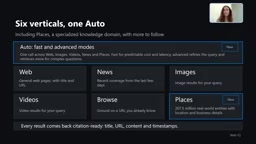
Microsoft WebIQ: Verifiable Real-Time Web Grounding for AI Agents
Microsoft WebIQ gives AI Agents real-time, citable web grounding across web, news, images, videos, and Places—164ms P95 latency, 50% fewer tokens, Scopes source control, and MCP integration.
Augmentable Gaussian Splatting: Building Photorealistic Simulation Environments for Robot Training
Team combines Gaussian Splatting with meshes to build photorealistic robot simulation environments, integrating MuJoCo Warp physics and Franka Panda for augmentable, relightable real-site simulation.
Gemini 4 Carbon Released: The Leap from Gemini 3 to Gemini 4 in Under a Year
Google releases Gemini 4 Carbon, less than a year after Gemini 3. In the official demo, Carbon reverse-engineered the Theme Park binary, added a new DeepMind-themed ride, and ported it to the web in one shot.