Apple Tests Daily Limits for Siri AI, Ending Unlimited Access to Advanced Features
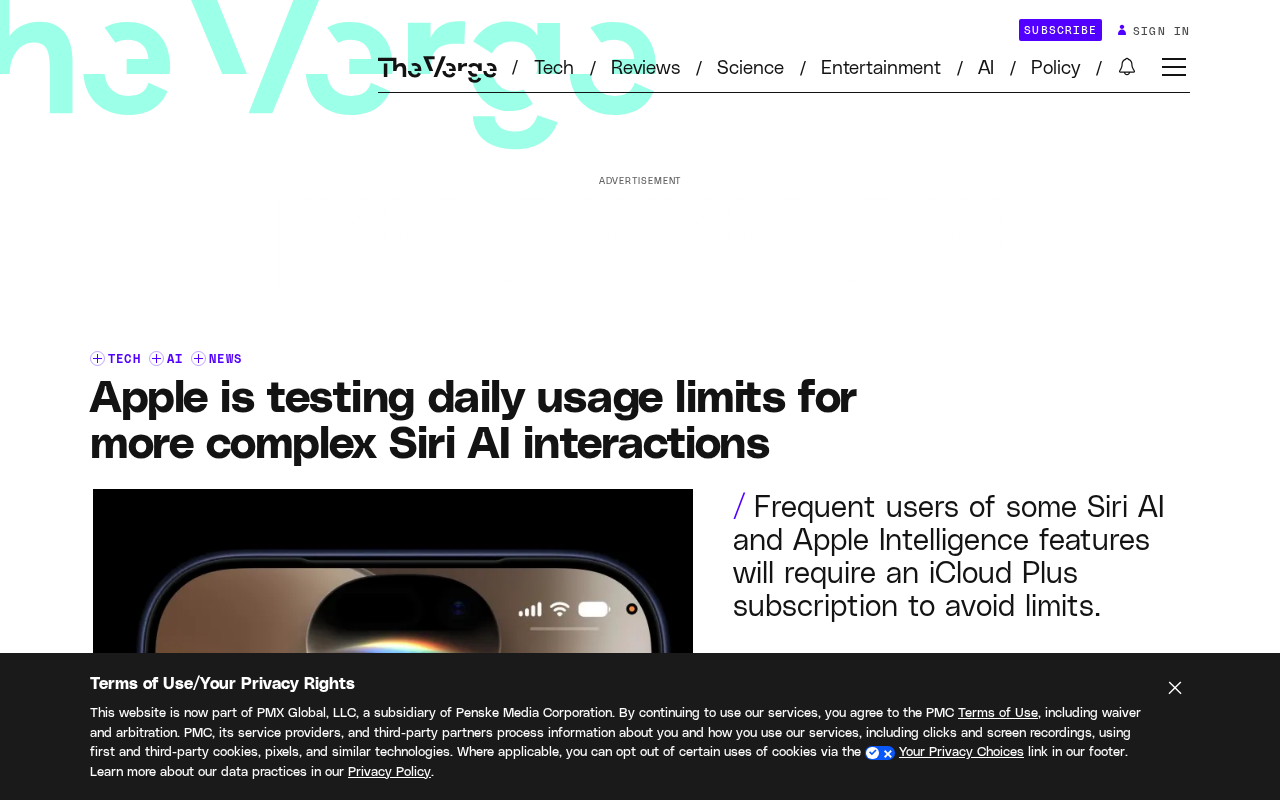
Apple introduces per-device daily limits for advanced Siri AI features in betas like iOS 27.3, while basic commands remain free.
Apple has begun testing per-device daily usage limits for advanced Siri AI and Apple Intelligence features in the iOS 27.3, iPadOS 27.3, and macOS 27.3 betas. Basic voice commands such as alarms, calls, and texts remain free and unlimited; what's constrained are complex interactions relying on contextual understanding, cross-app task execution, and generative responses. Limits are counted per device rather than per Apple ID, giving each device under the same account an independent quota—better matching actual compute consumption and possibly a conservative test approach while the quota model is still being finalized. The article argues this signals Apple is splitting Siri into a basic voice assistant and a high-cost AI service, paving the way for future tiered subscriptions and cost control, and reminding developers who rely on Siri's advanced capabilities to prepare fallback plans.
Apple is quietly changing the rules for free Siri. According to MacRumors, Apple today released beta versions of iOS 27.3, iPadOS 27.3, and macOS 27.3, and is using the update to begin testing "per-device daily usage limits" for some Siri AI and Apple Intelligence features. Basic Siri commands and requests remain free and unlimited, but interactions that rely on more complex capabilities will be subject to usage caps.
What the Limits Actually Cover
The details disclosed so far are limited, but the boundary is clearly drawn: traditional voice commands like setting alarms, making calls, and sending texts are unaffected and remain free and unlimited. Advanced features powered by Apple Intelligence—such as contextual understanding, cross-app task execution, and more complex generative responses—are being brought under a daily quota. This means Apple is splitting "Siri" into two layers: one is the basic voice assistant that has been around for years, and the other is an AI service that consumes compute.
This layering isn't necessarily bad for users—at least the basic experience hasn't been taken away. But it sends a clear signal: Apple doesn't intend to keep absorbing the cost of on-device and cloud AI inference forever.
Apple Intelligence is a set of AI capabilities introduced at Apple's 2024 WWDC that combines on-device and cloud processing, covering writing assistance, notification summaries, image generation (Image Playground), Genmoji, and a rewritten Siri. Its architecture is built around an "on-device first" principle: inference that can be done locally (such as text proofreading and simple classification) is handled by the neural engine of Apple's custom chips, while complex or long-context requests are sent via "Private Cloud Compute" to servers running Apple's custom silicon, with a commitment not to retain user data. This hybrid architecture determines the cost structure—the marginal cost of on-device inference is close to zero, while every cloud inference call consumes real GPU compute and electricity. So when Apple sets limits on "interactions that rely on more complex capabilities," what it's really constraining is the volume of calls that trigger cloud inference, which also explains why basic voice commands can remain free and unlimited.
Why "Per Device" Rather Than "Per Account"
The report uses the qualifier "per device," which deserves separate discussion. Counting by device rather than by Apple ID means that an iPhone, iPad, and Mac under the same account each have independent quotas. This is closer to how compute consumption is actually distributed—AI call volume naturally differs across devices—and it prevents multi-device users from being blocked by a single shared allowance.
Another possibility is that Apple hasn't yet decided on the final billing or quota model, and per-device testing is the most conservative approach during the data-collection phase. Either way, the wording shows that Apple is carefully measuring the real usage intensity of AI features.
A "per-device daily limit" is a common rate-limiting design for services. Counting by device rather than by account is uncommon outside streaming and cloud storage, because most subscription services use accounts as the billing unit to maximize revenue. But the actual consumer of AI inference is the device: the on-device model of an iPhone, the local compute of a Mac, and the usage scenarios of an iPad all differ, and cloud call volume varies accordingly. Per-device quotas can more closely match actual resource consumption while avoiding a thorny problem—if quotas were shared per account, heavy multi-device users would exhaust their allowance within half a day, while light users would waste most of theirs. But this design also creates a fragmented user experience: the same user must readjust to quotas when switching devices and can hardly "borrow" remaining uses across devices. The final form is likely to be a combination of account-level subscriptions plus device-level soft limits.
Comparison with Industry Trends
Mainstream AI assistants generally adopt a free-quota-plus-subscription model. Apple had previously offered Apple Intelligence free as a system selling point, but the marginal cost of complex reasoning doesn't disappear. Testing daily limits looks very much like paving the way for future tiered subscriptions: basic features retain all users, while advanced capabilities are reserved for those willing to pay or willing to wait.
The "free quota + subscription" model was first established by ChatGPT in 2023: free users can use the basic model but are subject to message limits and peak-hour throttling, while paying users get stronger models and higher quotas. Since then, Claude, Gemini, and Perplexity have all followed a similar structure, while Microsoft Copilot embedded it into Microsoft 365 subscriptions. The common logic of this model is that although the marginal cost of model inference declines with scale, it never reaches zero; the free tier serves customer acquisition and data collection, while the paid tier bears the break-even burden. Apple's difference is that its AI capabilities are bundled into the operating system with no standalone subscription entry point, so "limits" become its only available soft layering mechanism—preserving the free selling point while leaving room for bundling AI benefits into iCloud+ or Apple One in the future.
What the Beta Stage Means
It should be emphasized that this is still behavior in beta, and the final form may change—it may even apply only to some features or some regions. But the direction of testing itself says enough: the "unlimited free" phase of AI features is being replaced by more granular quota management. For developers, if an app relies on Siri's advanced interaction capabilities, it also needs to start considering fallback plans for when calls are restricted.
Apple has not yet announced specific quota numbers or an official launch date, and changes in subsequent beta versions are worth continued attention.
One-line Summary
Apple introduces per-device daily limits for advanced Siri AI features in betas like iOS 27.3, while basic commands remain free.
Paragraph Summary
Apple has begun testing per-device daily usage limits for advanced Siri AI and Apple Intelligence features in the iOS 27.3, iPadOS 27.3, and macOS 27.3 betas. Basic voice commands such as alarms, calls, and texts remain free and unlimited; what's constrained are complex interactions that rely on contextual understanding, cross-app task execution, and generative responses. Limits are calculated per device rather than per Apple ID, giving each device under the same account an independent quota—a better fit for how compute consumption is actually distributed across devices, and possibly a conservative test approach while the quota model is still being finalized. The article argues that this move signals Apple is splitting Siri into two layers—a basic voice assistant and a high-cost AI service—paving the way for future tiered subscriptions and cost control, and reminding developers who rely on Siri's advanced capabilities to prepare fallback plans.
Related articles

CIO SmartKobe EX05 Review: A MagSafe Power Bank with Built-in Cable and Stand
CIO SmartKobe EX05 power bank review: built-in detachable Type-C cable, folding rotating stand, Qi 2.2 magnetic 25W wireless charging with 7.5W safe mode, 10000mAh dual semi-solid-state cells, pass-through charging and three-device simultaneous power—ideal for multi-device users who hate cables.

Nobel Laureates' Daring Self-Experiments: Betting Their Bodies to Rewrite Medical History
The official Nobel Prize video chronicles five laureates' self-experiments: de Hevesy's radioactive leftovers, Forssmann's self-catheterization, Tu Youyou's first dose, and Marshall's H. pylori gamble—how betting their bodies rewrote medical history.

Anthropic CEO Rings Nasdaq Bell: Reaffirms AI Won't Be Accelerated by Commercial Pressure
Anthropic CEO Dario Amodei reaffirmed at the Nasdaq bell-ringing that regardless of commercial or political pressure, the company will hold firm to setting the pace of AI development. This article examines the background, industry pressures, and potential impact.