Apple vs. OpenAI: The 400-Employee Exodus and the Battle for AI Hardware Dominance

Apple sues OpenAI over trade secrets as the AI hardware and talent wars intensify across Silicon Valley.
Apple has filed a lawsuit against OpenAI, alleging that OpenAI coached roughly 400 former Apple employees to steal confidential information about unreleased products. This legal battle goes beyond talent poaching — it reflects a fierce competition over next-gen AI hardware form factors, the strategic importance of HBM memory chips, and geopolitical pressure to localize semiconductor manufacturing in the U.S.
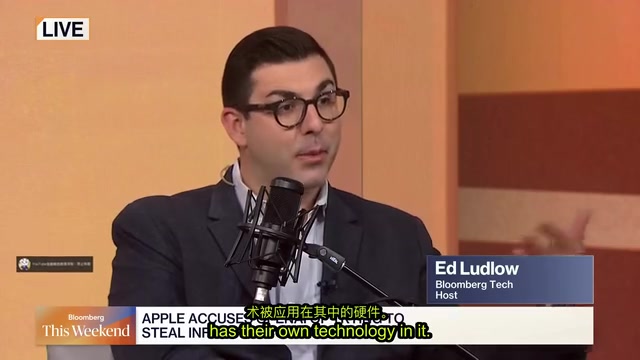
Apple and OpenAI, once partners, are now facing off in court. This lawsuit — centered on talent, trade secrets, and the future of hardware — not only exposes the most intense AI talent war in Silicon Valley history, but also reflects a collective anxiety among tech giants over the next generation of hardware form factors. Bloomberg Technology host Ed Ludlow, reporting from New York, offers a multidimensional view of this unfolding dispute.
From Partnership to Falling Out: The Collapse of a Relationship
The relationship between Apple and OpenAI didn't start with animosity. Just a few years ago, the two companies were working side by side — OpenAI's AI technology was integrated into Siri on the iPhone, and the two parties collaborated deeply at the software level.
The specific arrangement took shape as a centerpiece of the "Apple Intelligence" strategy announced at Apple's 2023 WWDC: Apple deeply embedded OpenAI's ChatGPT into Siri using a "model routing" architecture — simple queries handled by on-device models, complex tasks forwarded to cloud-based GPT-4o. Apple emphasized user privacy, claiming that forwarded requests were encrypted through "Private Cloud Compute." Yet this architecture planted the seeds of conflict from the start: Apple needed OpenAI's model capabilities, but remained acutely sensitive about data sovereignty and brand control. At WWDC two years ago, Sam Altman appeared on stage in person, and Apple executives publicly called OpenAI "the leader in the field."
But the honeymoon didn't last. According to Ed Ludlow's analysis, the turning point came from OpenAI's frustration with Apple's pace — they felt Apple had been slow to deliver on what was agreed in the original arrangement. At the same time, former Apple design legend Jony Ive established a partnership with OpenAI, and direct competition in hardware quietly emerged.
Jony Ive served as Apple's Chief Design Officer for 27 years, leading the design of landmark products including the iMac G3, iPod, iPhone, and Apple Watch. After going independent in 2019, he co-founded a hardware company called "io" with OpenAI in 2024, securing approximately $6.5 billion in investment. "io" reportedly aims to build an entirely new AI-native device that breaks free from the smartphone screen-centric interaction paradigm — a direct challenge to Apple's most fortified hardware moat.
"In David's words, this relationship has been 'souring' — and that might be putting it mildly," Ed Ludlow remarked. One telling detail: before filing the lawsuit, Apple attempted to pressure OpenAI through out-of-court channels, issuing what amounted to cease-and-desist warnings — but months passed with no effect.
The Core of the Lawsuit: 400 Former Employees and Trade Secret Allegations
The most striking figure in this lawsuit is Apple's claim that approximately 400 former Apple employees are currently working at OpenAI. But the real legal focus isn't on talent mobility itself — in Silicon Valley, movement of technical talent between companies is common practice, as long as it's legal and above board.
Understanding the legal logic requires familiarity with the U.S. trade secret protection framework. The Defend Trade Secrets Act (DTSA, 2016) governs trade secret misappropriation at the federal level, while California labor law generally prohibits companies from restricting employees from switching jobs through non-compete agreements. That's precisely why Apple's litigation strategy deliberately sidesteps the non-compete argument, focusing instead on the harder-to-defend charge of "actively inducing theft of trade secrets" — if it can be proven that OpenAI executives explicitly directed employees to systematically obtain confidential documents, this could constitute "misappropriation" under the DTSA, exposing OpenAI to punitive damages.
Apple's core allegation is that OpenAI executives allegedly "coached" departing employees on how to make a "clean exit." Court filings specifically describe how OpenAI taught these employees to avoid being immediately escorted out — essentially how to secure a two-week transition period after submitting their resignation. Apple's accusations go further: OpenAI allegedly encouraged these employees to use that window to access confidential documents related to unreleased products and undisclosed technologies.
Apple is seeking two outcomes through the litigation: first, to force OpenAI to stop what it characterizes as trade secret abuse; second, to require OpenAI to redesign any hardware Apple believes incorporates its technology. Apple has also demanded a jury trial, signaling a combative stance.
As one guest on the program noted, this phenomenon is nothing new in tech history. From GE to Apple, industry benchmarks have always faced talent drain and technology spillover — "You become the gold standard, and then people leave to start something new."
The AI Hardware War: The Fight for the Next Human-Machine Interface
In Ed Ludlow's view, this lawsuit is "less about people and more about Silicon Valley's bets on the future of hardware." Apple, Meta, and other giants are all grappling with the same question: through what device form factor will consumers access AI?
Smartphones remain the primary gateway, but AI glasses are on the rise, and companies have previously experimented with innovations like AI lapel pins. OpenAI's collaboration with Jony Ive is aimed squarely at this nascent hardware frontier. While Apple's lawsuit characterizes OpenAI's hardware efforts as "embryonic," and little is publicly known about the device's specific form or progress, the competition is fundamentally about staking out a strategic position at the next human-machine interface.
For OpenAI, Apple mobilizing its "full economic and legal firepower" poses a threat not just to its hardware expansion plans, but to its ability to achieve sustainable profitability from AI applications at all.
HBM Memory Chips: The Overlooked Key to AI Infrastructure
In discussing AI hardware competition, Ed Ludlow extended the conversation to another critical area — High Bandwidth Memory (HBM) chips. He recently interviewed the chairman of SK Group, whose subsidiary SK Hynix is a core HBM supplier.

Understanding why HBM is so critical requires a grasp of the underlying technology: HBM uses Through-Silicon Via (TSV) technology to vertically stack multiple layers of DRAM chips, then integrates them alongside a GPU on the same substrate using 2.5D packaging. Compared to conventional GDDR memory, HBM delivers 3–8x the data transfer bandwidth at lower power consumption. In AI large model training and inference scenarios, GPUs must repeatedly read and write billions of parameters at extremely high speeds — take the NVIDIA H100, for example: a single GPU is equipped with 80GB of HBM3 memory with a bandwidth of 3.35TB/s, tens of times that of ordinary DDR5 memory. Memory bandwidth is often the computational bottleneck, which has transformed HBM from a consumer electronics accessory into a "strategic resource" for AI infrastructure. Global supply is currently dominated by just three companies: SK Hynix, Samsung, and Micron.
SK Hynix just completed the largest IPO by a foreign company in the United States, raising $2.65 billion through American Depositary Receipts (ADRs). ADRs are a common tool for foreign companies listing in the U.S. — American banks hold shares in the foreign company and issue equivalent certificates, allowing U.S. investors to hold stakes without trading directly on overseas markets. The use of proceeds is clear: expand HBM production capacity, primarily targeting an advanced packaging facility in Indiana, in alignment with CHIPS and Science Act incentives while providing geographic and political assurance to secure long-term NVIDIA orders.
Perhaps the most striking assessment: despite SK Hynix's all-out effort and hundreds of billions in capital investment, the chairman candidly acknowledged that supply may never be able to keep pace with ever-growing demand.
Historically, memory chips were a quintessentially cyclical industry — manufacturers expand capacity when consumer electronics demand spikes, only to face oversupply when demand falls. But the AI era may be different: data center demand for memory trends more consistently upward, and SK Hynix's response confirms this shift.
Memory as a Service: The Next Frontier in Computing Paradigms
During the interview, the SK Group chairman introduced a disruptive concept — "Memory as a Service" (MaaS). A prominent UCLA professor specializing in memory has also called it "the next frontier."

The core logic of this idea is to shift chipmakers' business model from "hardware sales" to "capacity subscription" — analogous to how the cloud computing industry transitioned from selling servers to selling compute instances. Traditional memory companies are trapped in a "boom-bust cycle": expand capacity during high demand, then watch prices collapse as supply floods the market, cycling through with highly unstable margins. If MaaS can be realized, it would mean SK Hynix could rent HBM capacity to cloud service providers on a monthly or on-demand basis, smoothing revenue curves and building stronger customer lock-in.
The underlying logic is this: in AI inference scenarios, ordinary users and enterprises don't buy large quantities of chips themselves — they rent compute from cloud providers like Amazon, Microsoft, and Google. So why shouldn't memory manufacturers directly "lease" memory capacity rather than selling chips? Technical challenges remain, however: unlike CPUs and GPUs, memory currently lacks mature remote virtualization standards. The CXL (Compute Express Link) interconnect protocol, which the industry is actively exploring, is seen as a key pathway to memory pooling — but large-scale commercialization is still years away. Korean media has paid close attention to this vision, though the specific path to execution remains riddled with open questions.
Chip Localization: Industrial Restructuring Driven by Geopolitics
SK Group has already invested over $35 billion in the United States, and the chairman disclosed that future plans will "far exceed that figure." Behind this is NVIDIA-driven demand — for every NVIDIA GPU, roughly eight HBM chips are required, and NVIDIA's growth curve directly determines SK Hynix's fate.
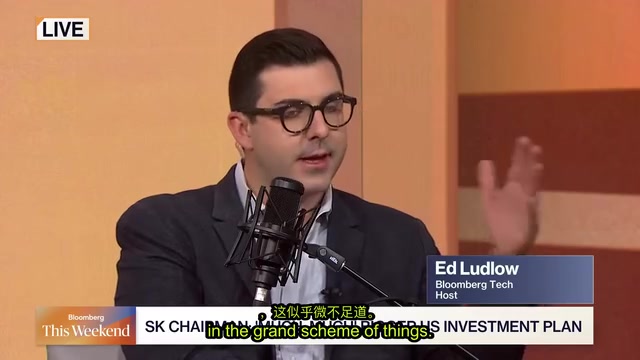
U.S. Secretary of Commerce Howard Lutnick has explicitly expressed a desire for Samsung and SK Hynix to expand production on U.S. soil, bringing chip manufacturing back to America — a goal that carries both industrial and national security weight. The world's heavy reliance on Taiwan (particularly TSMC's advanced logic chips) is viewed by many as a strategic risk. TSMC currently produces roughly 90% of the world's most advanced logic chips (3nm and below), and Apple's A-series chips and NVIDIA's AI GPUs all depend on its capacity. This highly concentrated structure is what strategists call the "Taiwan Paradox," and it is the fundamental motivation behind the CHIPS and Science Act's approximately $52.7 billion in subsidies to bring TSMC and others to build fabs in the U.S.
But one unresolved central debate remains: will Samsung and TSMC prioritize bringing their most advanced process nodes to the United States, rather than keeping them at home? Ed Ludlow thinks this "seems unlikely." A widely observed industry pattern is that overseas fabs tend to receive previous-generation or mainstream nodes rather than cutting-edge ones — TSMC's Arizona factory has lagged behind its Taiwan facilities in production timelines and yields, reflecting deep challenges around talent, supply chain ecosystems, and tacit knowledge that are difficult to replicate across geographies. A true semiconductor champion capable of achieving technology breakthroughs on U.S. soil remains elusive.
Conclusion: The Ultimate Question of AI's "Net Return"
When asked what topic deserves the most attention going forward, Ed Ludlow gave an answer that cuts to the core — earnings season. "What the American public most needs to know is: how much have tech companies spent on AI? And how much is coming out the other end?"
From Apple and OpenAI's hardware lawsuit, to anxiety over HBM memory capacity, to the geopolitical push to localize semiconductor manufacturing — every thread in this story leads back to the same ultimate question: what is the net return on this massive wave of AI investment? This quarter's earnings reports may prove to be the critical test of that answer.
Key Takeaways
Related articles

Gaussian Process Bandit Optimization: Exploration Strategies and Inference Regret Guarantees
Cumulative regret guarantees in Bayesian optimization fail to reflect final recommendation quality. This article examines a new study that provides inference regret guarantees for Gaussian process bandit optimization through exploration query strategies and fill distance analysis, validated on hyperparameter optimization and control tasks.

The Most Detailed Codex Guide on Bilibili: From Installation to Real-World Practice
The most detailed Codex guide on Bilibili: from app store installation to daily work mode configuration, with a real coffee shop project demonstrating file organization, data extraction, dashboard creation, and other practical tasks. Learn to use Plan Mode and desktop pets to leverage Codex efficiently.

Appearance Compensation in Volume Rendering: Why RGB Accuracy Cannot Guarantee Density Correctness
Volume rendering research reveals that volumetric data perfectly reproducing external RGB views may still contain density errors: appearance compensation can double central density and keep external rays unchanged even when L2 error exceeds 14.52%. Density recovery depends on appearance capacity, spatial resolution, and measurement design.