Apple 'Welcome Home' Event Preview: What to Expect from Apple's Smart Home Push
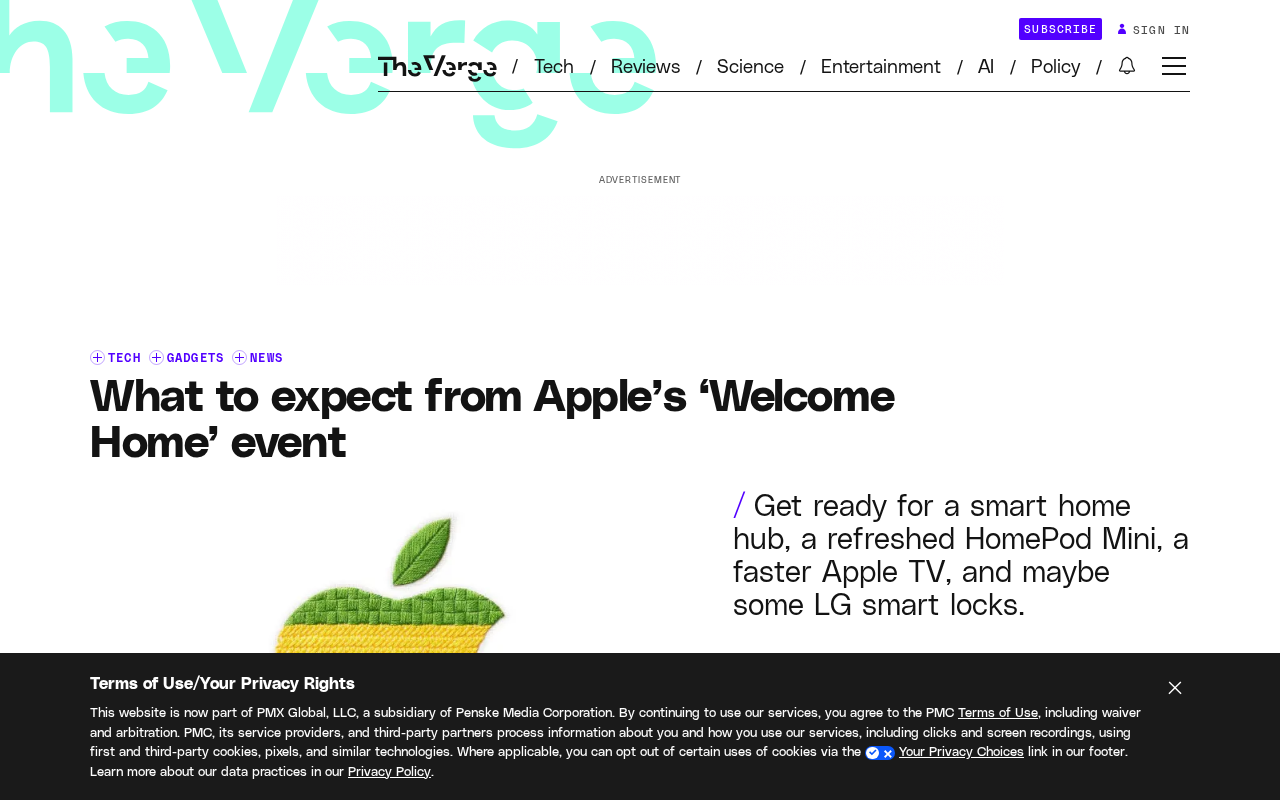
Apple's 'Welcome Home' event is expected to bring a smart home hub, Apple TV refresh, HomePod Mini update, and a new homeOS platform.
Apple's upcoming 'Welcome Home' event is set to focus entirely on its smart home ecosystem, with expected hardware announcements including an Apple TV refresh, an updated HomePod Mini, and a brand-new dedicated smart home hub. On the software side, Apple may debut homeOS, an independent home operating system to replace the patchwork of iOS and tvOS. Partner devices leveraging the Matter standard are also expected, signaling a broader push toward openness. Together, this marks Apple's most systematic smart home strategy yet, putting it in direct competition with Amazon and Google's home platforms.
Apple is set to host an event called "Welcome Home" — and the name alone makes clear this will be a smart home-focused affair. Unlike previous events headlined by the iPhone or Mac, Apple is putting the spotlight on its home ecosystem products, a category that has long played a supporting role.
Expected Hardware Announcements
Based on information currently circulating, the most anticipated hardware updates fall into three areas.
A Refreshed Apple TV
Apple TV, the cornerstone of Apple's living room strategy, is expected to receive a hardware refresh. Despite fierce competition in the streaming box market, Apple has consistently positioned Apple TV as a key node connecting TV entertainment with its broader ecosystem. A chip and performance upgrade would help support more complex smart home interactions and a smoother gaming experience.
An Updated HomePod Mini
Since its launch, the HomePod Mini has carved out a stronger sales position within Apple's smart speaker lineup, thanks to its compact size and solid audio quality. The expected refresh may bring improvements to the chip and connectivity, making it a more reliable smart home controller.
A Brand-New Smart Home Hub
Most anticipated of all is the rumored dedicated smart home hub device. Products in this category are designed to serve as a unified controller for all the smart devices in a home. If Apple launches a purpose-built hardware hub, it signals the company wants to offer a more systematic solution for the smart home market — rather than relying on a speaker or a TV box to moonlight as the control center.
For industry context, Amazon's Echo lineup and Hub Controller, along with Google's Nest Hub, are classic examples of smart home hub products — integrating voice assistants, local processing, and control over hundreds of third-party devices. Apple has never released a standalone device explicitly positioned as a "control hub." The HomePod and Apple TV have only incidentally served partial hub roles, with notable limitations in response speed, offline reliability, and concurrent multi-device handling. A dedicated hub with onboard processing chips would mean home automation commands no longer need to route through the cloud every time, dramatically reducing latency and improving privacy — the two factors smart home users care about most.
homeOS: A New Platform That Could Make Its Debut
Beyond hardware, the event may also introduce an entirely new software platform: homeOS.
For years, Apple's smart home features have been bolted onto existing systems like iOS and tvOS, with no independent operating system purpose-built for the home environment. If homeOS does appear, it would mark a significant turning point in Apple's smart home strategy — potentially providing a unified interaction model and development framework for smart displays and hub devices, while opening new doors for third-party developers and device manufacturers.
This would align with broader industry trends. Amazon's Alexa and Google Home are both building out their own home platform ecosystems. For Apple to stay competitive in this space, a dedicated platform of its own is almost inevitable.
Right now, Apple's smart home devices run on several separate systems: Apple TV runs tvOS, HomePod runs audioOS (HomePod Software), and iPad runs iPadOS when used as a home hub — with no unified development interface or interaction logic across platforms. If homeOS actually materializes, the most immediate impact would be giving developers a single SDK and app distribution channel, lowering the cost of building apps for Apple's home devices. By comparison, Amazon's Fire OS and the Google Home platform already offer relatively mature development ecosystems for partner manufacturers — a gap in Apple's smart home strategy that has been a long-standing criticism.
Signals from Partner Devices
Reports also suggest that partner devices from third-party manufacturers could appear at the event. This detail is often overlooked, but it carries real significance.
The core value of a smart home lies in interoperability between devices. Apple has already established a foundational ecosystem through HomeKit and the Matter standard. If more third-party products take the stage alongside Apple's own hardware, it signals that Apple is actively expanding its compatible device ecosystem and lowering the barrier for users to build out a fully connected home. The breadth of an ecosystem often determines a platform's ultimate success more than the strength of any single product.
HomeKit is Apple's smart home framework, launched in 2014. Its strict device certification process was long criticized for creating a closed ecosystem with limited compatible devices. Matter, on the other hand, is an open smart home communication standard co-led by Apple, Google, Amazon, and Samsung, officially released in 2022. It's designed to allow devices from different brands to communicate directly on the same local network, without relying on each company's cloud service. Apple's deep support for Matter has been built into iOS 16 and later, enabling rapid expansion of its ecosystem compatibility. If more partner devices appear at this event, it can be read as Apple actively leveraging the benefits of the Matter standard — a deliberate shift from closed to open.
What This Means for Apple's Smart Home Strategy
Taken together, the "Welcome Home" event sends a clear message: Apple is getting serious about the smart home market, an area where it has historically invested with relative restraint.
A dedicated hub on the hardware side, homeOS on the software side, and an expanding partner ecosystem — these three elements combine to form a far more complete strategy than anything Apple has put forward before. For users already in the Apple ecosystem, this means a smoother and more unified home automation experience. For the industry as a whole, Apple's increased commitment will further accelerate the push toward smart home standardization and interoperability.
Of course, much of the above remains pre-event speculation and rumor. Final product details, pricing, and availability should be taken directly from Apple's official announcements. But one thing is certain: this will be Apple's most concentrated and significant statement on the home ecosystem in years.
Related articles

Amphibious Transforming Drone: Beyond 100x Power Savings, What Are the Real Needs?
Is the amphibious transforming drone just a gimmick? Starting from the 100x power difference of the M4 Morphobot, explore real application scenarios and thesis topic ideas, analyzing boundary conditions where pure drones and pure ground robots both fail.

Warhound Raises $200 Million: Genetically Engineered "War Dogs" Paired with Anduril Gear
Warhound raises $200M, backed by Ben Lamm and Palmer Luckey, to genetically engineer dogs for military and law enforcement use and equip them with Anduril gear. This article analyzes its technology direction, funding logic, and ethical controversy.

Claude API Comes to Google Cloud: IAM Integration and SDK Access Guide
Anthropic hosts the full Claude API on Google Cloud with IAM-controlled permissions and unified billing. This guide covers the Vertex AI and Anthropic-hosted entry points, IAM role configuration, and SDK access.