Aqara Goes All-In on Smart Lighting: A Deep Dive into Its Dual Zigbee and Thread Protocol Strategy
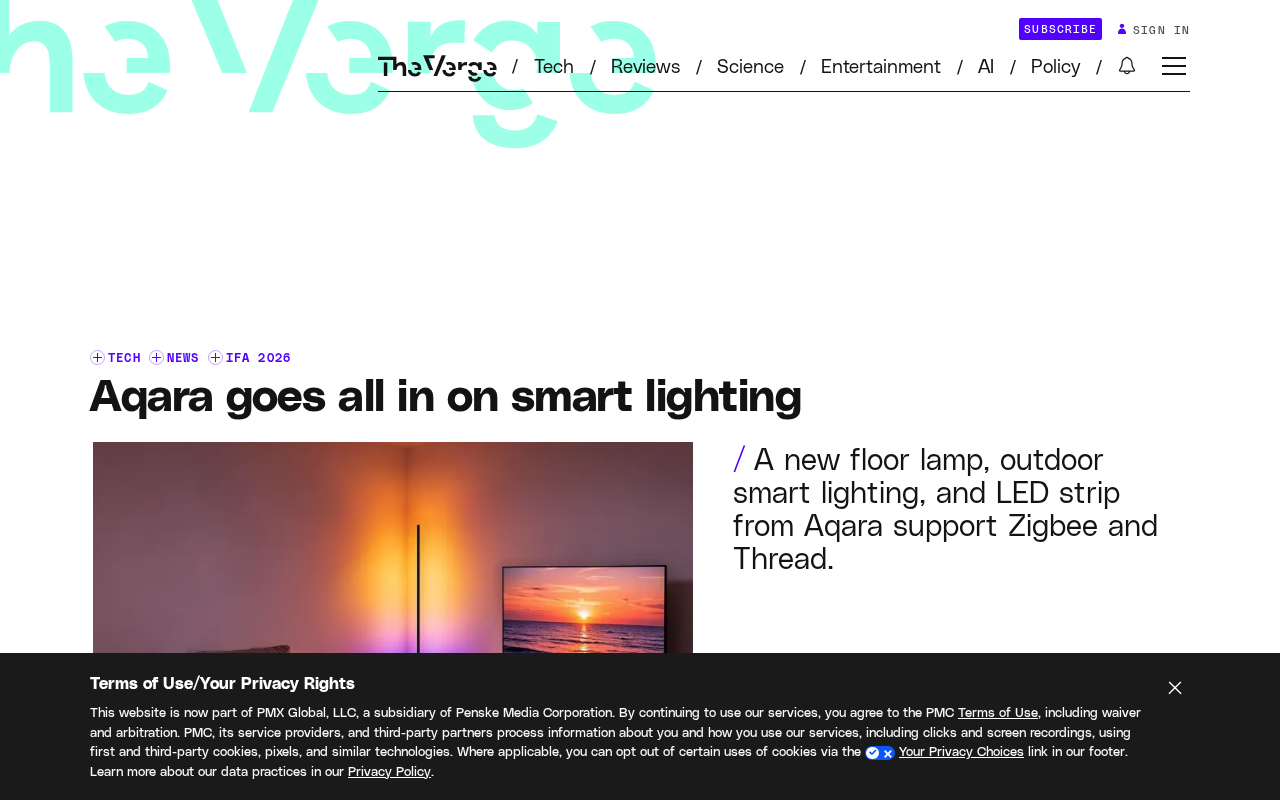
Aqara launches a dual-protocol smart lighting line at IFA, headlined by the minimalist Floor Lamp T1.
At IFA, Aqara unveiled a full smart lighting product line supporting both Zigbee and Thread protocols, highlighted by the Floor Lamp T1's innovative LED column design. This dual-protocol strategy positions Aqara for the Matter-driven future while maintaining backward compatibility. Combined with its deep ecosystem of sensors and automation, Aqara aims to differentiate itself from established lighting brands like Philips Hue.
Aqara's New Smart Lighting Strategy
After showcasing several industry-first smart home products at CES, Aqara unveiled a brand-new smart lighting product line at the IFA trade show. This time, Aqara's core strategy is crystal clear — go all-in on the smart lighting market while supporting both Zigbee and Thread, two of the most prominent wireless protocols.
This move carries significant weight. In recent years, the smart home industry has seen relentless competition around connectivity protocols, and simultaneous compatibility with both Zigbee and Thread signals Aqara's intent to secure a stronger position in a fragmented protocol landscape, offering users across different ecosystems greater flexibility.
The Technical Background of Zigbee and Thread
To understand the deeper implications of Aqara's dual-protocol strategy, it helps to know the technical foundations of these two protocols. Zigbee is a low-power wireless communication protocol based on the IEEE 802.15.4 standard. Since its release in 2004, it has accumulated over 20 years of deployment history in the smart home space, with hundreds of millions of devices deployed worldwide. It uses a mesh network topology, where devices can relay signals to one another, thereby extending network coverage. Thread is also based on the IEEE 802.15.4 standard but employs an IPv6 network layer protocol, giving each device its own independent IP address — a design that naturally aligns with internet communication architectures. Thread was developed by the Thread Group, backed by tech giants including Google, Apple, and Samsung. Its self-healing mesh network capabilities and low-latency characteristics have made it one of the preferred underlying transport protocols for the Matter smart home unified standard. Although both protocols share the same physical-layer wireless technology, they differ significantly at the network and application layers. Supporting both simultaneously requires dedicated dual-mode design in both hardware RF modules and software protocol stacks.
Floor Lamp T1: Redefining the Floor Lamp Form Factor
Among the newly launched products, the Floor Lamp T1 is the undeniable star. Unlike traditional floor lamps, this product abandons the conventional shade design in favor of an LED light strip column mounted on a base.
This minimalist column design is not only more visually modern but also serves as a superior medium for ambient lighting and colorful light effects. The LED column form creates a continuous, uniform light strip effect, making it ideal for users seeking personalized home ambiance. This type of design is becoming increasingly common in smart lighting products, reflecting a broader evolution of smart luminaires from purely functional lighting toward emotional and atmospheric experiences.
The Technical and Aesthetic Evolution of LED Strip Column Design
The column-style light strip design used in the Floor Lamp T1 is the product of years of LED strip technology maturation. Modern LED strips typically use high-density SMD (Surface-Mount Device) packaging, such as SMD 2835 or SMD 5050 chips, achieving densities of 60 to 144 LEDs per meter on ultra-narrow flexible circuit boards. Combined with diffusion lenses or softening films, they produce continuous, uniform illumination with no visible light spots. Tunable CCT (Correlated Color Temperature) technology enables stepless adjustment between 2700K warm white and 6500K cool white, while RGBIC (Independently Controllable RGB) technology allows each segment of the strip to display different colors, enabling flowing, gradient, and other dynamic lighting effects. These technological advances have shifted lighting product design from the traditional "light source + shade" paradigm toward a new approach where the light source itself becomes a design element. The minimalist design philosophy of Danish brands and the indirect lighting aesthetics of Japanese design have profoundly influenced this trend, driving lighting products to evolve from functional tools into spatial atmosphere art pieces.
The Practical Value of Dual Zigbee and Thread Protocol Support
The Floor Lamp T1, along with the other new products announced at the event, supports both Zigbee and Thread protocols. For users, this means seamless integration with existing smart home systems regardless of which protocol they're built on.
Thread, as a key underlying protocol behind the Matter standard, is becoming the future direction of smart home interoperability, while Zigbee boasts a massive installed base of mature devices. Supporting both allows Aqara's products to strike an excellent balance between compatibility and future-proof scalability.
The Industry Significance of the Matter Standard
Speaking of the relationship between Thread and Matter, it's worth understanding Matter's far-reaching impact on the smart home industry as a whole. Matter (originally named Project CHIP, or Connected Home over IP) is a unified smart home interoperability standard developed under the leadership of the Connectivity Standards Alliance (formerly the Zigbee Alliance). Version 1.0 was officially released in October 2022, aiming to solve the ecosystem fragmentation problem that has long plagued the smart home industry — previously, users had to verify whether a smart device was compatible with their specific platform, be it Amazon Alexa, Google Home, Apple HomeKit, or Samsung SmartThings. Matter addresses this by defining a unified application-layer protocol that enables cross-platform interoperability among all devices supporting the standard. Matter supports Wi-Fi, Thread, and Ethernet as underlying transport protocols, with Thread being particularly well-suited for battery-powered sensors and small control devices due to its low power consumption and mesh networking capabilities. As of 2024, Matter has iterated to version 1.3, adding support for device types such as energy management and EV charging, with the ecosystem expanding at an accelerating pace. Aqara's dual-protocol strategy is precisely a forward-looking move to prepare for the widespread adoption of this standard.
From CES to IFA: Aqara's Product Launch Cadence
Aqara's decision to make consecutive splashes at two of the world's premier tech trade shows is noteworthy. At CES earlier in the year, Aqara showcased several industry-first smart home products, while at IFA, the focus shifted to a large-scale rollout within the specific category of lighting.
The Different Strategic Value of CES and IFA
Understanding this launch cadence requires recognizing the distinct industry positioning of each event. CES (Consumer Electronics Show) takes place every January in Las Vegas, USA. It is one of the world's largest consumer technology trade shows, typically attracting over 100,000 visitors and more than 4,000 exhibitors, and is widely regarded as the annual barometer for the global tech industry. IFA (Internationale Funkausstellung Berlin), held every September in Berlin, Germany, was founded in 1924 and is Europe's most influential consumer electronics and home appliance trade show. The two events have different emphases: CES leans more toward cutting-edge technology demonstrations and proof-of-concept showcases, where companies often unveil their most innovative prototypes and technological breakthroughs; IFA is more closely aligned with mature markets and the consumer end, where companies typically present complete product lines that are ready for mass production or already available for purchase. Aqara's strategy of presenting breakthrough technologies at CES and rolling out scalable product lines at IFA makes precise use of the different audiences and communication rhythms of both events.
This cadence reflects a clear product strategy from Aqara: first establish a technology-forward brand image through innovative products, then cover specific use cases with a comprehensive product line. Smart lighting, as one of the most frequently used and immediately perceptible categories in the smart home space, has become a critical entry point for Aqara to expand its market share.
Smart Lighting Market Competitive Landscape
Aqara's full-scale bet on smart lighting also reflects a heating-up competitive landscape across the industry. Brands like Philips Hue, Nanoleaf, and IKEA have been deeply entrenched in this space for years. Aqara's differentiating advantages lie in its consistent value-for-money approach and the ecosystem synergy capabilities it has built through its extensive portfolio of sensors, controllers, and other smart home accessories.
A Deep Dive into Aqara's Ecosystem Synergy Strategy
Aqara (Lumi United Technology) was founded in 2009 and initially entered the smart home market as part of the Xiaomi ecosystem, focusing on infrastructure-type products such as sensors, controllers, and gateways. Its product line spans dozens of categories including human presence sensors (based on millimeter-wave radar technology), door/window sensors, temperature and humidity sensors, smart wall switches, and wireless buttons, forming a complete ecosystem covering security, environmental monitoring, lighting control, and other scenarios. One of Aqara's core competitive advantages is its proprietary Aqara Home app and automation engine, which supports complex conditional triggers and scene linkages — for example, "when the presence sensor detects someone entering the room and the ambient light falls below a certain threshold, automatically set the floor lamp to warm white at 50% brightness." This deep hardware-software integration allows Aqara's lighting products to transcend the definition of a single light source, becoming intelligent nodes within a holistic smart home automation system. By comparison, while Philips Hue leads in lighting quality and color performance, it falls short of Aqara in the breadth of its sensor and automation ecosystem.
By deeply integrating its lighting products with its own sensors, gateways, and automation systems, Aqara has the opportunity to deliver a more complete and intelligent lighting experience. For instance, scenario-based features like automatic lights triggered by presence sensors or intelligent brightness adjustment based on ambient light sensors represent unique competitive moats that Aqara holds over pure-play lighting brands.
Conclusion: The Strategic Significance of Aqara's Smart Lighting Play
Aqara's showcase at IFA marks a further step in its transformation from a smart home accessories maker into a full-scenario smart home brand. The new generation of lighting products, represented by the Floor Lamp T1, demonstrates Aqara's clear ambitions in the smart lighting arena through innovative form factor design and dual Zigbee/Thread protocol support.
As the Matter ecosystem continues to mature, products that support multiple protocols will undoubtedly command stronger competitive advantages. For users who are building or upgrading their smart home systems, Aqara's new offerings are well worth keeping an eye on.
Related articles
Qwen3 Next Flash Hands-On Review: An In-Depth Evaluation of the Qwen4 Architecture Preview Model
In-depth review of Alibaba's Qwen3 Next Flash preview model covering pixel-level visual replication, C++ 3D game generation, Blender+Godot tool invocation, and analysis of its Ngram embedding MoE architecture and local 4-bit quantized performance.
Alibaba's Qwen3.8-Max-0902 Tops Code Arena Leaderboard
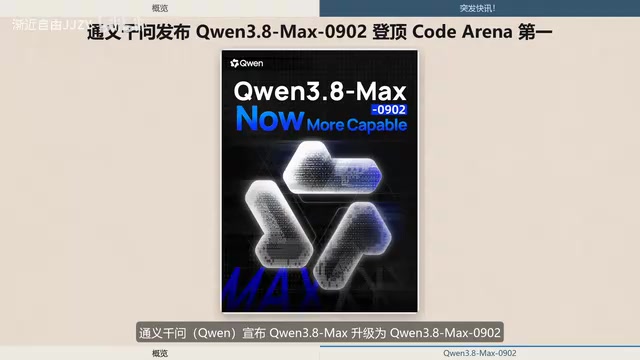
Alibaba's Qwen3.8-Max-0902 tops Code Arena with 1691 points, featuring a 2.4T MoE architecture, 128K context, surpassing Claude Opus 3.5 in coding and cost-efficiency.
Qwen3 27B Open-Sourced: A Multimodal Agent Model That Runs on a Single GPU
Alibaba open-sources Qwen3 27B dense multimodal model with image/video understanding and GUI control. 4-bit quantized needs only 17GB VRAM. Apache 2.0 licensed.