Arcade Controller Pro: A Leverless Fighting Controller with a Built-in Screen
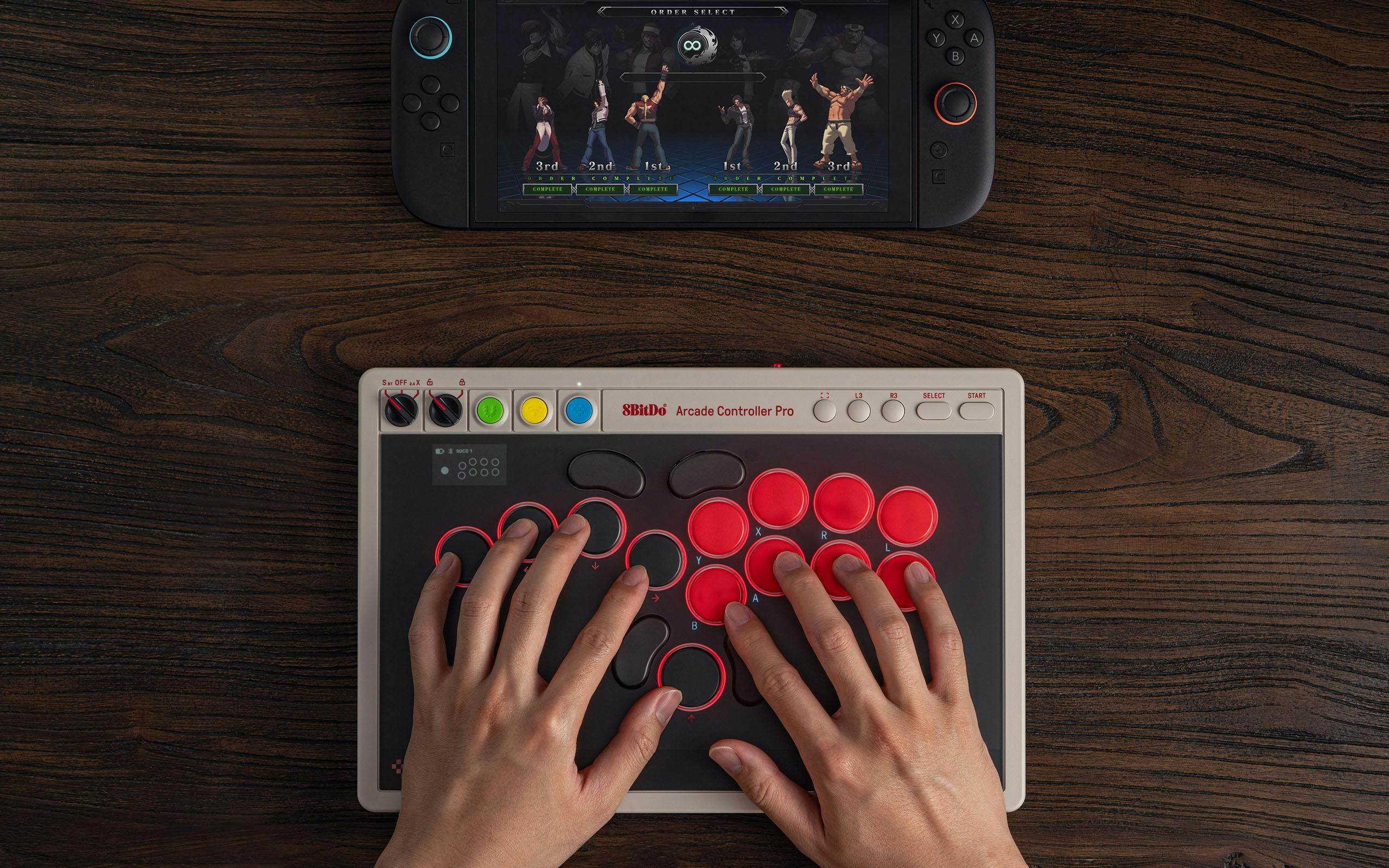
Arcade Controller Pro enters the fighting controller market with a leverless all-button layout, built-in screen, and hot-swappable switches.
Arcade Controller Pro is a fighting game controller that debuted on Product Hunt, featuring a leverless all-button layout that replaces the traditional lever with buttons to reduce directional input travel and misinputs. Its main selling points are a built-in display (presumably for button mappings, profiles, or input status), hot-swappable switches that allow solder-free switch changes, and a detachable magnetic wrist rest. The product targets the crossover between hardcore fighting game players and custom keyboard enthusiasts, emphasizing compact portability and personalized tuning. It received 87 votes on Product Hunt and ranked 10th for the day—above-average interest, but the impact of the screen and hot-swap structure on input latency and durability remains unsupported by data, and final performance depends on pricing, build quality, and actual reviews.
The fighting game controller market has long been dominated by arcade sticks and gamepads, but in recent years the all-button layout has gained traction among hardcore players. Arcade Controller Pro debuted on Product Hunt, featuring a leverless design along with customization elements such as a built-in screen and hot-swappable switches, aiming to strike a balance between a compact form factor and professional-grade feel.
Design Philosophy: Drop the Lever, Keep the Precision
Traditional fighting controllers rely on a lever to input directions, whereas Arcade Controller Pro adopts an all-button layout that replaces the lever with buttons. In games like Street Fighter and Tekken that demand fast, precise directional inputs, this design reduces the delay caused by lever travel while lowering the chance of misinputs. The compact layout means tighter button spacing, suiting players with smaller hands or those who need quick sliding inputs.
The leverless design is not an entirely new concept, but Arcade Controller Pro combines it deeply with customization—the hot-swappable switches let players swap mechanical switches without soldering to adjust feel and actuation force. For fighting game players chasing a personalized feel, this significantly lowers the barrier to maintenance and tuning.
All-button layout (also known as hitbox layout) is a form factor for fighting game controllers, first popularized by the Hit Box brand and thus often simply called "hitbox" by players. It replaces the lever with four directional buttons (up, down, left, right), each mapped to an independent microswitch or mechanical switch. Because the travel of a finger pressing a button is far shorter than the physical swing of a lever, directional inputs can trigger faster; meanwhile, left and right are operated by different fingers, eliminating the transition time a lever needs to pass through neutral when flicking from one side to the other, giving a clear edge in scenarios like Street Fighter's quick back-dash blocking and charge moves. Another characteristic of the all-button layout is the "SOCD" (simultaneous opposite cardinal direction) issue: when left and right are pressed at the same time, the firmware must handle it according to specific rules (such as canceling out, taking the last input, or prioritizing one direction), and tournament rules vary on this requirement—a compatibility detail worth noting when buying this type of controller.
Fighting games are far more sensitive to input latency than ordinary games: pro players often measure inputs in "frames," and at 60 frames per second, 1 frame equals roughly 16.7 milliseconds. Therefore, the total latency from button actuation to recognition by the console—including switch response time, scan cycle, and firmware processing—directly affects combo consistency and punish success rate. Part of the reason all-button controllers are favored by hardcore players is precisely their short button travel and clear actuation point, which reduce the uncertainty introduced by a lever's mechanical structure. But latency is not determined by layout alone; the main control chip, USB polling rate, and firmware optimization are equally critical—which is why players pay special attention to measured latency data when evaluating a new controller.
Hardware Highlights: Screen and Hot-Swap
The built-in display is the controller's most eye-catching feature. Although the specific screen size and resolution have not been announced, it can be inferred that it displays button mapping configurations, the current profile, or input status. When quickly switching profiles during a match, the screen provides intuitive feedback and avoids blind operation.
Hot-swappable switches are another major selling point. Players can swap linear or tactile switches for different game types, or even mix different switches on the same controller. RGB lighting satisfies the demand for personalized looks—though it has no direct impact on competitive performance, it boosts recognizability in streaming and offline meetup scenarios.
The addition of a magnetic wrist rest takes long-session comfort into account. The wrist rest attaches magnetically, making it easy to install and remove as well as to carry. The overall compact layout plus the detachable wrist rest suggests the product has made trade-offs for portability.
Hot-swap socket refers to a socket pre-installed on the circuit board into which a mechanical switch's pins are inserted directly to make contact, with no soldering required. Traditionally, changing switches on a keyboard or controller requires a soldering iron and desoldering pump—a high barrier to entry that easily damages the pads; hot-swap sockets let players pull and plug switches by hand, completing feel adjustments or single-switch replacements in minutes. The trade-off is that the socket structure slightly increases the PCB thickness, and the plug-in lifespan typically ranges from dozens to a hundred cycles, so it's worth checking whether the pins are bent when swapping frequently. For fighting controllers, hot-swap also means that when a directional button wears out or starts double-clicking, it can be replaced individually without sending the whole unit in for repair—especially practical for fighting game players who are picky about feel and put heavy wear on their buttons.
Market Positioning and Competition
Arcade Controller Pro received 87 votes and 1 comment on Product Hunt, ranking 10th for the day. That result is above average for hardware products, indicating a certain level of interest but not yet a breakout discussion. Its official website link points to the Product Hunt page, and information is currently limited.
In terms of positioning, it targets the crossover group between hardcore fighting game players and custom keyboard enthusiasts. Similar all-button controllers already exist on the market, but models integrating a screen and hot-swap are rare. If priced reasonably, it could attract players who want one device for multiple uses and don't want to solder to swap switches frequently.
However, the fighting controller market is extremely sensitive to latency and durability. Whether the built-in screen and hot-swap structure affect input latency and long-term reliability has no supporting data yet. When buying, players should still pay attention to actual reviews and feel feedback.
Summary
With its leverless all-button layout, built-in screen, and hot-swappable switches, Arcade Controller Pro brings an option focused on customization and portability to the fighting controller market. Whether it becomes a new choice for hardcore players depends on final pricing, build quality, and actual input performance. For players who enjoy tinkering with peripherals, this product is worth keeping an eye on.
Related articles

Agent Clan: Command Multiple AI Coding Assistants Simultaneously with Mid-Air Gestures
Agent Clan turns Claude Code and Codex agents into a 3D team on screen, supporting fist summoning, pinch selection, drag-to-approve permissions, and local gesture and voice processing, free on Mac and Windows.

Inkling 2 Small: A 594B MoE Model That Can "See" and Revise
Thinking Machines Lab releases Inkling 2 Small, a 594B-parameter MoE model activating only 17B, focused on long-horizon coding and visual tasks where it can see and refine its own output, with inference and fine-tuning via the Tinker platform.

Deduplication: How Tech 'Steals' Everyday Words
Deduplication uses Wikipedia pageview data to quantify 719 words redefined by tech across 14 domains, revealing which meaning wins. Free and open by HackerNoon.