ARCHER: Teaching Small Models Executable Reasoning

ARCHER compiles chain-of-thought into executable action traces and applies hierarchical RL to boost small models' math reasoning reliability.
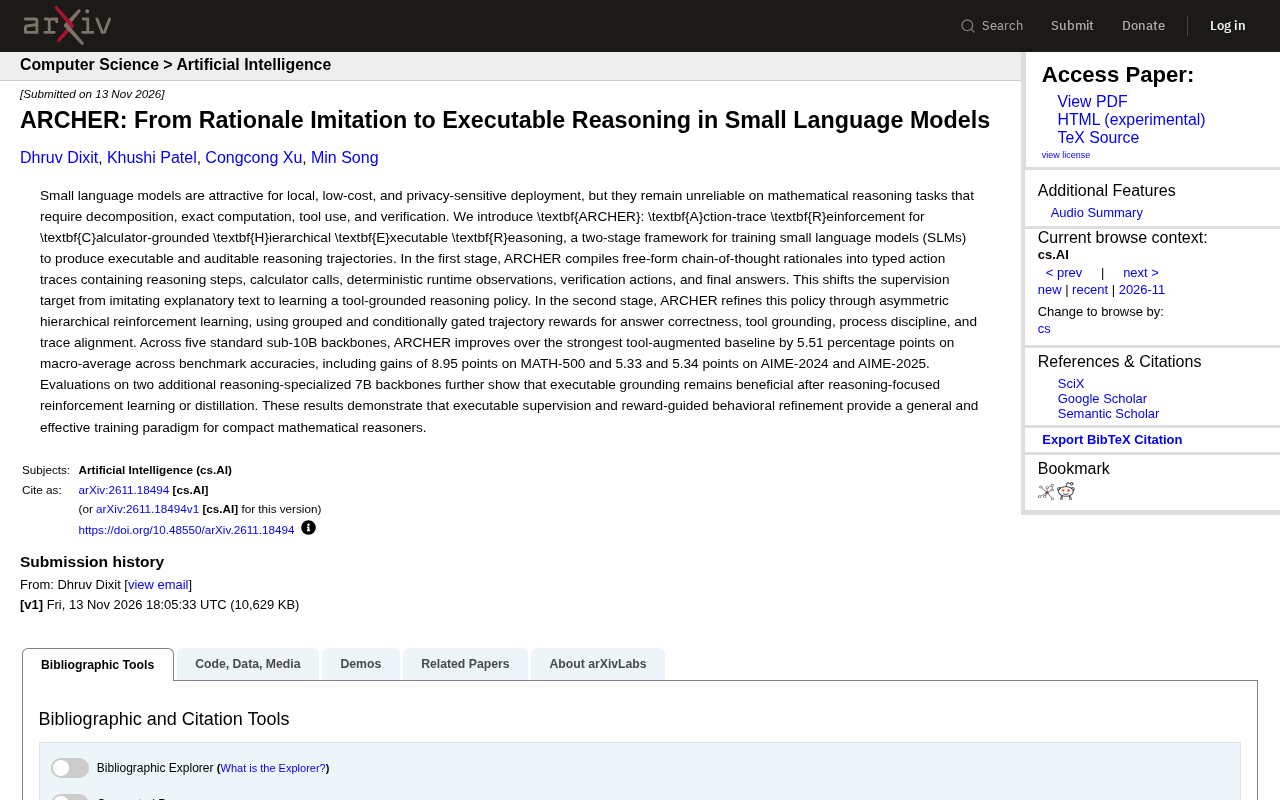
ARCHER is a two-stage training framework that addresses small language models' unreliable mathematical reasoning. Stage one compiles free-form chain-of-thought into typed action traces with reasoning steps, calculator calls, runtime observations, and verification actions, shifting supervision from text imitation to tool-grounded policy learning. Stage two uses asymmetric hierarchical RL with grouped, conditionally gated trace rewards to optimize answer correctness, tool grounding, process discipline, and trace alignment. On five sub-10B backbones, ARCHER improves macro-average accuracy by 5.51 points over the strongest tool-augmented baseline, including 8.95 points on MATH-500; executable grounding still helps reasoning-specialized 7B models after RL or distillation, showing generalizability for edge or privacy-sensitive deployment.
Small language models (SLMs) are highly attractive for local, low-cost, and privacy-sensitive scenarios, but they remain unreliable when faced with mathematical reasoning tasks that require decomposition, precise calculation, tool invocation, and verification. Traditional methods have models imitate free-form chain-of-thought text, yet they struggle to guarantee that the reasoning process is truly executable and auditable. To address this, researchers propose ARCHER (Action-trace Reinforcement for Calculator-grounded Hierarchical Executable Reasoning), a two-stage training framework designed to elevate small models' reasoning capabilities from "imitating explanations" to "executing strategies."
From Text Imitation to Action Traces: Stage-One Compilation
The core of ARCHER's first stage is compiling free-form chain-of-thought rationales into typed action traces. These traces include reasoning steps, calculator calls, deterministic runtime observations, verification actions, and final answers. In this way, the supervision target shifts from "imitating explanatory text" to "learning a tool-grounded reasoning policy." Models no longer merely generate plausible step descriptions; they learn when to call a calculator, how to read runtime results, and when to perform verification. This lays an executable, auditable foundation for subsequent reinforcement learning.
Typed action traces refer to abstracting each step in the reasoning process into an action with an explicit type (e.g., "calculate," "verify," "query") and recording its inputs, outputs, and runtime state. Unlike free text, typed traces are structured and machine-parsable, so they can be directly executed or checked by an execution engine. This representation makes the supervision signal focus not only on "what is said" but also on "what is done" and "what the result of doing it is," thereby providing a verifiable reward basis for reinforcement learning.
Asymmetric Hierarchical Reinforcement Learning: Stage-Two Refinement
The second stage employs asymmetric hierarchical reinforcement learning to refine the policy. Specifically, the framework uses grouped and conditionally gated trace rewards that comprehensively assess answer correctness, tool grounding, process discipline, and trace alignment. This reward design drives the model to pursue final-answer accuracy while also attending to whether the reasoning process is disciplined, whether tool use is appropriate, and whether action traces align with expectations. The asymmetric hierarchical structure means that reward signals at different levels affect policy updates in different ways, thereby guiding model behavior more finely.
In asymmetric hierarchical reinforcement learning, "asymmetric" typically means that reward signals at different levels (e.g., step level vs. trace level) differ in timescale, weight, or propagation—for example, trace-level rewards are sparse but global, while step-level rewards are dense but local. "Hierarchical" means the policy or value function is organized into multiple levels of abstraction, with higher levels responsible for planning action sequences and lower levels responsible for concrete execution. This structure helps mitigate the sparse-reward problem and enables the model to maintain consistency over long-horizon reasoning.
Grouped and conditionally gated trace rewards mean the reward function is not a simple weighted sum but is gated based on the completion status or quality conditions of the trace—for example, the answer-correctness reward is activated only when tool calls succeed and the process is compliant. Grouping may process different reward dimensions (correctness, grounding, discipline, alignment) in groups and then dynamically adjust each group's contribution via a gating mechanism, preventing a single dimension from dominating optimization.
Experimental Results: Significant Gains Across Multiple Benchmarks
On five standard sub-10B-parameter backbone models, ARCHER improves the macro-average benchmark accuracy by 5.51 percentage points over the strongest tool-augmented baseline. Among these, it improves 8.95 percentage points on MATH-500 and 5.33 and 5.34 percentage points on AIME-2024 and AIME-2025, respectively. These results show that executable supervision and reward-guided behavior refinement can concretely improve small models' performance on complex mathematical reasoning.
Furthermore, evaluations on two additional reasoning-specialized 7B backbones further show that executable grounding remains beneficial even after reasoning-oriented reinforcement learning or distillation. This means the method's gains do not depend on a specific model architecture or training stage and exhibit good generalization.
Macro-average is an aggregation method commonly used in multi-task or multi-dataset evaluation: it first computes accuracy on each task/dataset and then takes the arithmetic mean of these accuracies without considering differences in sample sizes across tasks. Compared with micro-average, macro-average gives each task equal weight and better reflects balanced performance across different difficulties and distributions, making it especially suitable for scenarios with imbalanced sample sizes across benchmarks.
Significance and Outlook
The value of ARCHER lies in providing a general and effective training paradigm: by transforming the reasoning process into executable action traces and refining the policy with hierarchical reinforcement learning, small models can achieve more reliable and auditable performance on mathematical reasoning tasks. This method points the way for scenarios that require deploying reasoning capabilities on edge devices or in privacy-sensitive environments. In the future, how to extend similar ideas to more domains that require tool invocation is worth further exploration.
Executable grounding means that the model's reasoning steps must be actually executable by external tools (such as calculators or interpreters), and the execution results must be consistent with the model's internal representations. This differs from merely using tools as post-hoc verification; instead, it requires the model to plan with executability as a precondition when generating reasoning. This grounding mechanism reduces reasoning that is "plausible-looking but non-runnable" and improves the credibility and auditability of small models on precise tasks such as mathematics.
One-line Summary
ARCHER compiles chain-of-thought into executable action traces and applies hierarchical reinforcement learning to significantly improve small models' mathematical reasoning reliability.
Paragraph Summary
ARCHER is a two-stage training framework designed to address the insufficient reliability of small language models in mathematical reasoning. The first stage compiles free-form chain-of-thought into typed action traces containing reasoning steps, calculator calls, runtime observations, and verification actions, shifting the supervision target from text imitation to tool-grounded policy learning. The second stage employs asymmetric hierarchical reinforcement learning, using grouped and conditionally gated trace rewards to comprehensively optimize answer correctness, tool grounding, process discipline, and trace alignment. On five sub-10B backbone models, ARCHER improves macro-average accuracy by 5.51 percentage points over the strongest tool-augmented baseline, with an 8.95 percentage point gain on MATH-500; on two reasoning-specialized 7B models, executable grounding still yields gains after reinforcement learning or distillation, indicating the method's generalizability. This work provides a new paradigm for deploying reliable reasoning capabilities in small models for edge or privacy-sensitive scenarios.
Related articles

ChatGPT Plus Subscription Pitfall Guide: Go/Plus/Pro Tier Comparison and Quick Activation
A complete ChatGPT Plus subscription guide based on a Bilibili tutorial: from registering an account, comparing Go/Plus/Pro tiers, to the practical steps for quickly completing your subscription.

GPT-6.2 Sol/Astra Released! A Step-by-Step ChatGPT Plus Subscription Guide and Tier Comparison
GPT-6.2 Sol/Astra is out—here's a ChatGPT Plus subscription guide: register an account, compare Go/Plus/Pro tiers, and subscribe in a minute.

Comparing Three Channels for Subscribing to GPT Plus in China: Is Website Top-Up the Easiest?
How to subscribe to GPT Plus in China? This article compares website top-up, credit card, and mobile top-up channels—process, cost, and risk—with steps and tips to help you choose wisely.