ArchSpace: Using Scaling Laws to Predict Large Model Architectures and End Blind Training

ArchSpace builds a cumulative LLM architecture knowledge base via record, review, and reference.
ArchSpace is a public platform for large model architecture research, addressing industry's lack of failure records and academia's compute-limited difficulty verifying scale effects. It centers on record, review, and reference: proposals include experiments and reasoning, are community-reviewed, and are cited by later work. Using scaling laws, it extrapolates large-scale loss from small experiments. Reviewed proposals become baselines, and Qwen3.5/OLMo3 baselines, fitted scaling laws, and reusable recipes are provided. Its impact depends on community participation but bridges industry and academia.
Large model architecture determines scaling behavior, training efficiency, and inference cost, making it a core issue of shared interest for both industry and academia. However, while industry teams such as DeepSeek, Qwen, and Kimi frequently introduce architectural innovations, public reports rarely document which ideas succeeded, which were abandoned, and why; academia, constrained by compute and inconsistent baselines, can often only perform small-scale, single-point comparisons and struggles to judge whether an improvement will hold at larger scales. ArchSpace, as a public platform, attempts to make architecture research cumulative and verifiable through three stages: "record, review, and reference."
The Dual Gaps Between Industry and Academia
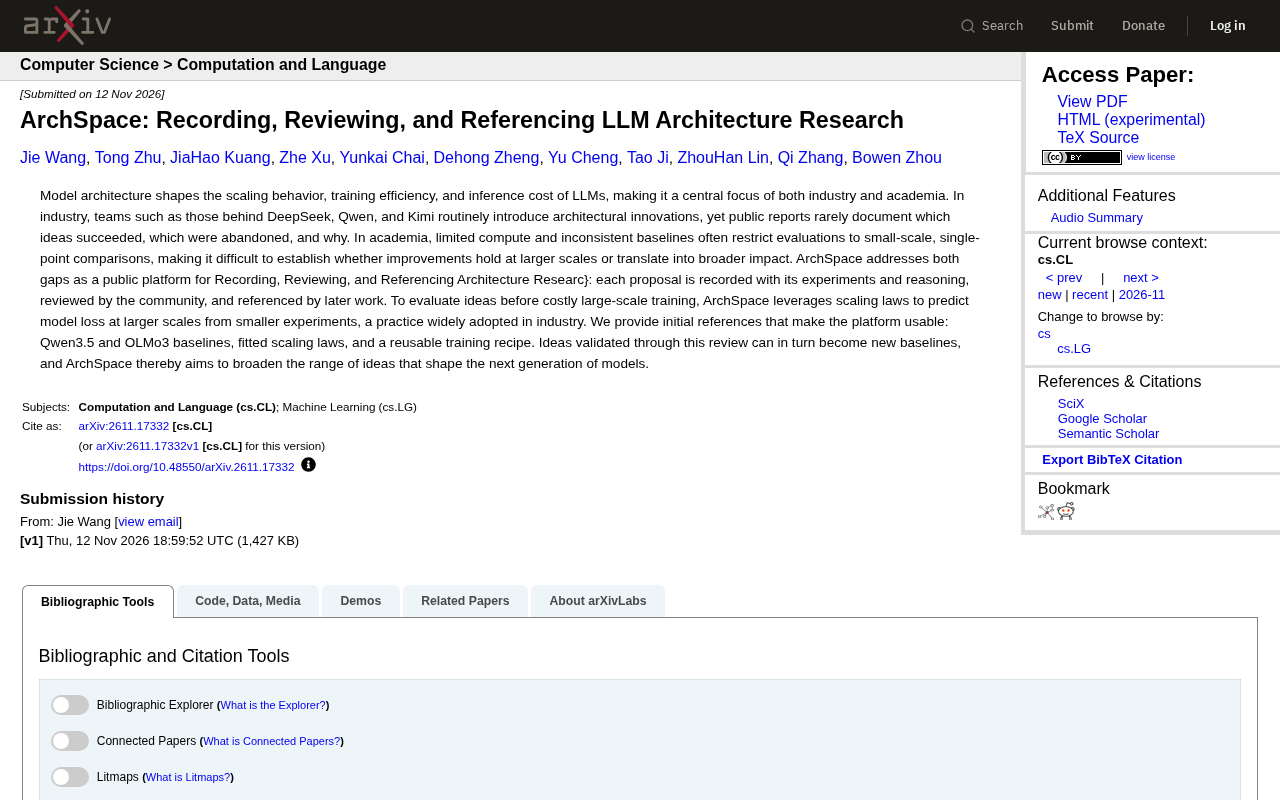
Industry explores large model architectures extensively, but public information often shows only the final successful solutions; failure paths and decision rationales are rarely recorded. This makes it easy for newcomers to repeat mistakes and impossible to learn from others' failures. Academia faces another problem: limited compute usually allows only small-scale, single-point comparisons, and whether an architectural improvement remains effective at larger scales is often hard to verify. ArchSpace's starting point is precisely to fill these two gaps—it requires every architecture proposal to include experiments and reasoning, be reviewed by the community, and ultimately be cited by subsequent work.
Using Scaling Laws to Predict Large Model Performance in Advance
ArchSpace's core method is to use scaling laws to predict model loss at larger scales from small-scale experiments, thereby evaluating ideas before committing to expensive large-scale training. This approach is already widely adopted in industry, but academia, due to resource and tool limitations, uses it less systematically. ArchSpace platformizes this practice, allowing researchers to infer how an architecture will perform at larger scales based on small-scale experiments and fitted scaling laws. This reduces validation costs and brings academic architecture research closer to the actual decision-making scenarios of industry.
Scaling laws refer to the power-law relationship between model loss and parameter count, data volume, and compute, typically expressed in forms such as L(N) = a·N^(-α) + b, where N is the scale variable, a and b are constants, and α is the power exponent. OpenAI's 2020 research on neural language model scaling and DeepMind's Chinchilla work both systematically validated this regularity: under a fixed compute budget, there is an optimal ratio between model parameter count and training token count, and loss decreases smoothly as scale increases. For architecture research, the value of scaling laws lies in extrapolation—after fitting a curve with multiple small-scale training points, one can predict the loss of the same architecture at larger parameter or data scales, thereby screening out poorly performing designs before expensive large-scale training. Note that scaling laws are usually fitted for a family of architectures; when comparing across architectures, conditions such as data distribution, training recipe, and tokenizer must be kept consistent, otherwise extrapolated conclusions may be distorted.
Record, Review, and Reference: Building a Cumulative Architecture Knowledge Base
ArchSpace's design revolves around three actions: Recording, Reviewing, and Referencing. Each architecture proposal must record its experimental setup, results, and reasoning process; community members can review it; and subsequent work can cite these records. In this way, ideas verified as effective can become new baselines for others to continue improving. The platform also provides initial references, including Qwen3.5 and OLMo3 baselines, fitted scaling laws, and reusable training recipes, so new users can get started quickly.
Qwen3.5 and OLMo3 are two representative open-source baselines. The Qwen series, continuously iterated by Alibaba's Tongyi Qianwen team, typically discloses key designs such as model scale, data mix, attention, and MoE structure in its technical reports, making it an important reference for industrial architecture decisions. The OLMo series, led by the Allen Institute for AI, emphasizes full openness—not only open weights but also public training data, training code, and intermediate checkpoints, enabling researchers to reproduce and conduct controlled architecture comparisons on this basis. Incorporating these two types of baselines into the platform provides both industrial-grade and academic-friendly references, and also allows architecture proposals from different sources to be compared in the same coordinate system, reducing conclusion bias caused by inconsistent baselines. Reusable training recipes further lower the reproduction barrier and make small-scale experiment results more comparable.
From Single-Point Experiments to Reusable Baselines
ArchSpace's goal is not just to collect ideas but to make reviewed architecture proposals become new baselines. In traditional research, baselines are often fixed, making improvements hard to compare horizontally; on ArchSpace, community-validated architectures can be upgraded to baselines, and subsequent research can continue on this basis. This mechanism helps form a positive cycle: more ideas are recorded and reviewed, more effective solutions become baselines, and more researchers are attracted to work on them. The platform hopes in this way to broaden the range of architectural ideas influencing next-generation models, so that more valuable explorations are seen and reused.
In machine learning research, a baseline is a reference system for measuring whether a new method is effective, usually including a fixed model structure, training hyperparameters, data processing pipeline, and evaluation protocol. Once the baseline changes, numbers across papers cannot be directly compared, which is one of the main reasons architecture research is hard to accumulate. By upgrading community-reviewed architectures to baselines, ArchSpace essentially establishes a versioned public reference: new proposals must be compared with the current baseline under the same experimental conditions, and reviewers can trace how the baseline evolved from earlier proposals. This is similar to the main branch and continuous integration in software engineering—each merged improvement becomes the starting point for subsequent development rather than a one-off experiment. The challenge is that maintaining baselines is costly, requiring training recipes, evaluation scripts, and scaling-law fitting methods to be updated in sync with the baseline.
Potential Impact on Architecture Research
ArchSpace's emergence reflects a trend: large model architecture research is moving from "single-point innovation" to "systematic accumulation." By recording failures and successes, using scaling laws to reduce validation costs, and establishing citable baselines, the platform is expected to make architecture research more transparent and efficient. Of course, the platform's effectiveness depends on community participation—only if enough researchers are willing to record and review can the knowledge base truly work. But regardless, ArchSpace builds a bridge between industry and academia, so that architectural innovation is no longer limited to the internal experience of a few teams.
One-line Summary
ArchSpace builds a cumulative LLM architecture knowledge base through three stages: record, review, and reference.
Paragraph Summary
ArchSpace is a public platform for large model architecture research, aimed at filling the dual gaps of industry's lack of failure records in architectural innovation and academia's difficulty verifying scale effects due to limited compute. The platform is designed around three actions: record, review, and reference: each architecture proposal must include experimental setup, results, and reasoning, be reviewed by the community, and be cited by subsequent work. Its core method is to use scaling laws to extrapolate model loss at larger scales from small-scale experiments, thereby evaluating ideas before expensive training. Reviewed proposals can be upgraded to new baselines, forming a positive cycle. The platform also provides Qwen3.5 and OLMo3 baselines, fitted scaling laws, and reusable training recipes as initial references. Its effectiveness depends on community participation, but it builds a bridge for architecture knowledge accumulation between industry and academia.
Related articles

ChatGPT Plus Subscription Pitfall Guide: Go/Plus/Pro Tier Comparison and Quick Activation
A complete ChatGPT Plus subscription guide based on a Bilibili tutorial: from registering an account, comparing Go/Plus/Pro tiers, to the practical steps for quickly completing your subscription.

GPT-6.2 Sol/Astra Released! A Step-by-Step ChatGPT Plus Subscription Guide and Tier Comparison
GPT-6.2 Sol/Astra is out—here's a ChatGPT Plus subscription guide: register an account, compare Go/Plus/Pro tiers, and subscribe in a minute.

Comparing Three Channels for Subscribing to GPT Plus in China: Is Website Top-Up the Easiest?
How to subscribe to GPT Plus in China? This article compares website top-up, credit card, and mobile top-up channels—process, cost, and risk—with steps and tips to help you choose wisely.