Are AI Agents Actually Making You More Productive? A Soul-Searching Question from Reddit

AI Agents make you faster — but faster isn't the same as making real progress.
A Reddit post comparing AI Agents to speeding through traffic sparked a deeper reflection on whether these tools deliver real value. AI Agents excel at compressing individual steps in a task chain, but when the true bottleneck is understanding, decision-making, or collaboration, raw execution speed just shifts the wait to the next stage. Worse, speed can mask a wrong direction — moving faster toward the wrong goal. The article identifies this as a psychological trap of substituting busyness for genuine accomplishment, and argues the real question isn't how much an Agent helps you do, but whether it brings you closer to where you actually want to go.
Speed vs. Direction: A Question We Keep Ignoring
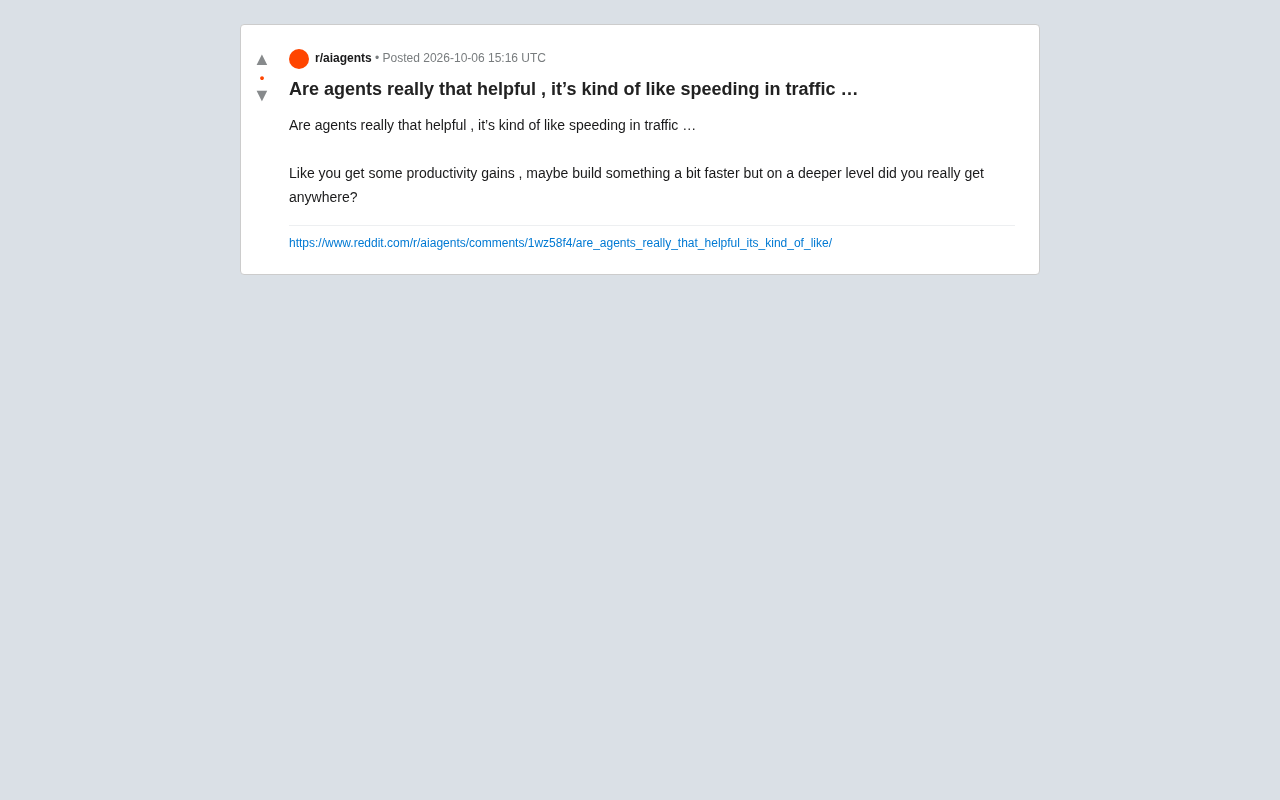
A recent Reddit post sparked considerable discussion with a thought-provoking analogy: is using an AI Agent kind of like speeding through traffic?
"You do get some productivity gains, maybe build things faster, but on a deeper level — are you actually getting anywhere?"
This analogy cuts straight to a blind spot that's easy to overlook in today's AI Agent hype: we constantly equate "faster" with "more valuable," but rarely stop to ask where that speed is actually taking us.
Speeding through traffic might win you a few car lengths at the next red light — but when the light turns red again, you're back at the same starting line as everyone else. Applied to AI Agents, this analogy points to something genuinely worth thinking hard about.
The Real Limits of Productivity Gains
The core promise of AI Agents is the ability to autonomously complete chains of tasks: write code, research topics, organize documents, automate workflows. On the surface, they clearly compress the time spent on repetitive work.
But the Reddit poster's challenge is this: does local acceleration translate into overall progress?
Several real-world tensions are at play here.
Only the Middle Steps Are Getting Faster
Most of the time, AI Agents optimize one segment of a task chain. They can help you generate code quickly — but the code review, debugging, integration, and coordination with your team don't disappear. When the bottleneck isn't "production" but "understanding" and "decision-making," even the fastest generation speed just shifts the waiting to the next stage.
Speed Can Mask the Wrong Direction
The real danger of speeding is that if you're heading the wrong way, you just reach the wrong destination faster. AI Agents appear to lower the cost of trial and error — but they may also cause people to skip the critical step of pausing to ask, "What problem am I actually trying to solve?" Rapidly producing a pile of half-finished outputs isn't necessarily more valuable than slowing down to think clearly about one real problem.
This phenomenon is known in productivity research as the Local Optimization Trap: when one part of a system is dramatically sped up, overall throughput doesn't necessarily increase proportionally — it may simply make other bottlenecks more visible. The Theory of Constraints, developed in manufacturing back in the 1980s, established that a system's output is capped by its weakest link, not its average speed. Applied to knowledge work: if a project's real bottleneck is stakeholder alignment or ambiguous requirements, making code generation ten times faster just means the "waiting for feedback" bottleneck surfaces earlier and more frequently. In this context, an AI Agent is less like a turbocharger and more like a high-powered engine installed in a car with failing brakes — plenty of horsepower, but overall system performance is still constrained by everything that hasn't been optimized.
Why This Analogy Deserves to Be Taken Seriously
The reason this post resonated is that it touches on a universal psychological trap in how we use tools: substituting the feeling of being busy for the feeling of actual accomplishment.
When an AI Agent lets you process more tasks per hour, your brain naturally produces a sense of "I'm being productive." But that satisfaction can be an illusion — just like the feeling of control that comes from speeding, without actually closing the distance to your destination.
The questions worth asking:
- Of all the tasks being accelerated, how many actually matter?
- Is the time you're saving going toward higher-value thinking, or is it just being filled with new low-value tasks?
- Does what the Agent is helping you "build faster" point toward a goal you've actually thought through?
Psychological research on Action Bias offers a useful framework here: faced with uncertainty, humans naturally prefer taking action over waiting, because action itself generates a sense of control and progress — even when that action isn't optimal. AI Agents' instant responsiveness directly feeds and amplifies this bias. They make "continuous action" nearly effortless, making it easy to fall into the cognitive trap of measuring your own value by task completion count. Behavioral economists call this the Fluency Effect: when something feels smooth and fast, the brain automatically interprets "easy" as "correct" or "valuable." This means the better an AI Agent gets, the more its users need to actively build external checkpoints — regularly asking: are the things I'm breezing through actually worth doing at all?
The Tool Is Neutral: The Problem Isn't the Agent Itself
To be clear, none of this is a rejection of AI Agents' value — it's a reflection on how we use them.
Speeding isn't inherently bad; maintaining an appropriate speed on a highway is necessary. The problem is pursuing speed in the wrong context, with the wrong mindset. Likewise, AI Agents deliver genuine efficiency gains when goals are clear and task boundaries are well-defined. But if you're using them as a shortcut to avoid deep thinking, then even the most powerful tool will just help you spin your wheels faster.
The real measure of whether an AI Agent is "actually useful" isn't how much it helps you do — it's whether it brings you closer to where you actually want to go.
A Note for Users
This brief Reddit discussion offers a reminder to everyone embracing AI tools:
Set your direction before you talk about speed. Taking time to think clearly about your goal before handing a task to an Agent will often do more for the quality of your output than chasing execution speed ever will.
Watch out for fake productivity. Learn to distinguish between "did a lot of things" and "accomplished something important" — don't let a tool's efficiency become an excuse to avoid the decisions that actually matter.
Put the time you save to work on things that count. The real value of AI Agents may not be helping you do more, but freeing you from mechanical labor so you can focus on the deep thinking and creative work that machines can't replace.
At the end of the day, technology gives us the accelerator. But the person holding the steering wheel — deciding where to go — is always us.
Related articles

Workbuddy for Absolute Beginners: How a Desktop AI Agent Fits Into Real Workflows
A beginner's guide to the Workbuddy desktop AI agent: installation, claiming credits, file management, and building automated workflows—compared with CodeX for fit and cost, helping professionals shift from AI question-askers to AI managers.

OpenAI's New Agent Stack: Computer Use, Decisions API, and Ultra-Fast Workflows
OpenAI Dev Day unveiled a new agent stack: Computer Use outperforms humans, Decisions API delivers ultra-low-latency classification via Luna, Agents API opens the same Computer Use capabilities, and GPT-6.1 Sol costs only one-seventh of Astra. Core updates, benchmark data, and developer insights.

Liang Wenfeng Open-Sources DeepInfo Inference Framework, Takes On U.S. Ban
DeepSeek open-sources its DeepInfo inference framework after its models, featuring GPU/CPU cross-pipelining, small-model prediction with large-model verification, and full Huawei Ascend and NVIDIA chip support—facing the U.S. federal ban head-on. This article analyzes its significance for AI deployment and open-source strategy.