Are AI Aggregation Platforms Reliable? The Truth and Risks Behind One-Stop Access to Multiple LLMs

AI aggregation platforms promise free multi-LLM access, but hide real costs, privacy risks, and compliance issues.
AI aggregation platforms claim to offer free, unlimited access to top LLMs like GPT, Claude, and Gemini through a single interface. This article examines the hidden costs behind these promises, including questionable model quality, data privacy concerns from man-in-the-middle architectures, and regulatory gray areas. It recommends safer alternatives such as compliant domestic models, official free tiers, local open-source deployment, and legitimate API routing services.
The Phenomenon: Why AI Aggregation Platforms Are So Popular
As global competition among AI large language models enters a fierce stage, users in China face a real dilemma — there are more and more excellent LLMs on the market, but the barriers to registering for and switching between them keep getting higher. Gemini, GPT, Claude, Grok, Kimi, DeepSeek… each has unique strengths, yet they're scattered across different platforms.
Recently, platforms like Bilibili have seen a flood of content recommending "AI aggregation sites," claiming users can access multiple top-tier LLMs — including Gemini Pro, GPT, Claude, and Grok — through a single entry point at zero cost, without switching network environments, and with full-featured, unrestricted access.

The core selling point of these platforms is clear: lower the barrier to entry and aggregate multi-model capabilities. From a user needs perspective, this genuinely hits a pain point — but there are also quite a few issues that deserve rational scrutiny.
What AI Aggregation Platforms Typically Offer
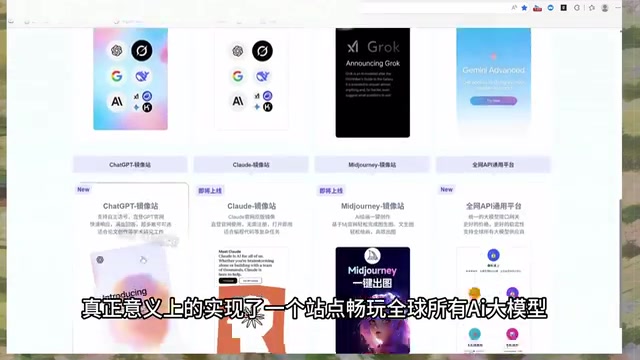
Based on related video demonstrations, these sites generally share the following characteristics:
Unified Multi-Model Access
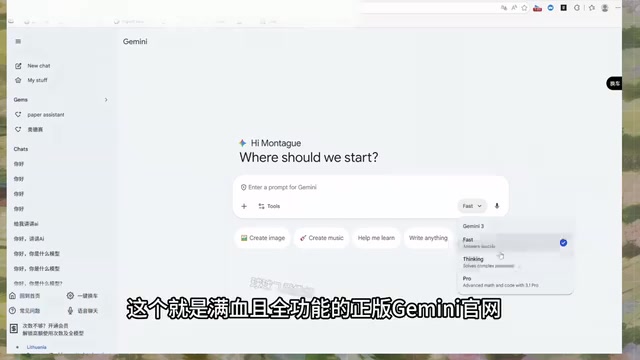
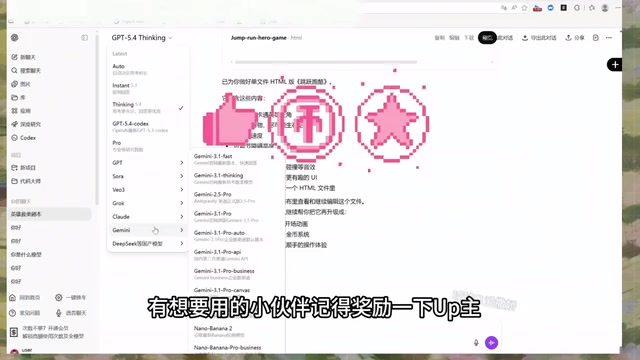
Users don't need to visit each LLM's official website separately. Within a single site, they can switch between models like Gemini, GPT, and Grok. Some platforms even offer the latest released model versions, such as the Gemini Pro series.
Free Usage Strategy
Most aggregation platforms use "free unlimited access" as their main draw. For models that normally require paid subscriptions (like GPT-4 or Claude Pro), this holds considerable appeal.
Bundled Prompt Resources
Some platforms also provide prompt packs optimized for different models, including specialized prompt templates for DeepSeek, Grok, GPT, and others, helping users get more out of each model. Prompt engineering has become a critical skill for using LLMs effectively — different models interpret instructions differently, and targeted prompt optimization can significantly improve output quality. For example, Claude excels at handling long texts and structured analysis tasks, while GPT stands out in creative writing. Prompt templates designed around each model's strengths can genuinely help users achieve better results.
The Costs and Potential Risks of Free AI Aggregation Platforms
Before enjoying the convenience, users should rationally assess several key issues:
The "Full-Power" Claims Are Questionable
LLM API calls have inherent costs. Take GPT-4 as an example — the input cost per million tokens is in the range of several US dollars. Here's a quick explanation of "tokens": a token is the basic unit that large language models use to process text — think of it as the smallest fragment the model "reads" and "writes." In English, one token corresponds to roughly 4 characters or 0.75 words; in Chinese, a single character is typically encoded as 1–2 tokens. Different models use different tokenizers (e.g., the GPT series uses the BPE algorithm), so the same text may result in different token counts across models.
Looking at specific API pricing: OpenAI's GPT-4o costs $2.50 per million input tokens and $10 per million output tokens; Anthropic's Claude 3.5 Sonnet costs $3 per million input tokens and $15 for output; Google's Gemini Pro series offers a certain free quota, but charges per usage beyond that. An average user conducting 10–20 rounds of in-depth conversation per day could incur monthly API costs of tens of dollars. If a platform claims to provide free unlimited calls for a large user base, its monthly API costs alone could reach tens or even hundreds of thousands of dollars.
Therefore, the business model sustainability of a platform claiming "free unlimited" access to full-power models is highly questionable. Common possibilities include: using downgraded versions (e.g., substituting GPT-3.5 or lower-parameter models for GPT-4), imposing hidden usage limits (such as rate limiting or restricting context length), or monetizing through other means (such as ads or data).
Data Privacy and Security Concerns
When using LLMs through third-party platforms, your conversation content actually passes through an intermediary layer. This means all the information you input — including content that may involve personal privacy or trade secrets — could potentially be accessed and stored by the third party. From a technical architecture perspective, these aggregation platforms typically act as a proxy layer between users and the LLM APIs, with all request and response data passing through their servers. Even if a platform claims it doesn't store user data, users have no way to verify the truthfulness of that promise. In the field of cybersecurity, this architecture is known as a "Man-in-the-Middle" pattern, which inherently creates data leakage risk points. For sensitive use cases, using official channels directly is always the safer choice.
Regulatory Gray Areas
Although related videos emphasize "accessing through legal and compliant channels," some overseas models (like Claude) have not officially launched services in China. According to the "Interim Measures for the Management of Generative AI Services" that took effect in August 2023, companies providing generative AI services to the public within China must complete algorithm registration. As of 2025, domestic models such as DeepSeek, Kimi, Tongyi Qianwen (Qwen), ERNIE Bot, and Doubao have all completed registration and are officially operating, while overseas models like Claude and ChatGPT have not officially provided services in mainland China nor completed the relevant registrations.
The actual technical implementation of these aggregation platforms — whether they make compliant calls through official APIs or use other methods — is difficult for users to verify. Using non-compliant services not only carries legal risks but also faces the uncertainty of service being interrupted at any time.
Safer and More Reliable Alternatives
If you genuinely need to use multiple LLMs, here are some more reliable approaches:
-
Domestically compliant models: Domestic models like DeepSeek, Kimi (Moonshot AI), Tongyi Qianwen, and ERNIE Bot have developed considerable capabilities and are fully compliant — they should be your first choice. In fact, domestic models have already reached world-class levels in Chinese language understanding, code generation, mathematical reasoning, and other dimensions. DeepSeek-R1's performance on multiple benchmarks is comparable to GPT-4o, fully capable of meeting the vast majority of use cases.
-
Official free tiers: Google Gemini, OpenAI, and others offer certain free usage quotas that you can access by registering through official channels. For example, Google Gemini provides quite generous call quotas for free users, sufficient for everyday exploration and light usage needs.
-
Local deployment of open-source models: Open-source models like Llama and Qwen can be run locally using tools like Ollama, giving you complete control over data security. Ollama is currently one of the most popular tools for running models locally — it simplifies model downloading, configuration, and execution to just a few command-line instructions, supporting Mac, Linux, and Windows. As for hardware requirements, running 7B (7 billion parameter) models typically requires 8GB+ of VRAM or 16GB+ of RAM; running 70B models requires professional-grade GPUs. Besides Ollama, LM Studio offers a graphical interface that's more suitable for non-technical users. The biggest advantage of local deployment is that data never leaves your machine, making it ideal for scenarios involving sensitive information.
-
Legitimate API aggregation services: Transparent API routing services like OpenRouter offer pay-per-use pricing with a clear business model. Services like OpenRouter sign formal API partnership agreements with multiple LLM providers, obtain legitimate access rights, and then offer users a unified API interface format (typically compatible with OpenAI's API specification). Users only need to integrate with one API and can call different providers' models by switching model parameters. Their business model typically involves adding a service fee on top of the original API price. Users can clearly see the model version, token consumption, and cost breakdown for each call — a stark contrast to opaque "free aggregation platforms."
Conclusion: A Rational View of AI Aggregation Platforms
The emergence of AI aggregation platforms reflects genuine market demand — users want low-barrier access to experience and compare different LLMs' capabilities. But promises of "zero cost, full power, no limits" often don't hold up under scrutiny. When choosing AI tools, users should prioritize official channels and compliant platforms, maintain a cautious attitude toward third-party aggregation services, and exercise particular care when important data is involved.
Technological progress should make AI more accessible, but convenience shouldn't come at the expense of security and compliance. Rather than chasing the shortcut of "all-in-one aggregation," it's better to deeply master one or two models that suit your needs — that's the more sustainable approach to using AI. In an era where LLM capabilities are rapidly converging, which model you choose matters far less than learning how to use models effectively — clear requirement definition, precise prompt design, and sensible workflow integration are the factors that truly determine how well AI works for you.
Related articles
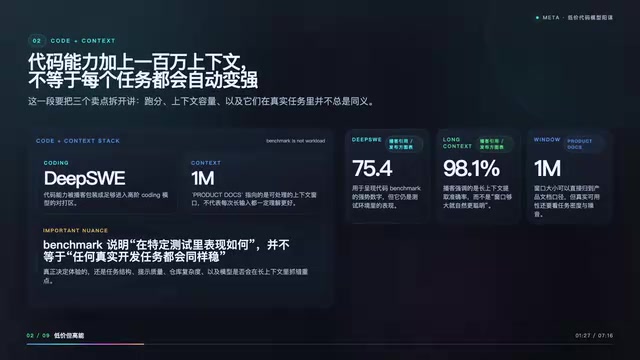
Meta Muse Spark 1.3 In-Depth Review: The Truth Behind Top-Tier Coding Capability and Ultra-Low Pricing
In-depth analysis of Meta Muse Spark 1.3's coding capabilities, million-token context, ultra-low pricing strategy, and data exchange logic. Covers performance benchmarks, technical architecture, use case recommendations, and privacy risk warnings to help developers rationally evaluate this AI programming model.
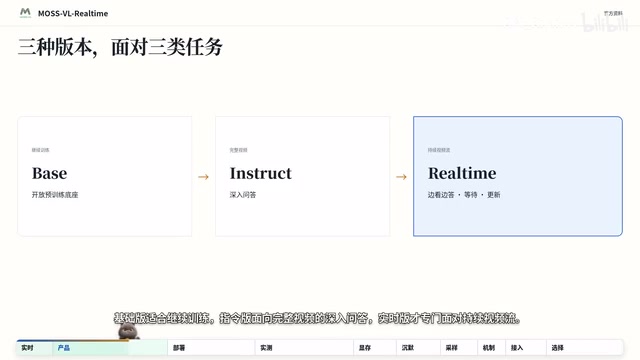
MOSS-VL-Realtime Hands-On: 11B-Parameter Real-Time Video Understanding on Consumer GPUs
MOSS Intelligence's MOSS-VL-Realtime model hands-on: 11B open-weight parameters supporting watch-while-answering, active silence, and dynamic updates. Successfully deployed locally on dual RTX 4070Ti Super with ~13.3GB memory usage. 256K context with 1fps sampling suits real-time scenarios like live monitoring and experimental observation.
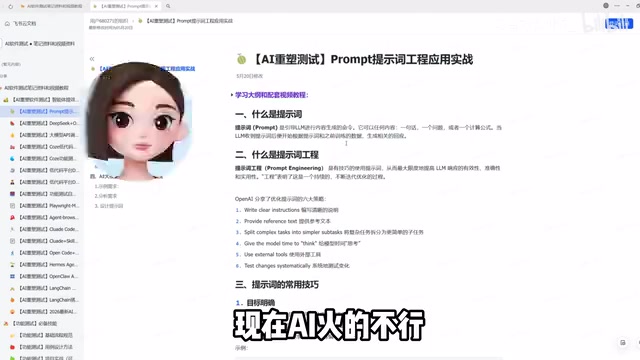
AI Test Automation Learning Roadmap: A Complete Guide from Beginner to Expert
Complete AI test automation learning roadmap covering foundation building, AI testing-specific skills, and toolchain practice. Master data quality testing, model performance testing, adversarial testing, and more to achieve rapid career transformation.