Are AI-Generated Learning Roadmaps Reliable? A Beginner's Guide to Verification and Use

A practical guide to verifying and properly using AI-generated learning roadmaps as a beginner.
AI-generated learning roadmaps offer structured starting points for overwhelmed beginners, but come with risks like hallucinated resources, outdated recommendations, and lack of practice orientation. This guide explains how to verify AI roadmaps through cross-referencing, community validation, and focusing on framework over details, while offering practical advice on project-based learning and building feedback loops.
Introduction: When Beginners Turn to AI for Learning Roadmaps
I recently came across a highly representative post on Reddit: a complete beginner with zero background didn't know where to start learning, so they simply asked Claude to create a learning roadmap for them, then returned to the community asking: "Is this roadmap reliable? Are the recommended learning resources valid?"
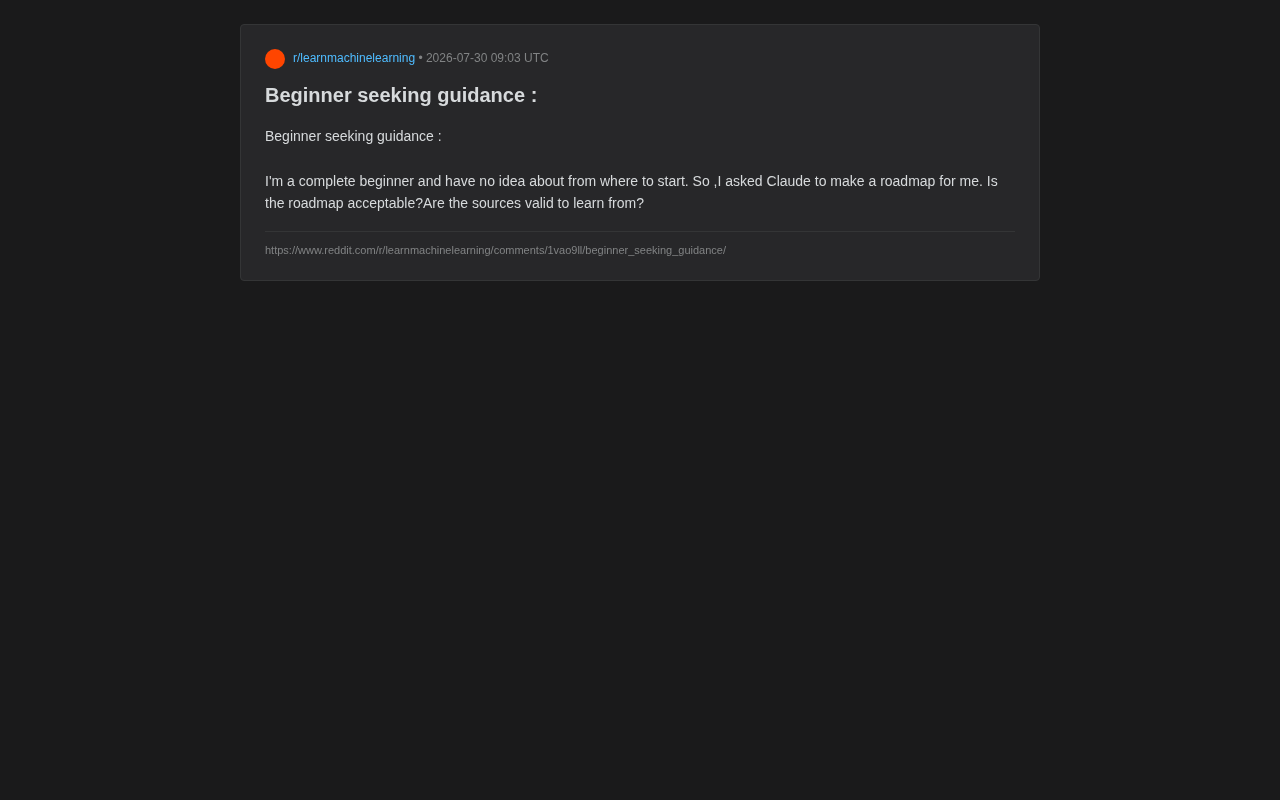
This scenario is extremely common. In an era where AI tools are readily accessible, more and more beginners first ask large language models for learning plans, then bring the results back to communities for human "secondary validation." This raises several questions worth exploring in depth: Are AI-generated learning roadmaps actually trustworthy? How should we evaluate them? And for someone starting from zero, what's truly the most effective way to begin?
Advantages and Limitations of AI-Generated Learning Roadmaps
Why Using AI to Plan Your Learning Path Is a Reasonable Starting Point
Indeed, having models like Claude or ChatGPT generate learning roadmaps has its merits. Large language models have "read" massive amounts of tutorials, course syllabi, and technical blogs, enabling them to quickly produce a structured knowledge framework—from foundational concepts to advanced topics—that is typically well-organized and logically clear.
From a technical standpoint, large language models (LLMs) like Claude and ChatGPT are trained on the Transformer architecture, processing trillions of tokens of text data during pre-training, covering technical documentation, textbooks, forum discussions, course outlines, and more. This makes them excellent at knowledge organization and structured output—essentially compressing and reorganizing the vast educational content available on the internet. When you ask a model to generate a learning roadmap, it's leveraging internally learned patterns of curriculum design and knowledge dependency graphs to construct a seemingly reasonable learning sequence.
For beginners overwhelmed by information overload and unsure where to start, this at least provides a "scaffold" they can act on. Psychologist Barry Schwartz proposed in The Paradox of Choice that too many options actually lead to decision paralysis and decreased satisfaction. This theory perfectly explains why zero-background learners feel overwhelmed when facing the ocean of online learning resources. The internet offers tens of thousands of free and paid resources for AI/programming learning—Coursera, Udemy, Fast.ai, YouTube tutorials, GitHub projects, technical blogs—each claiming to be the "best path." In this information-overloaded environment, an AI-generated structured roadmap acts as a "decision simplifier," compressing infinite options into one executable linear path.
Another benefit is immediacy and personalization. You can tell AI your background, available time, and learning goals, and it will adjust recommendations accordingly. This interactive experience far surpasses searching blindly through search engines.
Three Major Pitfalls to Watch Out For
However, this Reddit user's cautious approach deserves praise—they didn't blindly trust the output but chose to verify it with the community. This highlights the core risks of AI-generated learning roadmaps:
First, the resource "hallucination" problem. Large models sometimes recommend books, courses, or links that don't actually exist, or misattribute authors, versions, or URLs. For beginners, it's very difficult to distinguish which resources are real and effective versus which ones the model has "fabricated."
The root cause lies in how LLMs work: they fundamentally perform probabilistic text generation, predicting the next most likely token sequence, rather than retrieving verified information from a curated knowledge base. When asked to recommend specific books or course links, the model may "synthesize" a plausible-sounding but nonexistent resource based on patterns in its training data. The industry is addressing hallucination through methods like RAG (Retrieval-Augmented Generation, where the model retrieves from external knowledge bases before answering) and factuality alignment training, but the problem hasn't been fully solved. For beginners, the most practical strategy is to independently verify every specific recommendation.
Second, temporal lag. AI training data has a cutoff date, and the "latest" frameworks or courses it recommends may already be outdated. All large language models have a knowledge cutoff date—the last point in time their training data covers. In the AI/ML field, technology iterates extremely rapidly—taking 2023-2024 as an example, the explosion from GPT-4 to open-source models, the proliferation of RAG architectures, and the rise of multimodal models all happened in quick succession. A learning roadmap generated from older data might completely miss these critical developments or even recommend tools and methodologies already abandoned by the community. In the fast-moving AI field, a resource list from just six months ago can significantly lag behind current best practices.
Third, lack of practice orientation. AI-generated roadmaps tend to emphasize knowledge listing, easily becoming a "theory checklist" while neglecting the hands-on projects and feedback loops that beginners need most. This shares the same flaw as traditional textbook-style teaching—comprehensive in knowledge points but lacking the practical bridges that convert theory into capability.
How to Verify the Reliability of an AI Learning Roadmap
When faced with an AI-generated learning roadmap, rather than agonizing over whether it's "right or wrong," it's better to establish your own verification methodology:
Cross-Reference Resource Authenticity
For every specific resource mentioned in the roadmap—whether it's a course, book, or documentation—you should independently search to confirm it actually exists and has a good reputation. Look up real reviews on Reddit, Hacker News, or similar communities, rather than accepting the AI's claim that something is a "classic textbook" at face value. A practical tip is to add keywords like "review" or "worth learning" to your searches to quickly find genuine user feedback.
Use Community Consensus for Secondary Calibration
This Reddit user's approach is itself a best practice: taking AI's output to a real human community for verification. Experienced practitioners can immediately spot whether a roadmap is reasonable, has obvious gaps, or contains outdated content. Recommendations that reach consensus across multiple independent sources are far more credible than a single AI output. This "triangulation" method has long been proven in research methodology to effectively improve the reliability of conclusions.
Focus on Framework Structure Rather Than Specific Details
A more mature approach is to treat AI learning roadmaps as "framework references" rather than "standard answers." They help you clarify roughly which modules to learn and in what order, while the specific resources for each module should be filled in through community verification and your own judgment. In other words, AI excels at answering "what to learn" and "in what order," but questions like "what to learn with" and "to what depth" still require human judgment to supplement.
Practical Advice for Zero-Background Learners
Start Hands-On First, Then Fill in Theory
A common mistake among beginners is wanting to "systematically complete all the fundamentals before starting a project," which often leads to endless theoretical study with no visible results. A more effective approach is to start a small project as early as possible, letting real problem-solving drive your learning in reverse.
This method has solid pedagogical theory behind it. Project-Based Learning (PBL) stems from constructivist learning theory, which holds that knowledge isn't passively received but actively constructed by learners through interaction with their environment. Cognitive science research also shows that knowledge learned in meaningful contexts has stronger transfer capability and longer retention than concepts memorized in isolation. Specifically in programming and AI, the famous Fast.ai course adopts a "top-down" teaching approach—first letting students run complete deep learning models and see actual results, then gradually diving into underlying mathematical principles and implementation details. This stands in stark contrast to the traditional "math first, code later" route and has been confirmed by numerous learners to be far more efficient.
An AI roadmap can tell you what knowledge you need, but true mastery comes from hands-on practice.
Build Feedback Loops
The biggest enemy of learning is working in isolation. Joining relevant communities (such as corresponding subreddits, Discord groups), regularly sharing your progress, and seeking feedback is far more efficient than burying yourself in solitary study. This Reddit user's proactive community question is itself an act of building such a feedback loop.
From a learning science perspective, feedback loops matter because they help learners correct misunderstandings, identify knowledge blind spots, and maintain motivation. Research shows that social learning (observing others, discussion, and exchange) can significantly accelerate skill acquisition, which is why hackathons, study groups, and open-source communities play an increasingly important role in technical education.
Treat AI as a Learning Partner, Not the Sole Authority
The healthiest mindset is: AI is an always-available learning partner with broad knowledge but occasional errors. You can use it to explain concepts, generate exercises, and plan directions, but the final judgment and verification responsibility remain in your own hands. Learning to "trust but verify" is one of the most important meta-skills of the AI era.
Specifically in learning scenarios, the best ways to use an AI learning partner include: having it explain error messages you don't understand, asking it to create targeted practice problems for you, requesting it explain a complex concept from a different angle, and having it review your code with improvement suggestions. However, note that when AI's explanations contradict information you've obtained from other authoritative sources, you should prioritize verified resources (such as official documentation, classic textbooks, and renowned courses) over AI's immediate responses.
Conclusion
This Reddit beginner's question, seemingly simple, reflects a core proposition of the AI-assisted learning era: When accessing information becomes extremely easy, the ability to evaluate information becomes even more precious. There's nothing wrong with having AI create a learning roadmap—it's even worth encouraging—but unconditionally treating its output as truth is dangerous.
Truly smart learners treat AI as a starting point rather than an endpoint—using it to quickly build a framework, then polishing, verifying, and refining it through community consensus and hands-on practice. For any beginner just stepping into AI or technology, this is perhaps a more valuable first lesson than any perfect roadmap. In this era of increasingly close human-machine collaboration, mastering how to effectively leverage AI tools while maintaining independent judgment is itself a core competency—and this humble beginner seeking verification on Reddit has already unknowingly taken the right first step.
Related articles

LaraCopilot: The Paradigm Leap from AI Copilot to Autonomous Engineer
LaraCopilot positions itself as an agentic AI engineer that generates full production-ready apps from natural language, covering frontend, backend, database, auth, and APIs—with no vendor lock-in.

AI Generates Lions vs. T-Rex Battle: Cross-Species Combat Estimation and Image Generation Capabilities Analyzed
A Reddit user asked AI how many lions could defeat a T-Rex—the answer: 35-45 male lions. This article analyzes generative AI's real capabilities and limitations in quantitative reasoning and visual creation.

Surging Demand for Qwen3-Max Cloud Deployment: Analyzing Ollama Cloud Model Availability Trends
Analysis of developer demand for Qwen3-Max on Ollama Cloud, exploring trends in local-to-cloud inference tools and China's LLM globalization.