Are AI Giants Manufacturing Fear to Suppress Open-Source Models?

Major AI labs may be weaponizing safety panic to capture regulators and suppress open-source competition.
This article examines a sharp argument circulating on Reddit: that mainstream AI labs are deliberately amplifying AI threat narratives to push regulations that benefit themselves while harming open-source models. Closed-source commercial models rely on API subscriptions, while open-weight models structurally undermine that business moat — a root conflict of interest. Regulatory capture risk is especially acute in AI, since industry giants control the technical discourse and can design compliance standards as barriers favoring themselves. The article also cautions that not all safety appeals are manipulation; the key test is whether proposed regulations treat open-source and closed-source models equally and focus on verifiable harms rather than vague capability panic.
A Suspicion Worth Taking Seriously
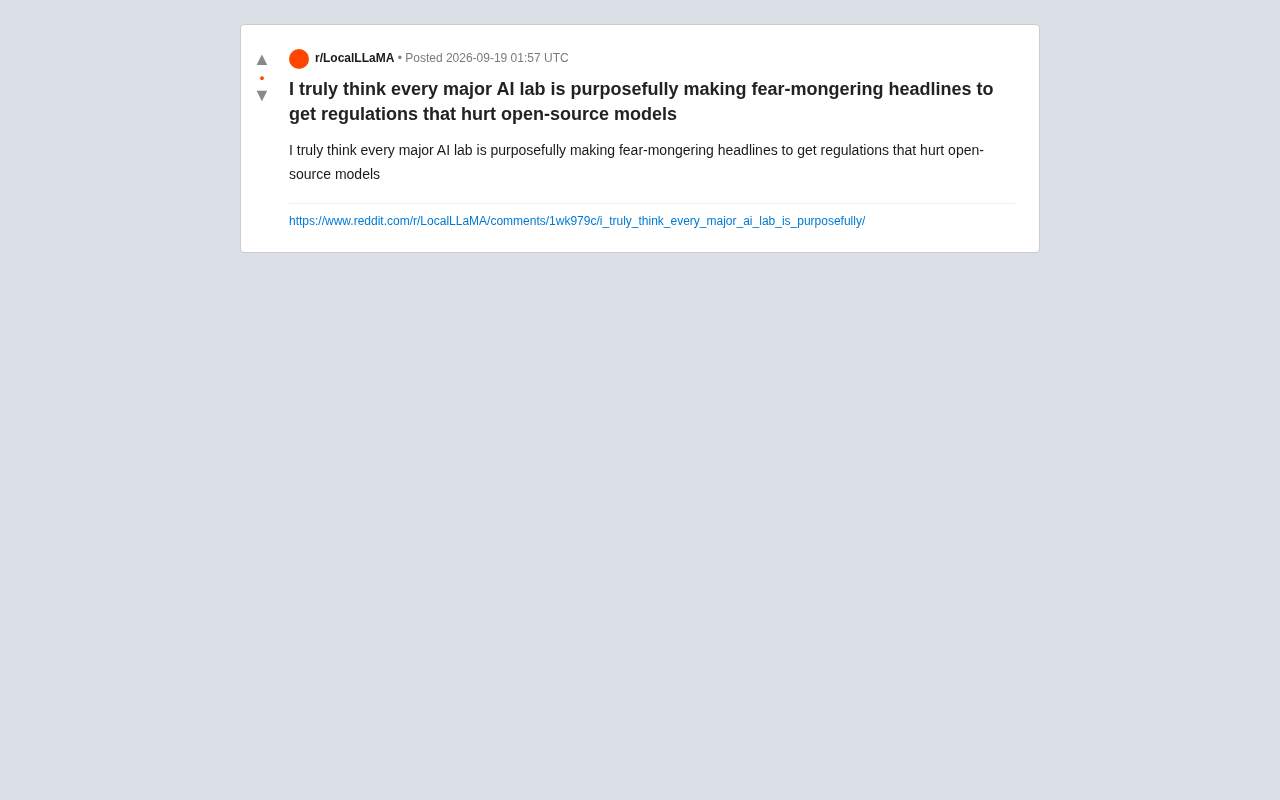
A sharp observation has been making the rounds on Reddit: nearly every major AI lab is deliberately generating "AI threat" panic headlines — not out of genuine safety concerns, but to push regulatory policies that would harm open-source models. While this claim carries a conspiratorial edge, it touches on a very real tension in the current AI competitive landscape: the risk of regulatory capture.
Regulatory capture refers to how industry giants shape legislation to create rules that favor themselves while disadvantaging competitors — especially open-source communities with limited resources. When a company calls for "AI to be strictly regulated because it's too dangerous," it typically already has the resources to meet those regulatory requirements, while small teams and open-source projects may be priced out by the cost of compliance.
The concept of regulatory capture was first systematically articulated by economist George Stigler in 1971. Its core mechanism: regulated industries, with their highly concentrated interests and strong organizational capacity, have far more motivation and resources to influence regulators than a diffuse public. Over time, regulations gradually tilt toward industry giants rather than protecting the public interest. In the AI space, this risk is especially acute — setting technical regulatory standards requires deep expertise, and the people who actually possess that expertise are disproportionately concentrated in a handful of top labs. When legislators must rely on industry experts for technical guidance, the power to define risk and design compliance standards quietly falls into the hands of those being regulated. Finance, pharmaceuticals, and telecommunications have all seen similar patterns.
The Business Logic Behind the Panic Narrative
Why would major AI labs have an incentive to amplify risk? The answer lies in competitive structure. Closed-source commercial models generate revenue through API licensing and enterprise subscriptions — and open-source models (freely downloadable, fine-tunable, locally deployable weight files) fundamentally undermine that moat. Once anyone can run a near-frontier model on their own servers, the case for paying to use a closed-source API weakens considerably.
In this context, the "AI poses existential risk" narrative serves a dual purpose: it casts the company as a "responsible industry leader" in the public eye, while simultaneously providing moral justification for restricting open distribution of models. If regulations require that any powerful model undergo licensing, auditing, or registration, open-weight release models will be the first to take the hit.
Two Kinds of Panic Worth Distinguishing
To be clear-headed about this: not every discussion of AI risk is manipulation. AI does involve genuine safety issues — from deepfakes and automated cyberattacks to amplified bias. The question is one of motivation: when risk narratives are selectively deployed to support "centralized control" rather than "transparency and accountability," it's worth asking whether commercial interests are being smuggled in.
There's an important but often overlooked distinction between open-weight models and fully open-source software. Open-weight means publicly releasing the trained model parameter files — users can download and run or fine-tune them locally, but training data and full training code aren't necessarily disclosed. "Fully open-source" typically also requires releasing datasets and the training pipeline. Meta's Llama series and Mistral AI's models are open-weight — anyone can download and deploy them on their own hardware for free, without paying API fees to the original developers. It's precisely this "download once, run locally forever" quality that makes open-weight models a structural threat to closed-source API business models: once enterprise customers have the capability to self-host, their motivation to pay for subscriptions drops sharply. This is why the commercial stakes around open-weight model regulation are so sensitive.
The Real Pressure Facing the Open-Source Community
The core fear among open-source advocates is that regulation may use "safety" as cover to achieve monopoly. Some proposed regulatory frameworks — for instance, imposing strict scrutiny on models trained above a certain compute threshold — appear to target "the most dangerous frontier models" but would in practice erect legal barriers to future open-source releases.
The open-source community's value proposition lies precisely in decentralization: it allows academics, startups, and individual developers to participate in frontier research and prevents AI capabilities from being monopolized by a handful of companies. If that participation channel closes due to compliance barriers, the direction of AI development will be shaped more by commercial interests than by the public good.
The "compute threshold" regulatory approach is exemplified by proposals like the U.S. Frontier Model Registration Act (FMRA), which typically uses floating-point operations (FLOPs) during training as the regulatory trigger — for instance, requiring mandatory reporting and auditing for training runs exceeding 10²⁶ FLOPs. Supporters argue this precisely targets genuinely "dangerous" frontier models; critics note that FLOPs thresholds are a blunt instrument. They can't reflect rapid improvements in algorithmic efficiency (capabilities that require 10²⁶ FLOPs today may be achievable with a tenth of that compute next year), nor can they distinguish between actual use cases. More critically, large commercial labs can absorb compliance costs as operating expenses — but individual researchers or small institutions in the open-source community who cross the threshold would face legal and administrative burdens they simply cannot bear, effectively creating an asymmetric barrier to entry.
How to Think Rationally About This Debate
The Reddit observation is a useful reminder to think critically — but we shouldn't slide to the other extreme and treat every safety appeal as a conspiracy. A more mature approach is to watch specific behaviors: Is a company that calls for regulation also accepting equivalent scrutiny of its own closed-source models? Are the rules it promotes increasing overall transparency, or specifically raising the bar for open distribution?
Truly healthy regulation should treat open-source and closed-source models equally, focusing on verifiable, concrete harms rather than vague "capability panic." For practitioners and users who care about AI's future, understanding this layer of commercial and policy gamesmanship matters far more than simply accepting or dismissing either side's talking points.
Conclusion
At its core, this community skepticism is asking a question about power: who gets to define AI safety? Whether or not the panic headlines reflect any coordinated intent, one clear fact remains: how regulation is designed will profoundly shape the survival of the open-source ecosystem. Staying vigilant, demanding transparency, and insisting on fair treatment of both open-source and closed-source development may be the best response to this potential power play.
Related articles

JobRunner MCP Server: AI Agents Can Now Fix Failed Java Jobs
JobRunner launches an open-source MCP server enabling AI agents to view cluster status, diagnose failures, and recover Java jobs—incident response from any cloud coding environment or existing agent.

MLAI Digital Launches 9 Security Agents: MCP Server Safeguards the Full Lifecycle of Agentic AI
MLAI Digital launches Security MCP Server with nine built-in specialized security agents covering vulnerability discovery, attack simulation, prompt injection detection, API and infrastructure assessment, and accelerated remediation—embedding security validation across the full Agentic AI lifecycle from development to production.

Running Isaac Lab on H100 GPUs: Exploring Better Approaches
Exploring optimization methods for running Isaac Lab on NVIDIA H100 GPUs, including MIG configuration, mixed precision, TensorRT acceleration, and community experience to improve robotics simulation and reinforcement learning efficiency.