Are SWE-Bench Tests Too Strict? New Metric STCG Reveals Evaluation Bias and Leaderboard Distortion
New metric STCG uses dual LLM judges to quantify overspecified tests in SWE-bench, revealing systematic leaderboard distortion.
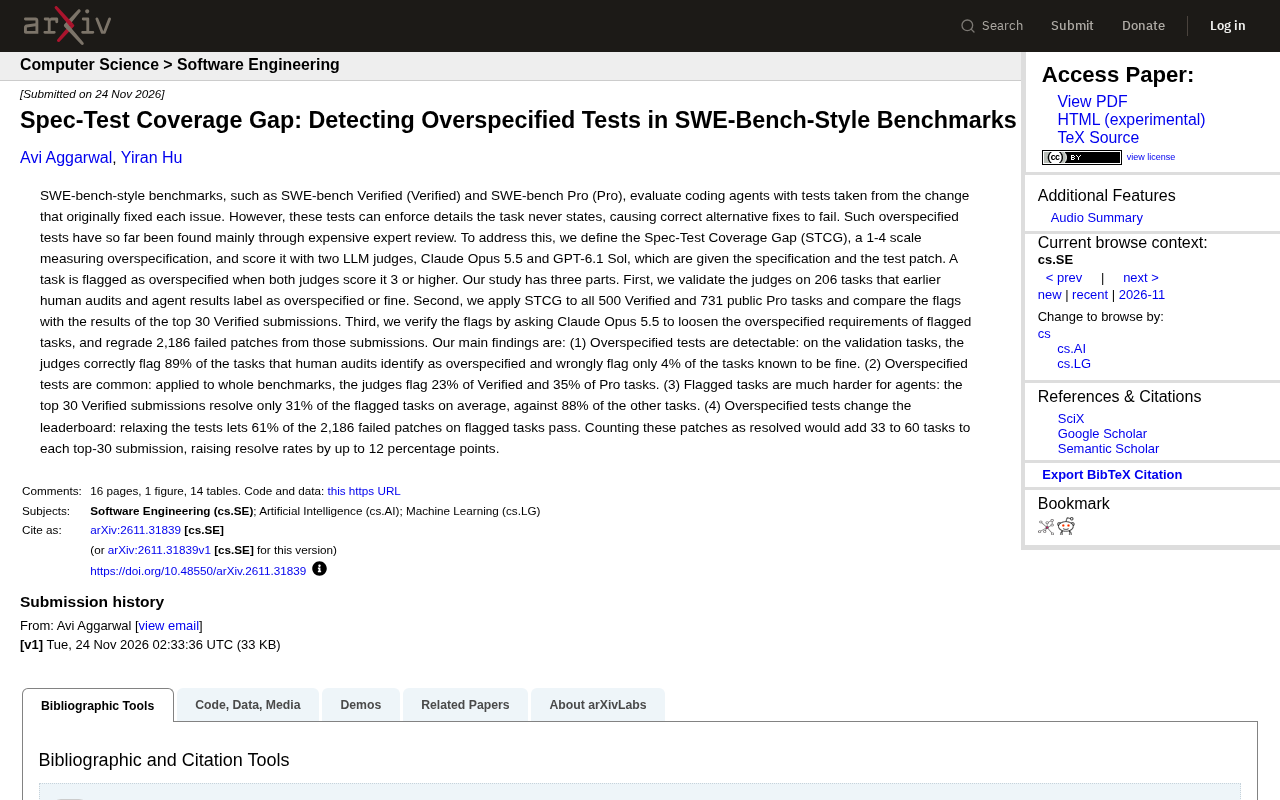
The article introduces a methodological study targeting the SWE-bench family of coding agent benchmarks. Because benchmark test cases are directly extracted from original changes in fix PRs, some tests impose implementation details not mentioned in the task description, causing equally correct alternative fixes to be judged as failures. The study proposes the Spec-Test Coverage Gap (STCG) metric, in which two LLM judges (Claude Opus 5.5 and GPT-6.1 Sol) assess the degree of overspecification on a 1-4 scale given both the task specification and the test patch; a task is flagged as overspecified when both judges score 3 or higher. Three-stage validation shows: 89% recall and only 4% false-positive rate on 206 manually labeled tasks; full scan finds 23% of Verified tasks and 35% of Pro tasks overspecified; 61% of failed patches pass after relaxing tests. Leaderboard analysis shows top submissions solve only 31% on overspecified tasks versus 88% on others, and counting relaxed-pass patches can improve solve rates by up to 12 percentage points.
The Hidden Flaw in Evaluation Benchmarks: Tests Stricter Than the Task Requires
The SWE-bench family of benchmarks (such as SWE-bench Verified and SWE-bench Pro) has become the core yardstick for measuring the capabilities of coding agents. The evaluation method extracts test cases from the original changes that fixed each issue. The problem is that these tests may impose implementation details never mentioned in the task description, causing equally correct alternative fixes to be judged as failures. Such "overspecified tests" previously could only be discovered through expensive expert manual review.
A new study proposes the Spec-Test Coverage Gap (STCG) metric, an attempt to automatically identify these overspecified test problems using LLM judges. STCG uses a 1-4 scale to measure the degree of overspecification, scored by two LLM judges (Claude Opus 5.5 and GPT-6.1 Sol) that are given both the task specification and the test patch. When both judges give a score of 3 or higher, the task is flagged as "overspecified."
The value of this approach lies in turning "whether the tests faithfully reflect the task intent" from a subjective debate into a quantifiable signal. For a community that relies on SWE-bench scores to compare coding agent capabilities, bias in the evaluation itself directly affects the credibility of conclusions.
SWE-bench's core construction method automatically extracts data from issues and corresponding PRs in real open-source projects: the issue text serves as the task specification, the code changes in the PR serve as the reference solution, and the test changes accompanying the PR serve as the judgment criteria. SWE-bench Verified is a 500-task high-quality subset manually selected by OpenAI in collaboration with the community from the original 2,294 tasks, intended to alleviate problems such as ambiguous task descriptions and unreliable tests in the original version; SWE-bench Pro further expands to larger-scale, more recent codebases and deliberately increases task difficulty and diversity. Understanding this construction chain is crucial—the test cases were not independently designed for evaluation, but extracted "incidentally" from the fixer's implementation, and thus naturally carry the specific choices of the reference implementation. This is the structural root cause of overspecified tests, rather than incidental data noise.
Three-Stage Validation: From Manual Audit to Full Benchmark
The research design is divided into three progressive parts to ensure the reliability of the STCG signal.
Stage One: Judge Calibration
The research team validated the LLM judges on 206 tasks that had been labeled as "overspecified" or "normal" by prior manual audits and agent run results. The results showed that the judges correctly flagged 89% of the tasks identified as overspecified by manual audit, while the false-positive rate on known normal tasks was only 4%. This level of precision means STCG has the potential to replace most manual review work.
Stage Two: Full Benchmark Scan
After applying STCG to all 500 Verified tasks and 731 public Pro tasks, the judges flagged 23% of Verified tasks and 35% of Pro tasks as overspecified. This proportion is far beyond the category of "isolated flaws"—it means that a considerable portion of tasks in the benchmark may systematically penalize correct alternative solutions.
Stage Three: Relaxing Tests and Re-scoring
To verify the validity of the flags, the study had Claude Opus 5.5 relax the overspecified requirements of the flagged tasks, and then re-evaluated 2,186 failed patches from top submissions. The results showed that 61% of failed patches passed after the tests were relaxed. This directly proves that these patches were not genuine fix failures, but were wrongly killed by the additional constraints in the tests.
LLM-as-a-judge refers to an evaluation paradigm in which a strong language model scores or classifies samples according to a given rubric, often used in pairwise or ensemble settings to suppress single-model bias. Its reliability is typically measured in two directions: recall (the proportion of true positives correctly flagged) and false-positive rate (the proportion of negatives incorrectly judged as positives). Common failure modes include position bias, verbosity preference, preference for self-generated content, and drift in understanding of the scoring rubric. This paper uses two models from different vendors for cross-judgment and triggers only when "both judges reach the threshold," essentially trading an consistency threshold for precision, at the cost of potentially missing some borderline cases—which also explains why recall remains at 89% rather than higher.
"Relaxing tests" is not simply deleting assertions operationally; rather, it lets the model remove or weaken constraints that merely reflect reference implementation details—such as hard assertions about internal function names, log text, exception types, or call order—while preserving the behavior required by the task specification. Such assertions often do have justification in the original PR, but for a task that only requires "fix this bug," they are out-of-scope requirements. During re-scoring, the original patches are run against the relaxed tests, and if they pass, it indicates that the original failure stemmed from out-of-specification constraints. This closed-loop validation is more convincing than simply reporting classification accuracy, because it directly tests the causal validity of the flags rather than merely testing the agreement between judges and manual annotations.
Leaderboard Distortion: How Overspecified Tests Distort Agent Rankings
The most striking finding of the study comes from the analysis of leaderboard impact. Among 30 top Verified submissions, the average solve rate on tasks flagged as overspecified was only 31%, while the solve rate on the remaining tasks was as high as 88%. In other words, agent performance on overspecified tasks is significantly underestimated.
If patches that pass after the tests are relaxed are counted as solved, each top submission would gain 33 to 60 additional solved tasks, with solve rate improvements of up to 12 percentage points. For the densely ranked top of the leaderboard, such a shift is enough to change rankings.
This finding also points to a deeper problem: current SWE-bench-style evaluations may suffer from both "underspecified tests" and "overspecified tests" biases simultaneously. STCG targets the latter, but both together demonstrate that the quality of test cases and their fidelity to the task specification should be a first-class citizen in benchmark design.
Practical Implications for Coding Agent Evaluation
STCG's methodology has several noteworthy features. It does not rely on manual annotation, but instead uses two independent LLM judges for cross-judgment, reducing the risk of single-model bias; it inputs both the specification and the test patch, so that judgments are based on "what the task requires" rather than "what the tests say"; and it validates the flags through closed-loop re-scoring after relaxing tests, rather than stopping at classification metrics.
For researchers who use SWE-bench scores for model selection or training signals, this means they need to be wary of systematic noise in benchmark scores. For benchmark maintainers, STCG provides a scalable auditing tool that can screen for overspecified tests when releasing new tasks. The study also acknowledges that LLM judges themselves may still introduce bias—89% recall means that about one-tenth of overspecified tasks are still missed. Automated auditing is a supplement, not a complete replacement for manual review.
Related articles

Astrophysicist Pokes Fun at Supermoons: The Difference Between a 16-Inch and a 15-Inch Pizza
Astrophysicist Neil deGrasse Tyson criticizes the terms supermoon and micromoon, using a 16-inch vs. 15-inch pizza analogy to show the visual difference is negligible, and calls out exaggerated labels in science communication.
Bypassing the iOS Safari 60fps Limit: Building a Native-Like Web App Experience
A deep dive into bypassing iOS Safari's 60fps limit through compositor animations, frame rate decoupling, and interaction detail optimization to give web apps a near-native feel on iPhone.

Allstate's Multi-Day Technical Outage Before Thanksgiving
Insurance giant Allstate suffered a multi-day technical outage before the Thanksgiving travel peak. This article analyzes the impact of the timing, implications for insurtech, and the importance of system stability for financial institutions.