Astrophysicist Pokes Fun at Supermoons: The Difference Between a 16-Inch and a 15-Inch Pizza

Tyson uses a pizza analogy to debunk the exaggerated naming of supermoons and micromoons, urging science communication to return to facts.
Astrophysicist Neil deGrasse Tyson criticizes the popular terms "supermoon" and "micromoon" for exaggerating visual differences. He traces their origin: a full moon at perigee is called a supermoon, and at apogee a micromoon. To illustrate how small the difference is, he uses a pizza analogy—a supermoon is to an ordinary full moon as a 16-inch pizza is to a 15-inch; a micromoon is like a 14-inch. Tyson particularly objects to the casual use of "micro," arguing it should be reserved for things visible under a microscope. He notes that naming conventions that sacrifice accuracy for attention will, in the long run, harm public understanding of real astronomical phenomena—the universe's wonders need no exaggerated labels.
If you've ever been bombarded by "supermoon" posts flooding social media, you may have wondered: how much science is really behind this dramatic-sounding name? Astrophysicist Neil deGrasse Tyson recently took to a video to skewer the popular terms "supermoon" and "micromoon" with his signature wit and humor.
Where Did "Supermoon" Come From?
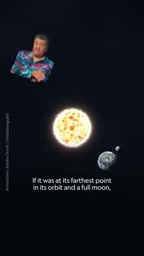
Tyson traces the term's origin: a few years ago, someone noticed that the Moon happened to be at perigee during a full moon, so they gave it a catchy name—supermoon. Conversely, if a full moon occurs at apogee, it's called a micromoon.
By definition, this is just a combined name for two astronomical events. But Tyson's complaint is that this naming convention exaggerates the visual difference, giving the public misleading expectations about astronomical phenomena.
Perigee and apogee are key to understanding these two buzzwords. The Moon's orbit around Earth is not a perfect circle but an ellipse with an eccentricity of about 0.055, so the Earth-Moon distance periodically varies between roughly 356,000 km and 406,000 km. The closest point is called perigee, and the farthest is apogee. If a full moon happens near perigee, its apparent diameter can be about 14% larger than a full moon at apogee, with an apparent area about 30% larger—this is the astronomical basis for the terms "supermoon" and "micromoon." However, this difference is only easily noticeable when comparing photos of two full moons side by side; it's hard to distinguish with the naked eye alone.
The Pizza Analogy: The Difference Between 16-Inch and 15-Inch
To illustrate the size difference between a supermoon and an ordinary full moon, Tyson used a very down-to-earth analogy: a supermoon is to an ordinary full moon as a 16-inch pizza is to a 15-inch pizza.
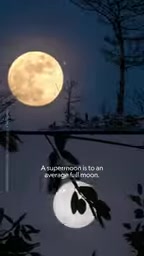
In other words, the so-called "super" visual boost is almost negligible in everyday perception. It's hard to tell the difference between a 16-inch and a 15-inch pizza with the naked eye without any reference, and the same goes for a supermoon versus an ordinary full moon.
Tyson's pizza analogy works because it directly exposes the confusion between "diameter ratio" and "area ratio." A 16-inch pizza is only about 6.7% larger in diameter than a 15-inch pizza, but about 14% larger in area; while the apparent diameter difference between a supermoon and an ordinary full moon is about 14%, and the area difference is about 30%. Looking at diameter alone, the difference is indeed close to the 15-inch vs. 16-inch comparison; but if perceived brightness is based on area, the difference is somewhat more noticeable. Tyson's point is not precise calculation but to remind the public: the "bigger and brighter" that the media often mentions is far less dramatic in visual experience than it sounds.
Micromoon? The Term Is Used Too Casually
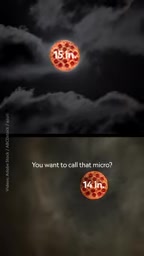
Tyson's criticism of "micromoon" is even more direct. By the same pizza logic, a micromoon is equivalent to a 14-inch pizza—only one size smaller than 15-inch.
His question is: we usually reserve the word "micro" for things that can only be seen under a microscope, like microbes and microchips. Calling an apogee full moon a "micromoon" is really an abuse of the word "micro." "Micro, please." His brief quip highlights a common problem in science communication: sacrificing accuracy for attention.
Micro comes from the Greek word mikros, meaning "small," and in scientific terminology is usually used for scales invisible to the naked eye or requiring magnification, such as microbes, micrometers, and microchips. Tyson's criticism targets the semantic boundary of the prefix: when an apogee full moon still has an apparent diameter of about 33 arcminutes and is fully visible to the naked eye, calling it "micro" undermines the precision of "micro" in scientific contexts. Borrowing prefixes to create a sense of contrast is common in science communication, but if the scale implied by the prefix is seriously inconsistent with the actual scale of the object, it can cause conceptual confusion, not just a rhetorical issue.
Where Should the Boundary of Science Communication Be?
Tyson's criticism is not against public interest in astronomy; on the contrary, he repeatedly emphasizes that there is so much in space worth learning about. The problem is that when media and social platforms package ordinary astronomical phenomena with exaggerated labels, the public becomes numb to the truly awe-inspiring scales of the universe.
The popularity of the supermoon reflects a broader trend: science communication needs to grab attention, but if the way it grabs attention deviates from facts, in the long run it will harm public scientific literacy. Tyson's pizza-size analogy is precisely to make ordinary people realize that those shocking-sounding labels may just be marketing talk.
Refocus on What's Truly Interesting
Rather than obsessing over how much bigger a supermoon is than an ordinary full moon, it's better to learn about the physical mechanisms behind the Moon's orbit, tidal locking, and lunar phases. Tyson mentioned that his new book "Lost in Space" contains 5,000 space facts, which is perhaps the message he really wants to convey: the wonders of the universe don't need exaggerated adjectives; real science itself is stunning enough.
Next time you see a "supermoon" headline, think of the 16-inch pizza analogy. The Moon is still the same Moon; what changes is the label we give it.
Related articles

Ternary Bonsai 2.5 27B: 27B Coding Power Packed into 5.9GB, Code Stays Local
Ternary Bonsai 2.5 27B uses ternary quantization to compress 27B parameters into 5.9GB, enabling local coding with code staying on-device. We analyze its approach, vendor benchmarks, and multi-turn progress.

Self-Host Google Photos with Open-Source Immich: Privacy and AI Combined
Learn how to self-host a Google Photos alternative with open-source Immich: automatic backup, local AI search, and remote access—private and smart.
Bypassing the iOS Safari 60fps Limit: Building a Native-Like Web App Experience
A deep dive into bypassing iOS Safari's 60fps limit through compositor animations, frame rate decoupling, and interaction detail optimization to give web apps a near-native feel on iPhone.