ArEssays: A New Benchmark for Arabic Handwritten Essay Understanding

The ArEssays dataset uses real student handwritten essays and dual-version annotation to reveal significant gaps among 34 models in Arabic handwriting recognition.
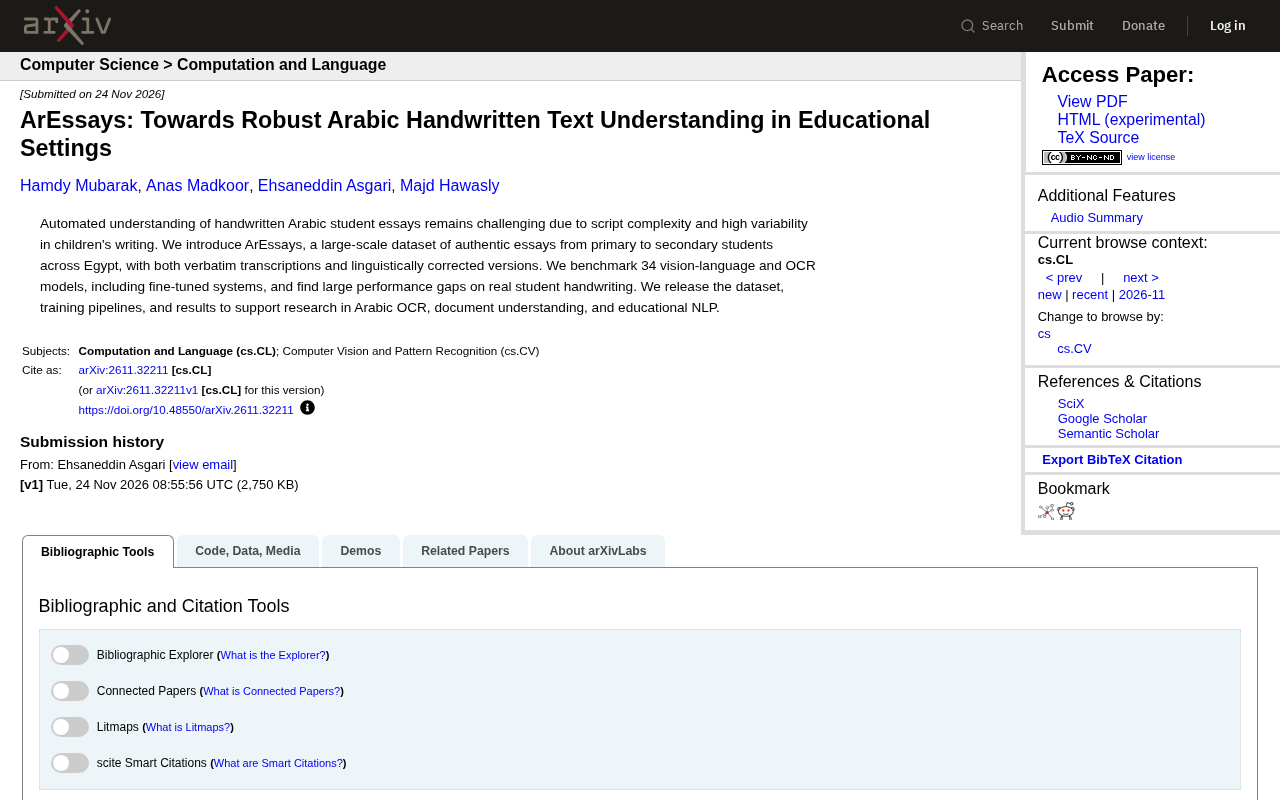
ArEssays is a large-scale dataset for Arabic handwriting understanding, collected from real essays by Egyptian students from primary through secondary school, preserving corrections, connected strokes, and spelling errors, and providing both verbatim and language-corrected annotations. The research team benchmarked 34 vision-language and OCR models and found that even after fine-tuning, existing systems still show noticeably lower recognition accuracy on children's handwriting, with a large gap compared to performance on printed or controlled handwriting benchmarks. The dataset covers multiple school stages with a wide span of writing maturity, providing an ideal setting for robustness evaluation. The dataset, training pipeline, and results are all open-sourced, supporting educational NLP research such as Arabic OCR, document understanding, automated essay scoring, and spelling correction, and reminding the industry that multilingual OCR progress cannot be measured by printed-text benchmarks alone.
Why Arabic Handwriting Recognition Is So Difficult
Automated understanding of Arabic handwritten text has long been a challenge in document analysis and educational NLP. Unlike printed text, handwriting presents inherent difficulties such as connected letters, stroke deformation, and letter shapes that vary by position, and the high variability introduced by children's writing amplifies these challenges further. The essay handwriting of Egyptian students from primary through secondary school contains both non-standard spelling and distinct individual writing habits, imposing robustness requirements on OCR and vision-language models that far exceed those of conventional benchmarks.
The recently released ArEssays dataset directly targets this pain point. The research team collected real handwritten essays from Egyptian students across primary and secondary school levels, built a large-scale dataset, and provided both verbatim transcription and language-corrected versions. This dual-version design allows models to learn the original written forms while aligning with standardized language expression, offering a more realistic testing ground for automated grading and text understanding in educational settings.
The Arabic writing system has several unique properties that directly magnify the difficulty of handwriting recognition. First, Arabic letters take different glyph forms depending on whether they appear at the beginning, middle, or end of a word, or in isolated form (i.e., "positional forms"), with a single letter having up to four variants, so models must learn to map these variants to the same character class. Second, most letters can be connected, forming continuous stroke sequences, and the spaces between words are sometimes indistinct, making character segmentation extremely difficult. Third, many letters differ only in the number and position of dots (e.g., ب, ت, ث), and missing or merged dots in handwriting directly cause ambiguity. In addition, short vowels in Arabic are typically not written, requiring readers to infer pronunciation and word meaning from context, which makes the gap between verbatim transcription and language correction even more pronounced. These properties, combined with the non-standard nature of children's writing, make Arabic handwritten OCR a task with extremely high demands on the collaborative capabilities of vision models and language models.
Dataset Construction and Dual-Version Annotation
The core value of ArEssays lies in its "authenticity." Many OCR benchmarks use writing samples collected in controlled environments, whereas this dataset comes directly from students' everyday essays, preserving original corrections, connected strokes, and spelling errors. The verbatim transcription version faithfully records every character the student wrote, including errors; the language-corrected version normalizes the text into standard Arabic. This dual-track annotation supports not only recognition tasks but also provides a reference basis for downstream applications such as spelling correction and language learning analysis.
The data covers multiple school stages from primary to secondary, meaning there is a wide span of writing maturity, and models must handle both the immature handwriting of younger grades and the relatively fluent writing of higher grades. This span is an ideal setting for evaluating robustness, and it also explains why model performance drops noticeably on real student handwriting.
Verbatim transcription and normalized/corrected transcription are two complementary annotation paradigms in document analysis and educational NLP. Verbatim transcription requires annotators to faithfully reproduce what the writer actually wrote, including spelling errors, omissions, repetitions, and corrections, with the goal of preserving the original writing evidence; the language-corrected version involves annotators rewriting the text into standard Arabic, correcting spelling and grammar errors, with the goal of reflecting the standardized semantics the writer "intended to express." The value of parallel annotation lies in the following: the verbatim version can be used to train and evaluate the character-level recognition capability of OCR, while the corrected version can be used for downstream tasks such as spelling correction, grammar checking, and automated essay scoring; at the same time, the differences between the two can themselves serve as quantitative signals of writing quality and language proficiency. This dual-track design is especially important in children's handwriting datasets, because errors themselves are the object of study in educational analysis rather than noise to be simply removed.
Benchmarking 34 Models and the Performance Gap
The research team benchmarked 34 vision-language models and OCR models, including fine-tuned systems. The results show that these models exhibit large performance gaps on real student handwriting. Although some models perform well on printed text or controlled handwriting datasets, recognition accuracy drops noticeably when faced with the variability of children's writing.
This finding carries a cautionary message: the deployment of existing OCR and vision-language models in Arabic educational settings still requires caution. Although fine-tuning can bring improvements, it does not fully close the gap. The research team open-sourced the dataset, training pipeline, and results, intending to advance follow-up research in Arabic OCR, document understanding, and educational NLP.
A Vision-Language Model (VLM) is a type of multimodal model that accepts both image and text inputs and can generate text outputs, with typical representatives including systems based on an image encoder plus a language model decoder architecture. In OCR tasks, VLMs typically encode an entire page or line of text image into visual features, and then the language model autoregressively generates recognition results, thus possessing a certain ability for contextual error correction. Compared with traditional pipeline-style OCR (first detecting text lines, then segmenting characters, and finally classifying and recognizing), VLMs process end-to-end, reducing dependence on character segmentation, which is especially beneficial for Arabic handwriting with severe connected strokes. However, a VLM's recognition capability depends heavily on its pre-training data distribution: if the pre-training corpus consists mainly of printed text or clean handwriting, performance will degrade significantly when facing the deformation, corrections, and irregular spacing of children's writing. Fine-tuning adjusts model parameters by continuing training on the target dataset, which can partially alleviate this distribution shift, but due to issues such as the scale of annotated data and catastrophic forgetting, it is often difficult to completely eliminate the gap.
Significance for Educational NLP and Arabic OCR
The release of ArEssays fills a gap in Arabic handwritten educational data. Previously, large-scale benchmarks for Arabic children's handwritten essays were relatively scarce, making it difficult for researchers to systematically evaluate model performance in real educational settings. The dataset's dual-version annotation and cross-stage coverage provide a reproducible evaluation foundation for tasks such as automated essay scoring, spelling correction, and handwriting quality analysis.
From a broader perspective, this work also reminds the industry that progress in multilingual OCR cannot be measured solely by printed-text benchmarks. As a widely used writing system, Arabic's handwriting variability tests model robustness and may provide a reference for research on other cursive scripts (such as Persian and Urdu). The open-sourced training pipeline and results lower the barrier for follow-up research.
Conclusion
Using real student handwritten essays as its entry point, ArEssays constructs a large-scale dataset with dual-version annotation and, through benchmarking 34 models, reveals significant gaps in existing systems' understanding of Arabic handwriting. For developers and researchers focused on Arabic OCR, educational NLP, and multilingual document understanding, this resource is worth following closely.
Related articles

A 19-Year-Old's Rental Horror Story: Ceiling Collapse, Bug Infestation, and the Lessons It Taught Me
At 19, my first off-campus rental brought bug infestations, no heat, a collapsed ceiling, and a ruined laptop with no renter's insurance. Here are the hard-won lessons for first-time student renters.

Veda Nurse's Cranial Nerve Exam: Why ASMR Role-Play Is Going Viral
Bilibili creator Veda's cranial nerve exam ASMR video goes viral, blending humor and sensory triggers through nurse role-play. This article analyzes its unique appeal and the audience psychology behind ASMR role-play.

LG Cinebeam AI Review: 120-Inch Giant Screen + 3000 Lumens, a New Choice for the Living Room Theater
LG Cinebeam AI projector review: 3000 ANSI lumens, 4K, 100 inches from about 8 cm and 120 inches from about 18 cm. Built-in webOS, AI Concierge voice recommendations, AI Sound Pro 11.1.2 virtual surround, and Game Optimizer—positioned for fixed living room installation, complementing the portable Cinebeam S.