ARM's Request to Shut Down Third-Party Resource Site Sparks Controversy
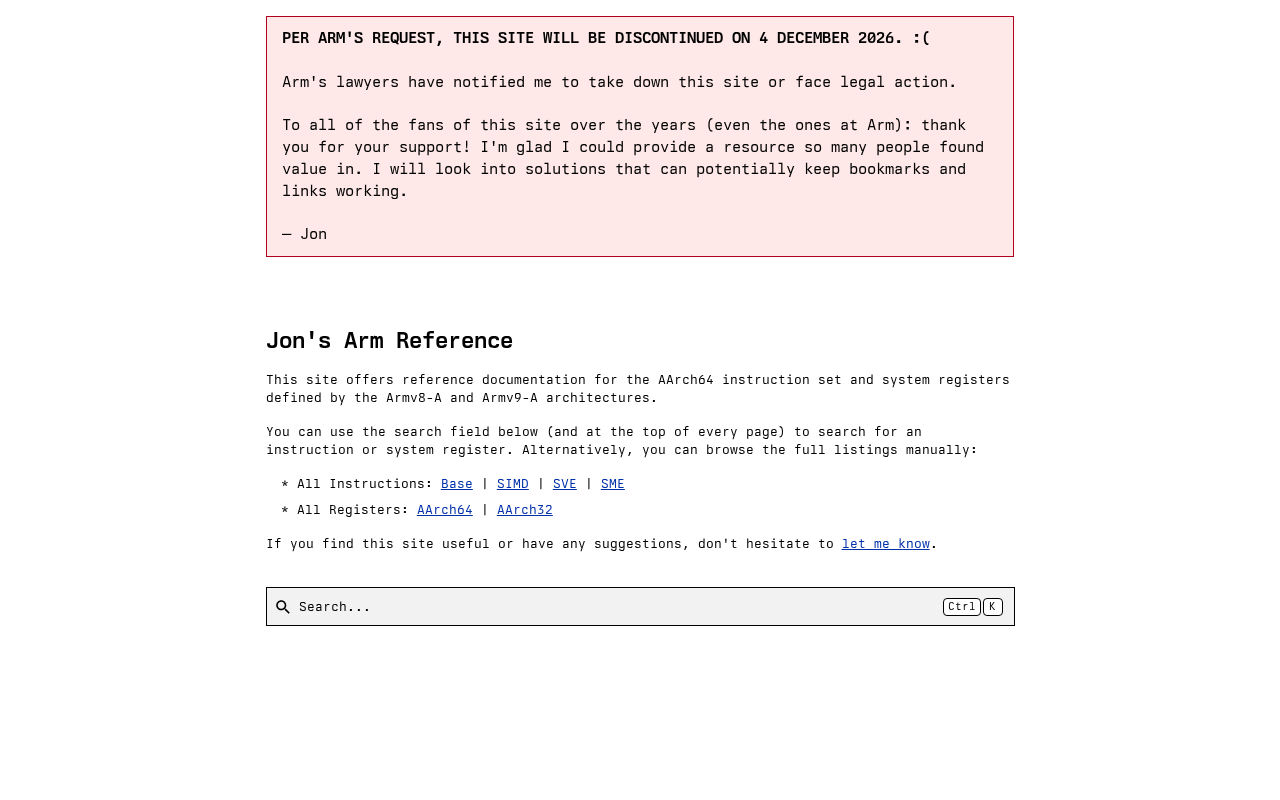
Third-party ARM resource site to shut down at vendor's request, sparking debate on brand control and information openness.
Third-party ARM resource site arm.jonpalmisc.com announced it will cease operations on December 4, 2026, at ARM's request, sparking heated discussion on Hacker News. Opinions are divided: some view vendor brand management of sites named "ARM" as normal, especially when content may involve copyrighted materials; others worry about narrowing technical information channels and the loss of old documentation and community experience. The incident highlights the long-standing tension between architecture vendors' brand control and developers' open information ecosystem.
Background: A Notice That Sparked Community Discussion
A website called arm.jonpalmisc.com recently posted an announcement stating that, at ARM's request, the site will cease operations on December 4, 2026. The news quickly gained traction on Hacker News, drawing 373 points and 67 comments, making it a hot topic in the tech community.
Judging from the wording of the announcement, the site operator did not express any hostility but simply informed users in a calm manner that the site would soon go offline. This restraint反而 shifted the focus of discussion to more fundamental questions: Does a chip architecture vendor have the right to demand the shutdown of a third-party information site? Where exactly is the boundary between open-source communities and commercial companies?
The Value and Predicament of Third-Party Resource Sites
Sites like arm.jonpalmisc.com are typically maintained by individual developers or small teams, with content centered on ARM architecture instruction set documentation, development toolchains, platform adaptation experiences, and the like. They often fill gaps left by official documentation in terms of usability, search efficiency, or retention of historical versions.
For embedded developers and low-level software engineers, such unofficial resources play an irreplaceable role in troubleshooting obscure issues and tracing the behavior of older architecture versions. However, they have long existed in a gray area: domain names, trademarks, and document copyrights can all become grounds for takedown requests. In this incident, ARM's specific demands were not disclosed in detail in the announcement, but the phrase "at ARM's request" is enough to indicate that the vendor proactively initiated intervention.
ARM Architecture and Instruction Set Documentation: ARM is a British semiconductor and software design company that does not manufacture chips itself but licenses the instruction set architecture (ISA) of ARM architectures (such as ARMv7, ARMv8-A, ARMv9) to chip vendors. Its official documentation system is vast, covering architecture reference manuals (ARM ARM), technical reference manuals (TRM), compiler toolchain documentation, and more. Because architecture versions iterate frequently, the official site typically retains only the latest versions, with older documentation often archived or removed—this creates space for third-party sites to preserve historical versions. At the same time, ARM documentation uses strict copyright licensing, and unauthorized reproduction by third parties may constitute infringement, which is one reason such sites have long existed in a gray area.
Community Divisions: The Tension Between Intellectual Property and Open Ecosystems
The Hacker News comment section showed clear divisions of opinion. Some commenters argued that ARM, as the architecture owner and trademark holder, making requests regarding third-party sites named "ARM" is normal brand management, especially when site content may involve unpublished documentation or copyrighted materials.
Other voices worried that this is the beginning of a trend: if vendors can easily make independently maintained technical resources disappear, developers' channels for obtaining information will increasingly converge on official narratives, and historical materials and community perspectives will gradually be lost. Some comments pointed out that such sites often carry old-version information that the official side no longer maintains, and shutdown means some knowledge is effectively "deleted."
According to cross-validation of multiple viewpoints in the Hacker News discussion, the core of the controversy is not the survival or demise of a single site, but the growing control of commercial companies over channels of technical information dissemination. This consensus appeared repeatedly in multiple highly upvoted comments.
Trademark Use and Brand Management: As a trademark holder, ARM has a legal obligation to manage third-party sites' use of the "ARM" name. Without intervention, it could face trademark dilution risks and even undermine the seriousness of its licensing system. However, trademark law typically allows descriptive fair use—third parties can state "this website discusses ARM architecture" without constituting infringement. Therefore, the common reason vendors request shutdowns is not the trademark itself, but that the site may contain copyrighted documentation, unpublished materials, or content violating licensing terms. In this incident, ARM's specific demands were not made public, so community discussion necessarily involves speculation.
Practical Impact on Developers
From a practical standpoint, the most direct impact of the site shutdown is broken bookmarks and broken documentation links. Developers who have long relied on the site for reference materials need to find alternative sources, and official documentation may not fully fill the gap in terms of historical version tracing and integration of community experience.
The deeper impact lies in information-gathering habits. When unofficial resources can disappear at any time, developers will be more inclined to locally archive important documents or turn to community-built mirrors and knowledge bases. This "defensive archiving" behavior is not new in open-source communities, but every similar incident reinforces this tendency.
Defensive Archiving: Refers to developers proactively saving online technical documentation, toolchain manuals, or community discussions that may disappear to local storage or decentralized mirrors. Common methods include using web archiving services like the Wayback Machine and Archive.today, or offline backups via Git repositories and personal knowledge bases. In open-source communities, this practice stems from concerns about project archiving, site shutdowns, or changes in vendor policies. While defensive archiving can mitigate information loss, it also faces copyright compliance issues—archiving copyrighted documents may be limited to personal use, and public mirrors require careful assessment of licensing.
Rethinking Vendor-Community Relations
ARM's request this time, whatever the specific reasons, touches on a long-standing tension: architecture vendors want to control how brands and documentation are disseminated, while developer communities rely on an open, diverse information ecosystem. The two are not inherently opposed, but friction easily arises in specific implementation.
One direction worth watching is whether vendors can provide clearer third-party content policies that allow independent maintainers to continue operating within a compliant framework, rather than reaching the point of requesting shutdown. For the community, this is also a reminder: relying on a single unofficial resource carries risks, and distributed backups and community collaboration are the more reliable path.
At present, the specific reason for the site's shutdown, ARM's complete statement, and whether there is room for negotiation have all not been disclosed in public information. Further developments仍需观察.
One-line Summary
A third-party ARM resource site will shut down at the vendor's request, sparking community discussion about brand control and information openness.
Paragraph Summary
Third-party ARM resource site arm.jonpalmisc.com announced it will cease operations on December 4, 2026, at ARM's request, triggering heated discussion on Hacker News. Opinions are divided: some see vendor brand management of sites named "ARM" as normal, especially when content may involve copyrighted materials; others worry about narrowing channels for technical information, with old-version documentation and community experience carried by unofficial sites being lost. The incident reflects the long-standing tension between architecture vendors' brand control and developers' open information ecosystem, and also prompts developers to strengthen defensive archiving habits such as local backups and community mirrors.
Related articles

The Gemini 4 Trio and 3.8 Flash: A Full Comparison of Positioning, Pricing, and Benchmarks
A comparison of Gemini 4 Neon, Carbon, Argon, and Gemini 3.8 Flash: positioning, context, API pricing, Artificial Analysis and Arena benchmark scores, and available entry points.

AI Coding Model Leaderboard: Opus 5.5 Crowned, Gemini Neon Stages a Comeback
Tech blogger Matthew Berman releases an AI coding model tier list: Claude Opus 5.5 holds S-tier, Gemini Neon surprises with A-tier, OpenAI Astra lands B-tier. How do open-source models like DeepSeek fare? We break down the scoring logic and practical takeaways.

New Jersey Joe Sandwich: Meat and Coleslaw on Triple-Decker Rye
New Jersey Sloppy Joe isn't a ground beef burger—it's triple-decker rye bread with meat, Swiss cheese, and coleslaw, plus Russian dressing. Learn the authentic Essex County method and family recipe.