Armin Ronacher's Sharp Take on AI: Thirty Years of Bad Software, Now Paying the Price
Ronacher quips that AI is amplifying thirty years of bad software's technical debt into security risks.
The article centers on a biting comment by Flask author Armin Ronacher: over the past thirty years we have written too much bad software, and now AI is punishing us on the universe's behalf. The author notes that large models did not create vulnerabilities; they made long-ignored issues like missing input validation, blurred permission boundaries, and arbitrarily pinned dependency versions discoverable and exploitable through automation. The article also explains why Simon Willison placed the comment in the AI security context—prompt injection is isomorphic to the input trust problem in web history—and outlines developer responses: fixing code hygiene, the dependency supply chain, and mindset, not just adding guardrails to models.
Armin Ronacher, the author of the Flask framework and a well-known developer, posted a rather biting remark on Twitter that, after being quoted on Simon Willison's blog, sparked considerable discussion.
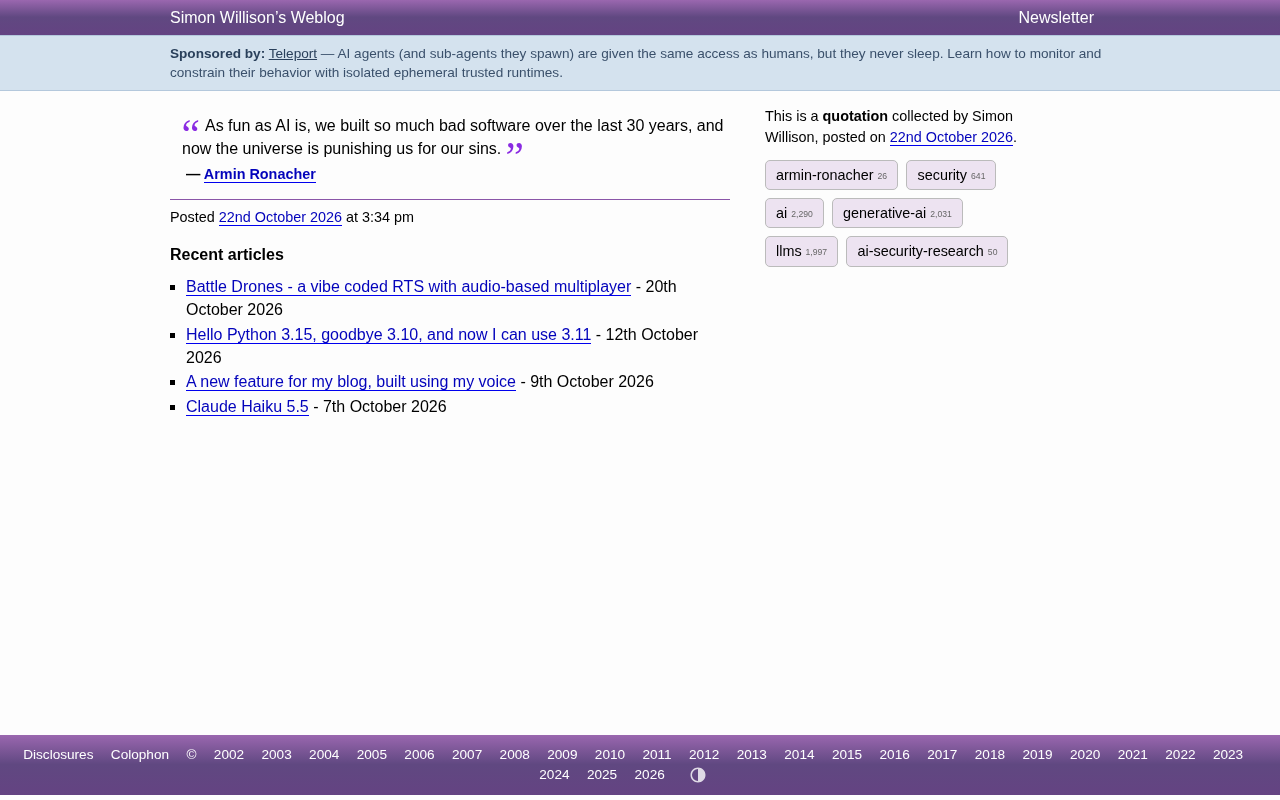
As fun as AI is, we built so much bad software over the last 30 years, and now the universe is punishing us for our sins.
It reads like a joke, but it precisely hits the most awkward reality in today's AI and security landscape—the capabilities of large models are multiplying the technical debt that software engineering has accumulated over the years into security risks.
The Real Problem Behind One Sentence
Ronacher's wording is tinged with banter, but what it points to is not "AI is hard to use" but a more fundamental causal relationship: the reason AI can create so many security problems today is that the systems it faces are already riddled with holes.
The past thirty years of software development history is a history of continuous compromise. To meet deadlines, input validation was skipped; to remain compatible with legacy systems, permission boundaries were blurred; to iterate quickly, dependency library versions were pinned arbitrarily. These practices were barely manageable in the single-machine era or on closed networks, but once LLMs gained the ability to automatically read code, generate requests, and compose tool calls, any overlooked edge case could become the starting point of an attack chain.
In other words, AI did not "create" vulnerabilities; it simply made previously dormant vulnerabilities discoverable and exploitable through automation.
Why This Sentence Appears in the AI Security Context
The tags Simon Willison attached to this quote include security, generative-ai, ai-security-research, and llms—the combination itself explains the context in which the problem is placed.
Much of current AI security research focuses on "whether models can be induced to do bad things," but Ronacher's perspective is different: he focuses on the layer of software infrastructure that models operate on. The reason prompt injection is hard to eradicate is essentially that models cannot reliably distinguish "instructions" from "data," and this flaw happens to be isomorphic to the long-standing input trust problem in web applications. The lesson SQL injection taught us is being replayed in a new form in the LLM era.
According to the citation and tag categorization on Simon Willison's blog, this comment was placed in AI security research discussions, indicating that many in the community agree with this judgment: AI security is not an isolated new problem; it is a concentrated reckoning of old software security debts.
Prompt Injection refers to an attacker embedding malicious instructions into an LLM's input to induce the model to deviate from its original task and execute the attacker's intent. Its key similarity to traditional injection attacks is that the system cannot reliably distinguish between "trusted instructions" and "untrusted data." In web security, the definitive fix for SQL injection is parameterized queries—completely separating code from data at the syntactic level; LLMs currently lack a comparable structural isolation mechanism, and the model treats all text in the context equally. This makes any content the model can read (web pages, documents, emails, tool return values) a potential attack vector, and makes mitigations like "adding a security prompt to the model" inherently fragile. Understanding this isomorphic relationship is the premise for understanding why Ronacher's comment was categorized under AI security research.
Practical Implications for Developers
If we accept Ronacher's framing, then addressing the security challenges brought by AI cannot rely solely on adding guardrails to models.
The first layer is code-level hygiene. Those input validations, permission checks, and error handling that have been shelved for years need to be re-examined in an environment where AI agents can automatically call interfaces. A branch that "basically never triggers" under manual operation may be just a routine path for a tireless automated agent.
The second layer is dependencies and the supply chain. LLM toolchains often introduce a large number of third-party packages and remote services, and what Ronacher calls "thirty years of bad software" is especially evident in the dependency tree—what you inherit is not just code, but also others' thirty years of compromises.
The third layer is mindset. Treating AI security problems as "AI's fault" easily leads people to overlook the truly actionable points of improvement. Ronacher's talk of "punishment" is joking, but the direction is clear: what needs fixing is the software itself, not complaining that the tools are too smart.
AI Agents differ from ordinary chat-style calls to large models in that they autonomously plan multi-step operations, call external tools and APIs, read execution results, and adjust the next action accordingly. This characteristic significantly amplifies the exposure surface of software defects—exception branches that are almost never reached in manual use may be triggered repeatedly by an agent within a single task; implicit assumptions that originally relied on "users won't do that" all fail in the face of automation. More critically, agents usually hold credentials and permissions within a certain scope, so once hijacked by prompt injection, what the attacker gains is not a single answer but an executable chain of operations. This is also the technical background for the article's emphasis that "input validation and permission checks need to be re-examined": protection assumptions designed for human operators need to be re-evaluated at machine speed and machine patience.
The Reach of One Sentence
The reason this quote was singled out is precisely that it accomplishes a shift in perspective in an extremely short space—from "what AI can do" to "what kind of world we have prepared for it." For developers who have long worked with code, this self-deprecating expression resonates more easily than lengthy security reports and is easier to remember.
It does not offer a solution, but it offers a way of asking questions worth revisiting: when AI starts operating software on our behalf, are we willing to first look back at the technical debt we incurred over the years?
One-line Summary
Ronacher quips that AI is amplifying thirty years of bad software's technical debt into security risks.
Paragraph Summary
The article centers on a biting comment by Flask author Armin Ronacher: over the past thirty years we have written too much bad software, and now AI is punishing us on the universe's behalf. The author points out that this comment hits the most awkward reality in AI and security—large models did not create vulnerabilities; they made long-ignored issues such as missing input validation, blurred permission boundaries, and arbitrarily pinned dependency versions discoverable and exploitable through automation. The article further analyzes why Simon Willison categorized this comment in the AI security context: prompt injection is isomorphic to the input trust problem in web history. Finally, it offers directions for developers: fix code hygiene, the dependency supply chain, and development mindset, rather than merely adding guardrails to models.
Related articles

5 Practical Ways Real Estate Agents Can Use AI to Boost Efficiency (2026 Edition)
How can real estate agents use AI to boost efficiency? Based on a YouTube walkthrough, this breaks down five methods — ChatGPT for listing descriptions, Canva for marketing materials, forms for open house leads, Zapier for automated follow-up, and seller meeting prep — and flags risk boundaries like fair housing laws, photo authenticity, and price verification.

Grok Bot vs ChatGPT Agent: Which AI Agent Is More Powerful?
How does Grok Bot differ from ChatGPT Agent? This comparison examines how they work: Grok Bot has a cloud computer and runs persistently inside tools to execute multi-step tasks automatically; ChatGPT Agent operates web pages in a browser and is more mature at general tasks. Includes selection advice.

Walmart Agent Gateway: AI Shops for You Automatically—Why Is Amazon Going the Opposite Way?
Walmart's Agent Gateway lets ChatGPT, Gemini and other AI assistants access its product catalog to search, compare and add to cart, with spending limits and per-purchase approval. Amazon blocks external AI agents—two retail giants, opposite paths. Currently US-only, India may follow.