ArSciKids: A Curriculum-Aligned Dataset for Arabic Primary School Science Education
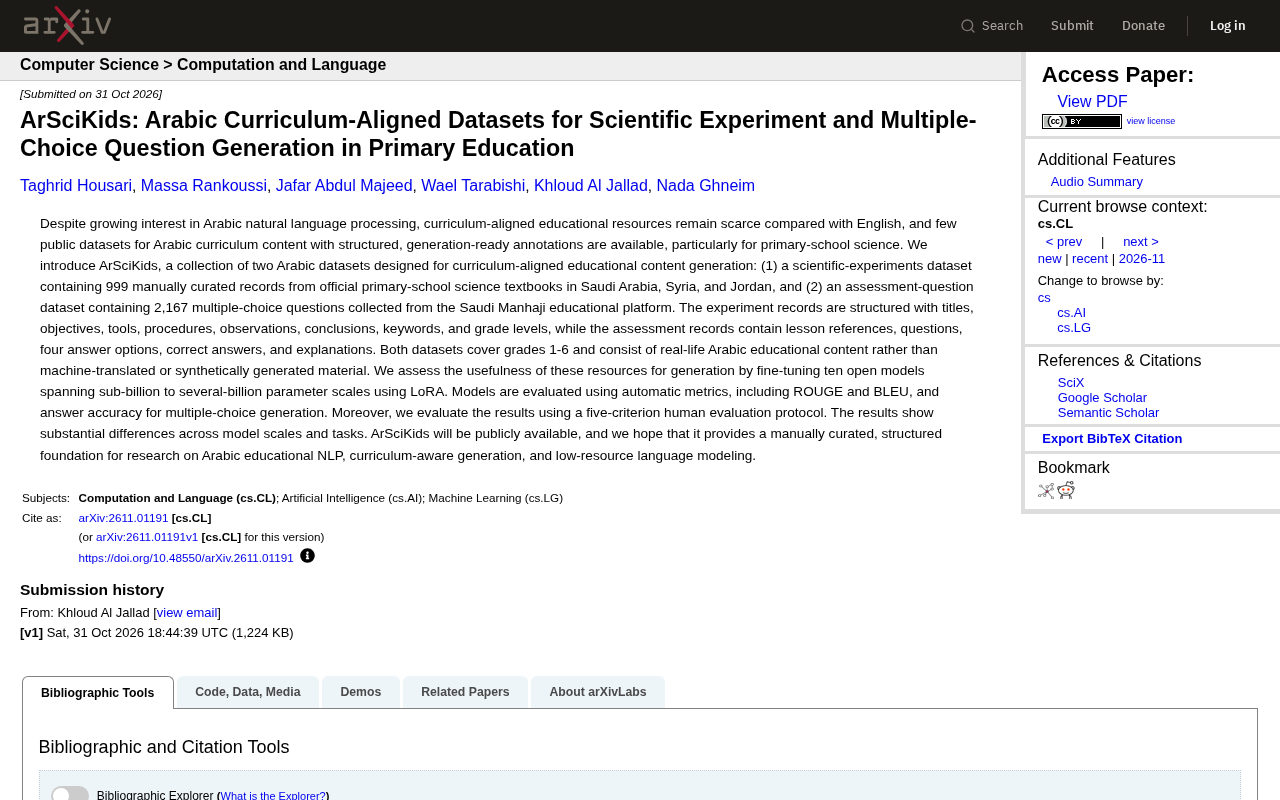
ArSciKids releases an Arabic primary school science dataset with 999 experiment records and 2,167 multiple-choice questions, evaluating ten open-source models with LoRA.
ArSciKids is a curriculum-aligned dataset for Arabic primary school science education, comprising two complementary parts: 999 structured science experiment records from official textbooks in Saudi Arabia, Syria, and Jordan, and 2,167 multiple-choice questions from Saudi Arabia's Manhaji platform, covering grades 1-6 and consisting entirely of manually curated authentic content. The team fine-tuned ten open-source models (from under one billion to several billion parameters) using LoRA, assessing generation with ROUGE, BLEU, answer accuracy, and human evaluation, finding significant differences across model sizes and task types. The article argues the dataset offers a reliable starting point for Arabic educational NLP, but its limited scale and three-country concentration make it better suited as an evaluation benchmark or fine-tuning seed, with generalization still to be validated.
Arabic NLP has long faced a shortage of educational resources, especially compared with English, where publicly available curriculum-aligned datasets are few and far between. The recently released ArSciKids dataset attempts to fill this gap by providing structured, generation-ready annotated resources for Arabic primary school science education.
Dataset Composition: Experiment Records and Multiple-Choice Questions
ArSciKids consists of two separate but complementary datasets. The first is a science experiment dataset containing 999 manually curated records from official primary school science textbooks in Saudi Arabia, Syria, and Jordan. Each record is structurally annotated with fields including title, objectives, tools, steps, observations, conclusions, keywords, and grade level. The second is an evaluation question dataset containing 2,167 multiple-choice questions collected from Saudi Arabia's Manhaji educational platform. These questions come with curriculum references, four options, correct answers, and explanations. Both datasets cover grades 1 through 6 and consist entirely of authentic Arabic educational content rather than machine-translated or synthetically generated material.
This positioning as "authentic content" is worth noting. In low-resource language NLP research, synthetic or translated data are often used as stopgap measures, but educational scenarios demand extremely high standards for content accuracy and cultural appropriateness. ArSciKids insists on manual curation; although limited in scale, it provides a more reliable benchmark for subsequent research.
Generation Capability Evaluation: From Sub-Billion to Multi-Billion Parameter Models
To validate the dataset's utility for generation tasks, the research team fine-tuned ten open-source models using LoRA, with parameter sizes ranging from under one billion to several billion. Evaluation employed automatic metrics (ROUGE and BLEU) and answer accuracy for multiple-choice generation, supplemented by a five-criteria human evaluation protocol.
The results revealed significant differences across model sizes and task types. This finding is not surprising—experiment record generation involves long-form structured output, while multiple-choice question generation focuses more on answer accuracy and distractor plausibility, placing different demands on model capabilities. You may not have noticed that even the smallest models showed some potential on specific tasks, offering a reference point for deployment in resource-constrained scenarios.
LoRA (Low-Rank Adaptation) is a parameter-efficient fine-tuning technique whose core idea is to inject low-rank decomposition bypass matrices alongside some weight matrices of a pretrained model, updating only these newly added small-scale parameters during training while freezing the original model weights. Compared with full-parameter fine-tuning, LoRA can reduce trainable parameters by several orders of magnitude, significantly lowering memory usage and training costs, while often achieving results close to full fine-tuning on downstream tasks. In low-resource language scenarios, LoRA's value is particularly prominent: researchers do not need to retrain multi-billion-parameter models for each language or task; they only need to train lightweight adapters for specific datasets (such as ArSciKids) to quickly validate model capabilities, and it also facilitates parallel comparison of multiple models under limited compute.
ROUGE (Recall-Oriented Understudy for Gisting Evaluation) and BLEU (Bilingual Evaluation Understudy) are the most commonly used automatic evaluation metrics in text generation. BLEU was originally designed for machine translation, measuring quality by computing the precision-based n-gram match rate between generated text and reference text, emphasizing precision; ROUGE focuses more on recall and is commonly used for summarization and long-form text generation evaluation, where ROUGE-N counts n-gram overlap and ROUGE-L is based on the longest common subsequence. In morphologically rich languages like Arabic, directly applying these metrics requires attention to tokenization and morphological normalization, otherwise match rates will be underestimated. More importantly, both capture only surface lexical overlap and cannot fully reflect semantic correctness or the reasonableness of educational content, which is why the ArSciKids study supplements automatic metrics with a human evaluation protocol.
The Significance and Limitations of Curriculum Alignment
The core value of ArSciKids lies in "curriculum alignment." Unlike general Arabic corpora, these data directly correspond to primary school science curricula in various countries, enabling generated content to be embedded in actual teaching scenarios. For Arabic educational NLP, this is an important starting point—previously, very few public datasets simultaneously featured curriculum annotations and generation-ready structure.
However, data sources are concentrated in three countries (Saudi Arabia, Syria, Jordan), and curriculum coverage is limited. Although the three countries all belong to the Arabic-speaking region, specific curriculum organization and terminology usage may differ, and whether the dataset can generalize to the curricula of other Arabic-speaking countries still requires further validation. Moreover, the total of 2,167 multiple-choice questions and 999 experiment records is still insufficient for training large-scale generative models, making it more suitable as an evaluation benchmark or fine-tuning seed.
Curriculum alignment in this context means that each item in the dataset explicitly corresponds to a specific chapter or instructional objective in a given country's and grade's science textbook, rather than being generic popular-science text. This attribute is crucial for educational NLP: if model-generated content is to connect with classroom teaching, it must match the knowledge boundaries, terminology system, and difficulty gradient of a specific curriculum. For low-resource languages like Arabic, general corpora often lack this pedagogical structure, causing generated content to appear fluent yet deviate from curriculum standards. ArSciKids, by annotating fields such as grade level and curriculum references, enables researchers to split training and evaluation data along curriculum dimensions and to detect whether models generate content beyond the cognitive level of the corresponding grade.
Implications for Low-Resource Language Modeling
The release of ArSciKids provides a manually curated, structured foundation for Arabic educational NLP research. The research team hopes it will advance research on curriculum-aware generation and low-resource language modeling. From a methodological perspective, the value of this work lies not only in the data itself but also in demonstrating how to transform official textbooks into usable NLP resources—a process that has reference value for building educational datasets in other low-resource languages.
The dataset will be publicly available. For researchers interested in Arabic NLP, educational technology, or multilingual generation, ArSciKids is worth including in their experimental scope. However, it should be clearly recognized that its scale makes it more suitable as a starting point than an endpoint; subsequent supplementation with data from more curricula, more grade levels, and more countries is needed to truly support large-scale application of Arabic educational AI.
Low-resource language in NLP typically refers to languages lacking large-scale, high-quality annotated corpora and mature toolchains. Although Arabic has a large speaker population, high-quality structured data in vertical domains such as education and science remains far less abundant than for English, so it is often classified as a vertical-domain low-resource case. Common strategies for low-resource language modeling include: leveraging multilingual pretrained models for cross-lingual transfer, building manually curated seed datasets, and adopting parameter-efficient fine-tuning to reduce adaptation costs. ArSciKids's practice shows that building structured resources from official textbooks is a viable path—textbooks themselves have undergone pedagogical review, with accurate and culturally appropriate content; transforming them into field-annotated data ensures higher quality than web crawling or machine translation, offering direct reference value for educational dataset construction in other low-resource languages.
One-line Summary
ArSciKids releases an Arabic primary school science dataset with 999 experiment records and 2,167 multiple-choice questions, and evaluates ten open-source models using LoRA.
Paragraph Summary
ArSciKids is a curriculum-aligned dataset for Arabic primary school science education, comprising two complementary parts: 999 structured science experiment records from official textbooks in Saudi Arabia, Syria, and Jordan, and 2,167 multiple-choice questions collected from Saudi Arabia's Manhaji platform, covering grades 1 through 6, all manually curated authentic content. The research team used LoRA to fine-tune ten open-source models (ranging from under one billion to several billion parameters), assessing generation capability with ROUGE, BLEU, and answer accuracy combined with human evaluation, finding significant differences across model sizes and task types. The article concludes that the dataset provides a reliable starting point for Arabic educational NLP, but its limited scale and concentration in three countries make it more suitable as an evaluation benchmark or fine-tuning seed, with generalization capability still requiring validation.
Related articles

World's First Humanoid Robot Company Agility Lists on Nasdaq: Buy or Not?
Agility becomes the world's first pure-play humanoid robot company to list on Nasdaq. This article analyzes what the landmark event means for the industry and investors, unpacking the commercialization test and investment framework for the pure humanoid robot sector.

Agent-Browser: A Browser Automation CLI for AI Agents
Vercel Labs open-sources agent-browser, a Rust-built browser automation CLI designed for AI agents, with over 45,000 GitHub stars and command-line-first browser control.

LZ4: The Open-Source Benchmark for Blazing-Fast Compression
Explore the LZ4 blazing-fast compression algorithm: its design philosophy, performance advantages, and wide use in the Linux kernel, databases, and more. How a 12k+ star open-source project became the speed benchmark.