ArtCraft: An Intent-Driven AI Creation Engine for Creators

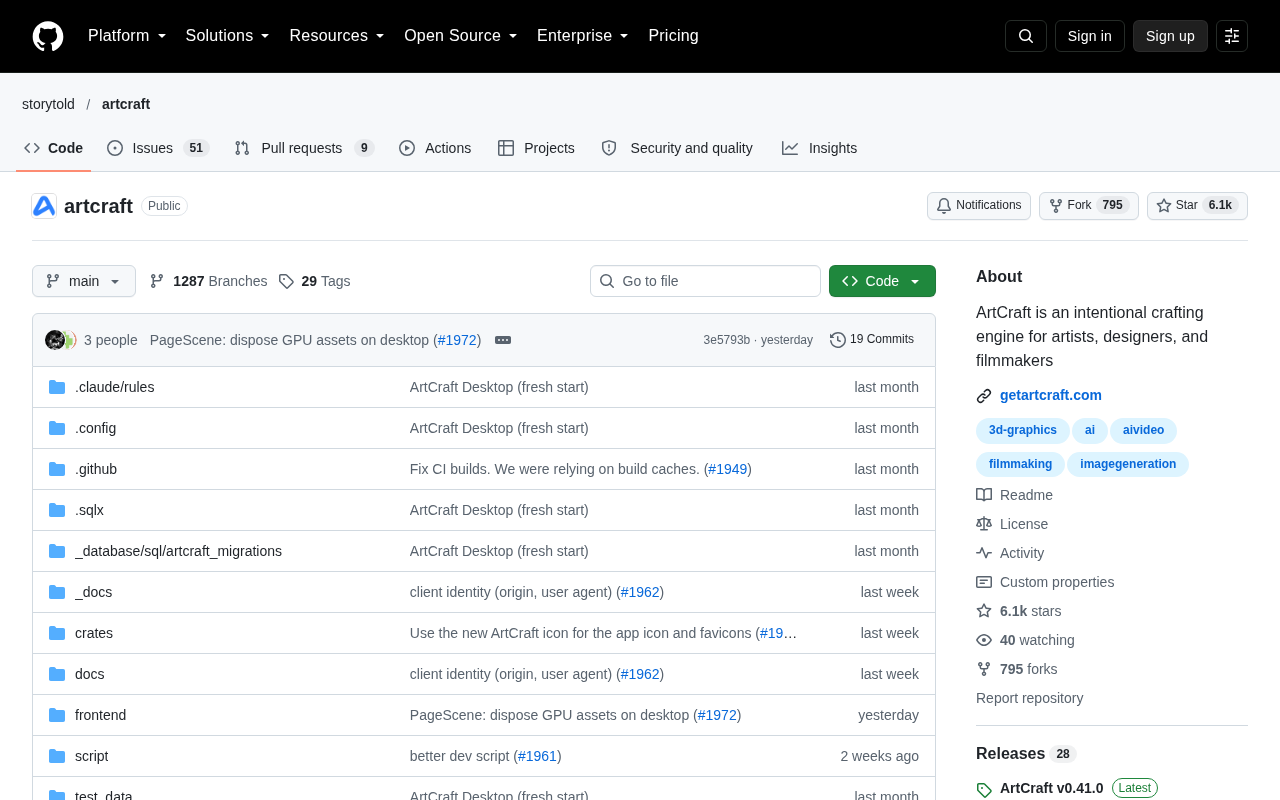
ArtCraft is an open-source, Rust-built intent-driven AI creation engine designed for artists and filmmakers.
ArtCraft is an open-source AI creation tool developed by the storytold team, positioning itself as an 'intentional crafting engine' for artists, designers, and filmmakers. Its core philosophy puts creators in control of the generation process rather than delivering passive one-shot outputs — aligning more closely with the iterative, detail-driven nature of professional creative work. Built in Rust, the project prioritizes local high-performance processing in an ecosystem dominated by Python. It gained over 1,465 Stars in a single day and nearly 6,000 total, signaling clear demand for open-source, workflow-friendly creative tools. However, public information remains limited and its full capabilities are still to be verified.
When AI Creative Tools Start Emphasizing "Intent"
In an era overflowing with generative AI tools, most products operate on a simple premise: input a prompt, get an output. A GitHub project called ArtCraft is trying to propose a different approach — defining itself as an "intentional crafting engine" built specifically for artists, designers, and filmmakers.
Developed by the storytold team, the project quickly accumulated over 5,900 Stars and 771 Forks after launch. More notably, it gained 1,465 Stars in a single day, signaling significant traction within the creator community. The entire project is written in Rust — a distinctive choice in an AI tooling ecosystem dominated by Python.
What Does "Intent-Driven" Actually Mean?
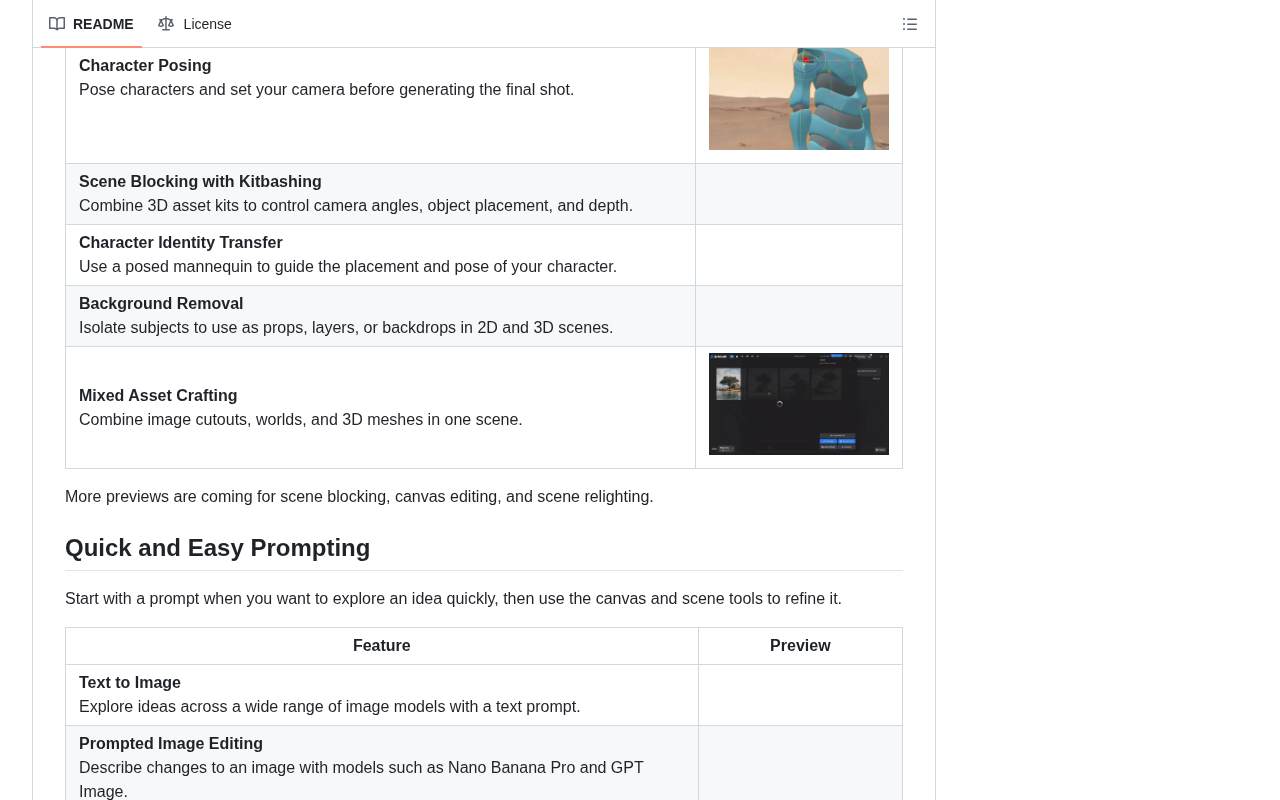
The phrase "intentional crafting" is the key differentiator that sets ArtCraft apart from conventional AI generation tools. Traditional text-to-image or text-to-video tools tend to be one-shot: you provide a description, the model returns a result, and the creator has virtually no control over the process in between. "Intent-driven" places the creator in the driver's seat — the tool doesn't make decisions for you; instead, it provides a controllable, iterative workflow built around your creative intent.
For artists, designers, and filmmakers, this framing is compelling because creative work is inherently a process of fine-grained refinement. A shot's composition, a frame's color grading, a character's pose — these require repeated adjustment. Compared to the "lottery-style" randomness of typical generation tools, an engine that can carry a well-defined creative intent and support precise control aligns far more closely with what professional creators actually need.
The concept of "intent-driven" tools has a long history in the creative software space. Blender's node editor, Adobe After Effects' expression system, and Unreal Engine's Blueprint visual scripting all attempt to let creators work in terms of "what effect I want" rather than "how to implement that effect." In the AI generation space, ComfyUI's node-based workflow is currently the closest open-source solution to "intent-controllable" pipelines, allowing users to explicitly wire together samplers, LoRA weights, ControlNet conditioning, and other modules into reproducible generation pipelines. For ArtCraft to establish meaningful differentiation in this space, it would need a higher-level abstraction in the "intent expression" interaction layer — enabling creators to drive generation using cinematic language, emotional vocabulary, or narrative structure, rather than simply exposing model parameter nodes.
Why Rust?
Given that most AI applications rely heavily on the Python ecosystem, ArtCraft's choice of Rust as its primary language is a noteworthy decision. Rust is renowned for memory safety, high performance, and excellent concurrency — qualities typically associated with performance-critical low-level systems.
For a creation-focused engine, this technical choice could point in several directions: prioritizing local, high-performance real-time rendering or processing with reduced reliance on cloud compute; or building a desktop-grade application with higher engineering quality and long-term maintainability, rather than a simple scripting tool. For use cases like filmmaking that demand high visual quality and processing speed, the advantages of a performant foundation translate directly into a smoother creative experience.
It's worth noting that Rust is not without precedent in AI tooling. The inference framework Candle (developed by Hugging Face) and the vector database Qdrant are both written in Rust — the former enables large model inference on edge devices without a Python runtime, while the latter achieves high-concurrency vector retrieval with extremely low memory overhead. These projects validate Rust's viability at the AI infrastructure layer. For a locally-focused creation engine like ArtCraft, Rust's zero-cost abstractions mean complex abstraction layers — such as workflow scheduling and image pipeline management — can be built without sacrificing performance, while avoiding the performance bottlenecks Python's GIL (Global Interpreter Lock) introduces in multi-threaded scenarios. That said, Rust's steep learning curve and higher barrier to community contribution compared to Python is a double-edged sword for an open-source project that depends on community collaboration.
Community Signals Behind the Open-Source Strategy
Gaining nearly 6,000 Stars in a short time, with over 1,000 added in a single day, reflects a clear unmet demand within the creator community. Most AI creative tools on the market today are either too closed (commercial SaaS products) or too technical (model frameworks aimed at developers). Tools that balance professional creator workflows with open-source customizability are rare.
ArtCraft's open-source approach gives it the opportunity to attract designers, independent filmmakers, and the technical community alike. The 771 Forks also indicate that a significant number of developers are already exploring the codebase for secondary development or experimentation. For creators who value creative autonomy and don't want to be locked into a single commercial platform, open source means greater transparency and control.
A Measured Take: Information Is Still Limited
It's worth noting that publicly available information about the project remains relatively sparse. Based solely on the repository description and basic metrics, it's difficult to fully assess ArtCraft's actual feature scope, model integration approach, or level of maturity. "Intentional crafting engine" is a positioning statement with plenty of imaginative room — but also one that's somewhat abstract. How it translates into product decisions — whether through node-based workflows, timeline editing, or some other interaction paradigm — still needs to be verified through more complete documentation and hands-on experience.
For interested creators and developers, the recommendation is to try running it locally first, paying close attention to documentation completeness, the AI models it depends on, and actual generation quality before deciding whether to integrate it into your creative workflow. Regardless of how it ultimately performs, the creator-intent-centered product philosophy that ArtCraft represents is a direction worth serious reflection across the entire AI creative tools industry.
Related articles

Random Pruning of the DPO Computation Graph: 1.4x Training Speedup and Lower Peak Memory
DPO training too slow and memory-hungry? This paper proposes a random pruning framework for the DPO computation graph, sampling independently across position, sequence, and branch dimensions; branch pruning achieves a 1.426x step-time speedup and cuts training time by about 30%, with in-depth attribution of memory and time gains.

Why Does JEPA Underperform MLM in Longitudinal EHR Representation Learning?
New study compares JEPA and MLM for longitudinal EHR representation learning on MIMIC-IV: three JEPA variants train stably without collapse but underperform MLM; target size, not heterogeneity, drives prediction error.

Transfer Learning + Visible Light Communication: A New Approach to Energy-Efficient Indoor Positioning
A study proposes a transfer learning-based visible light communication indoor positioning method, achieving 47% accuracy improvement on the BOSCH factory dataset, 67.5% model efficiency under high noise, and introducing the ME composite metric for energy-efficient positioning in energy-constrained industrial IoT scenarios.