AskDeck: Generate PPT Slides and Narrated Presentation Videos With a Phone Call
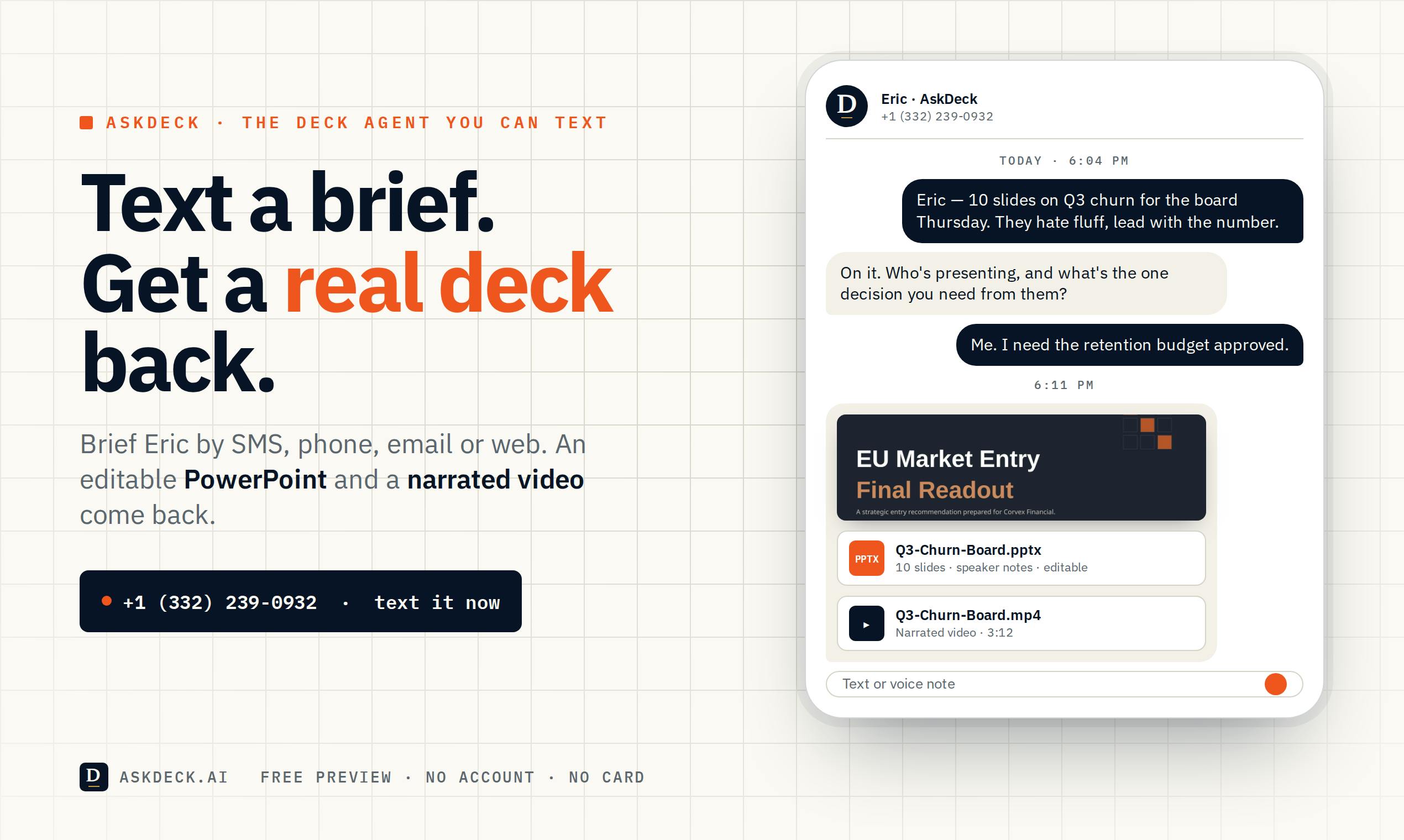
AskDeck lets you generate editable PPTs and narrated videos via phone call, SMS, or MCP — $29 one-time, no subscription.
AskDeck reimagines how AI presentation tools work. Instead of opening a browser and typing prompts, users can assign tasks by phone, SMS, email, or MCP from within Claude, ChatGPT, or Cursor. The output includes a standard editable pptx file and an auto-narrated walkthrough video. It also accepts half-finished decks for completion and polishing. Pricing is a one-time $29 for the final file; the free tier offers a watermarked preview with no sign-up required.
Making Presentations by Phone
Almost every AI presentation tool follows the same playbook: sit down at your computer, open a browser, type in a prompt, and wait for the result. AskDeck throws out that entire interaction model — you can just call it.
This tool, which landed at #20 on Product Hunt with 71 upvotes and 10 comments, offers an AI agent named "Eric." Users can assign tasks via phone call, SMS, email, or web interface — and even invoke it directly from within Claude, ChatGPT, or Cursor using the MCP protocol. When the job is done, you get two things: an editable PowerPoint file (pptx format) and a narrated video that automatically walks through the presentation slide by slide.
Multiple Entry Points as the Core Differentiator
AskDeck's real product philosophy is about liberating "generate a presentation" from the desktop experience. Traditional tools require your hands and eyes glued to a screen, while AskDeck lets you fire off a request during your commute, on a walk, or between meetings — with a single phone call or text message.
Equally notable is its compatibility with developer workflows. Through MCP (Model Context Protocol), AskDeck can be embedded directly into the conversational flow of mainstream AI tools like Claude, ChatGPT, and Cursor. That means while you're using an AI assistant to map out a project, you can seamlessly ask it to turn the discussion into a full presentation — no app switching, no copy-pasting. This "call it in place" capability is what sets it apart from most standalone deck tools.
MCP (Model Context Protocol) is an open protocol standard led by Anthropic, designed to let AI assistants invoke external tools and services in a unified way. Before MCP, every AI platform that wanted to integrate third-party capabilities had to build its own proprietary plugin or API adapter — costly to develop and incompatible with each other. MCP essentially defines a "universal power outlet" for the AI tool ecosystem: once a service provider integrates with the protocol, MCP-compatible clients like Claude, ChatGPT, and Cursor can call it directly without the user manually switching interfaces or copying content. AskDeck's MCP integration means presentation generation becomes an atomic operation available on demand within a conversation, rather than a separate app you have to open.
Output: Editable PPT Plus a Narrated Video
Many AI presentation tools only output static slides, or lock everything inside their own online editor with restricted export options. AskDeck delivers a standard pptx file, which means you can take it directly into PowerPoint, Keynote, or WPS and keep editing freely — no platform lock-in.
The accompanying narrated video addresses another common pain point. After finishing a deck, someone still has to present and explain it. AskDeck generates an auto-narrated video that walks through each slide with voiceover, making it well-suited for async sharing, archival recordings, or quick review materials.
Eric can also handle "works in progress." If you already have a half-finished deck, you can upload it and let the agent complete the rest — polish the content, recolor it to match brand guidelines, or fill in missing structure. This feature is genuinely useful for anyone stuck in the "started but never finished" state.
pptx is Microsoft PowerPoint's universal open format, part of the Office Open XML standard since 2007 and recognized as an international standard file format by ISO. Unlike PDF or image exports, pptx preserves the complete structural information of a presentation — text boxes, layers, animations, and styles are all stored as XML — so it can be read and re-edited without loss by PowerPoint, Keynote, WPS, LibreOffice Impress, and other major office applications. Many online presentation tools (like Canva or Beautiful.ai) offer pptx export but actually embed complex layouts as images, making text unselectable and formatting difficult to modify. AskDeck's emphasis on delivering "editable" pptx implies that its generated content retains native text and object structure — an important prerequisite for users who need to make adjustments later.
Pricing: One-Time Payment, No Subscription
At a time when SaaS tools almost universally default to monthly subscriptions, AskDeck takes a more straightforward approach. The free tier provides a watermarked preview with no account registration or credit card required, keeping the barrier to entry low. To get the clean, watermark-free final files, you pay a one-time fee of $29 — the files are yours, with no ongoing subscription charges.
This one-time purchase model is friendlier for users who only need to create presentations occasionally. Not everyone uses these tools frequently enough to justify a recurring monthly fee; paying per need simply fits the actual usage pattern better.
Thinking About Product Positioning
AskDeck's product logic is clear: it's not trying to compete head-on with established tools on slide aesthetics. Instead, it focuses on interaction model and output completeness. Multiple entry points reduce the time and situational cost of getting started; the dual pptx-plus-video output covers the full chain from creation to delivery; and one-time pricing sidesteps subscription fatigue.
Of course, the real-world value of any tool like this ultimately comes down to content quality — whether the AI layout looks good, whether the narration sounds natural, whether it correctly understands complex requests. These are things you'd have to verify through actual use. But from a product design standpoint, AskDeck has identified an angle that most comparable tools overlook: rather than making users adapt to the tool, it makes the tool adapt to whatever situation the user is in.
Related articles
WAN 2.1 Physics Motion LoRA Benchmark: Rankings and Methodology for 11 Models Tested
A Reddit user benchmarked 11 physics-motion LoRAs on WAN 2.1 using optical flow analysis. Only 3 worked meaningfully; 4 scored below the no-LoRA baseline. Full rankings and methodology inside.
Lucid Partners with Bolt to Target European Robotaxi Market
Lucid Motors has signed a letter of intent with European mobility platform Bolt to explore Robotaxi services in Europe, though no vehicle orders have been placed yet.
AI Assistants Enter the "Phone Call" Era: Instinct and Meta Muse Add Voice Task Execution
AI assistants Instinct and Meta Muse now make phone calls on your behalf — booking restaurants, canceling subscriptions — marking a leap from chat tools to real-world agents.