GPT-6.2 Dual-Model Hands-On Test: Astra Burns $419, Sol Just $5
GPT-6.2 Astra vs Sol tested: Astra high completion at high cost, Sol cheap but rough, still behind Fable/Opus in games.
A Bilibili creator compared OpenAI's GPT-6.2 Astra and Sol on Blender clock, neon shooter, and Formula racing tests. Astra targets professional work—high cost but good completion and follows feedback; Sol costs a quarter of Astra, with the clock test under $5, but is lazy and needs clearer instructions. Both clocks lack a real escapement. Fable and Opus still win on game detail and handling. Total: Astra $419, Sol $197.
OpenAI has released two new models at once—GPT-6.2 Astra and GPT-6.2 Sol—with completely different positioning: Astra claims to specialize in the most difficult professional work, while Sol is a daily-use model priced at only a quarter of Astra. A Bilibili creator ran both through the same three-round test (Blender clock, neon city shooter game, Formula racing game), and the results were both surprising and reasonable.
Unlike the comparison table on the official page—which shows Astra beating CloudFable 5.2 and Opus 4.5 on most tasks at a lower per-task cost, though Fable 5.2 still leads on the frontier code CAD benchmark and AI analysis index—the creator chose to ignore the table and just run the tests. All tests used a Codex subscription, with costs calculated using the models' own recorded estimated API prices, so every dollar spent is traceable.
Test 1: Blender Clock Workshop—The $5 Miracle and the $18 Flaw
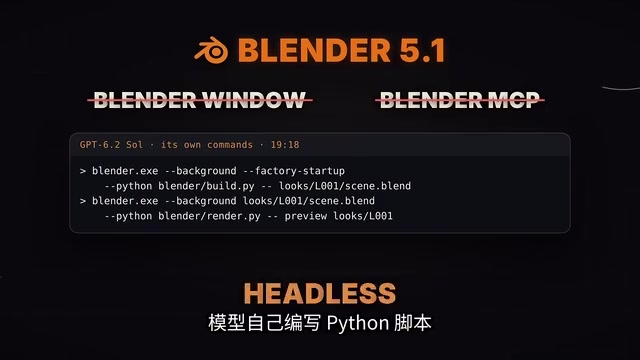
The first test required building a clock workshop inside an ancient bell tower just before dawn in Blender. The prompt had no reference image, no extra notes, and didn't even open a Blender window or use MCP—the model had to write its own Python script and run Blender headlessly from the command line.
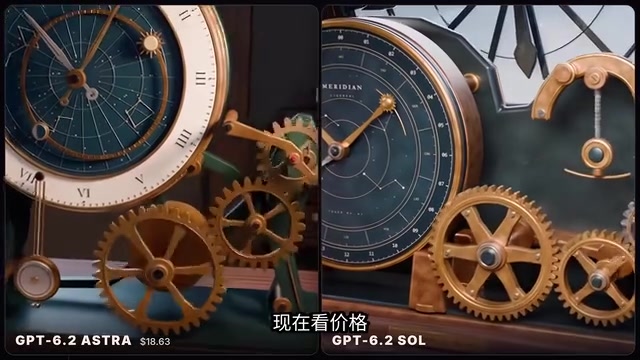
Astra's output was rich in detail: large windows, a table full of tools, clear background layering—though the clock itself was a bit chunky. Sol's version was chunkier still, but when placed side by side, the designs were almost identical—the large sphere behind the central clock, the gears on the sides, the crystal on the left, even the number 7. Checking the logs revealed that neither model had ever opened the other's folder—this is more likely a shared aesthetic preference within the same GPT family than plagiarism.
The more critical question: does the clock actually work? Opening the file and measuring the gears, three wheels mesh and rotate in opposite directions, with speeds perfectly matching tooth counts—the gearbox is fine. But the pendulum just swings on its own without driving any mechanism; there's no escapement. So both models delivered a "gearbox with a pendulum" rather than a real clock. This is exactly the old problem left over from GPT-6 Astra; by contrast, Fable and Opus both built escapements that actually tick.
On price: Astra cost $18, Sol under $5.
Historical costs for the same test, for comparison: Fable 5.2 was $36, Opus 5.5 was $42, GPT-6 Astra was $30, Kimi was $16, and the older Fable 5.1 was a whopping $125. Sol is thus the cheapest model on this test—but the creator also said plainly: it's also the worst.
Blender and Headless Mode
Blender is an open-source 3D modeling and animation application, usually operated through a graphical interface. But the test in this article used "no graphical interface," i.e., running via the command line with the blender --background parameter. In this mode, Blender creates no window—it only executes modeling, rendering, or simulation commands from a Python script, then exits. For an AI model, this means: it cannot rely on mouse clicks or visual feedback; it must precisely describe geometry, materials, lighting, and physical constraints entirely through code. The model therefore needs to understand Blender's Python API (bpy)—for example, using bpy.ops.mesh.primitive_cube_add() to create a cube, bpy.data.objects to manage objects, and constraints or drivers to achieve gear meshing. Headless mode also makes costs precisely measurable: each invocation is a script execution, and the model must plan its steps to avoid repeated trial and error driving up costs. This explains why the same task can vary so much in cost across models—some get it right in one pass, others need multiple rounds of debugging.
Test 2: Neon Cube—Astra Burns the Budget, Sol Is Too "Lazy" to Add Enemies
The second test was a shooter built inside a giant cube, where every wall is a neon city night street and players can walk on the walls. The test set a $100 checkpoint and a $200 budget cap.
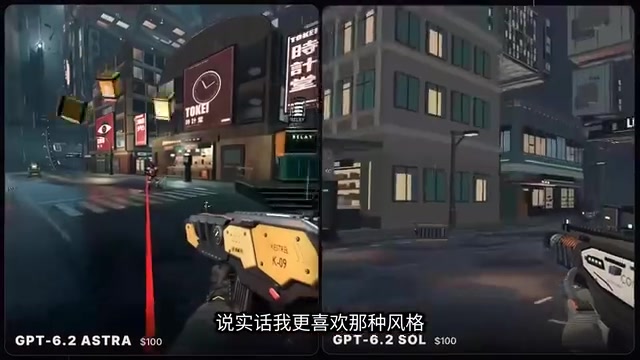
Astra performed well at the $100 mark: walls were nicely laid out, weapons matched the setting, but enemies were sparse, right-click zoom was missing, and the night was too bright. Sol was astonishingly slow—it took 9 hours to spend the first $100. The creator told it to "use more agents and spend the budget," but after running, there were no enemies at all—turns out enemies only appeared after a relay switch was turned on.
On color grading, GPT-family models have their own preferences: Sol 6.1, Sol 6.2, and Astra 6.2 are similar in style—slightly brighter, less orange; Anthropic's Opus and Fable are warmer and more orange, which the creator admitted preferring. After feeding back notes and continuing development, Astra's final version fixed right-click zoom, darkened the night, and burned through the entire $200 budget—overall quite good, but still not at Opus and Fable's level. Sol's final version had enemies appearing on the street from the start, and used only $145 of the budget.
One highlight in Astra's game: puddles realistically reflect the signs and buildings above, for which Astra wrote its own shader. Sol's ground this time was also slightly reflective, with faint light reflections visible. But in overall style and aesthetics, Fable and Opus still beat Neon Cube.
Agents and Budget Consumption Mechanics
The article repeatedly mentions "use more agents and spend the budget"—here, agents refer to autonomous subprocesses or tool-call units that an AI coding assistant invokes while completing a task. Under the Codex subscription model, the model can spawn multiple agents working in parallel or in series, and each agent's reasoning, code generation, file reads/writes, and command execution incur API costs. The budget cap (e.g., $200) is an artificial safety valve to prevent the model from falling into infinite loops or excessive trial and error. Astra's trait is "spends money extremely fast" because it tends to invoke agents frequently, repeatedly run Blender or the game engine, and generate lots of intermediate files; Sol is "lazy," possibly reducing agent invocations, leading to slow progress but low cost. Understanding this helps explain the test results: Astra traded budget for higher completion, while Sol traded less budget for a usable but rough result. It also suggests that when instructing a model, specifying "which parts to spend the budget on" is more effective than simply saying "spend the budget."
Test 3: Formula Racing—A Dual Test of Handling and Frame Rate
The third test was a racing game competing against other drivers, with the model responsible for everything—vehicles, trucks, crowds, etc. The budget was again $200 with a $100 checkpoint.
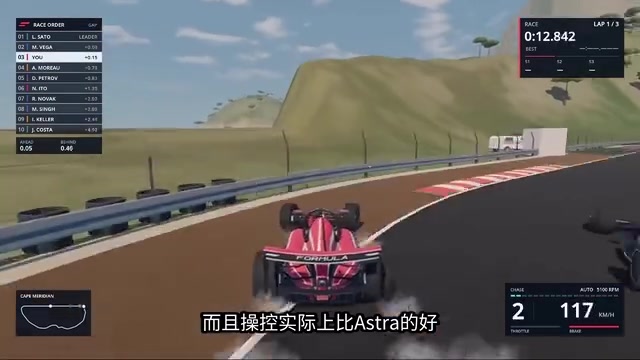
Astra at $100 looked okay graphically but was simply undrivable—spinning out on every corner, sparse backgrounds, and the hands in the cockpit had weirdly shaped fingers. Here the creator made a mistake with Sol: telling it in advance that it could deliver, so it finished in 27 minutes and spent only $28. The $28 result was a clear improvement over last time: hills, low-poly trees, and a beautiful sky, with handling even better than Astra's—at least it was actually drivable, though still toy-like, with no sense of speed, weak engine sound, and terrible steering feel.
After fixes, Astra's final version finally fixed the driving, no longer spinning out on every corner, adding spectacular mountains, four types of trees, and a village with a bell tower—once again burning through the entire budget. Sol's final version had cars with more weight, a camera that reacts to speed, louder engines, and new headlights. But there was one fatal detail: Sol's game at some point dropped to about two frames per second on every attempt.
Frame Rate (FPS) and Game Performance
Frame rate refers to the number of image frames rendered per second, measured in FPS. Racing games need a stable 30 FPS or higher to provide acceptable handling feedback, and 60 FPS or higher to feel smooth. Sol's final version "dropped to about two frames per second on every attempt," meaning the image is almost frozen and completely undrivable. Common causes of low frame rate include: excessive polygon counts in the scene, overly heavy real-time shadow or reflection calculations, too-small physics simulation steps, or inefficient loops in the code. For AI-generated games, models often prioritize visual effects (mountains, trees, headlights) while ignoring rendering optimization, leading to performance collapse. Astra's version, though also complex, did not exhibit extreme frame drops, suggesting it was slightly better in code structure or resource management. This detail reminds us: when evaluating AI-generated games, you can't just look at screenshots and feature lists—you must actually run them and measure frame rates, otherwise "drivable" may just be an illusion under static images.
Cost Ledger and Selection Advice
Total for the three tests: Astra spent $419, Sol spent $197. For reference, last week Fable 5.2 spent $357 completing the same tests.
The creator's observation: Astra spends money extremely fast, hitting the $200 cap in about 5 hours on both games; it's a powerful model that gets things done, follows notes, and will spend every cent you give it. Sol is cheap and a bit "lazy," but producing a clock repair shop for $5 is an incredible value. On game tasks, Fable and Opus continue to win—details (like hand modeling) and handling are clearly better, at the cost of being slower.
The selection logic thus becomes clear: for professional tasks demanding maximum completion with ample budget, Astra is worth the investment; for daily lightweight tasks or cost-sensitive scenarios, Sol can deliver usable results at a fraction of the price, just requiring clearer instructions and more patience. Astra is already very close to Anthropic's models, but still lags in fine motor control and physical correctness.
Codex Subscription and Estimated API Prices
The article mentions that "all tests used a Codex subscription, with costs calculated using the models' own recorded estimated API prices." Codex is a code generation service interface provided by OpenAI; under a subscription, users pay a fixed fee or are billed by token usage. But different models (Astra, Sol, Fable, Opus) have different unit prices, and the number of tokens consumed per call depends on prompt length, amount of code generated, and the model's internal reasoning steps. "Estimated API price" in the article means the model records its token consumption per call during operation, then multiplies by that model's public unit price to arrive at a dollar cost. This method isn't perfect—it doesn't account for subscription discounts, cache hits, or parallel-call optimizations—but it provides a horizontally comparable measure. Readers should note when referencing these numbers: cost depends heavily on task complexity and model strategy, and the same model can cost several times more under different prompts. Therefore, when selecting a model, look not just at total price but at "cost per unit of output"—the usable functionality or completion you get per dollar.
One-line Summary
GPT-6.2 Astra and Sol three-test hands-on: Astra high completion at high cost, Sol low price but rough, still behind Fable and Opus on game tasks.
Paragraph Summary
A Bilibili creator compared OpenAI's new models GPT-6.2 Astra and Sol across three tests: a Blender clock, a neon shooter game, and a Formula racing game. Astra targets professional work—high per-task cost but good completion, follows feedback, and will spend the entire budget; Sol costs a quarter of Astra, with the clock test under $5 setting a historical low, but it's "lazy" and needs clearer instructions. Both produced highly similar clock designs and neither implemented a real escapement, so the clocks don't run. On game tasks, Fable and Opus still win on detail and handling, though Astra is very close. Total: Astra $419, Sol $197. Selection advice: choose Astra for professional high-budget tasks, Sol for everyday low-cost tasks.
Related articles

ChatGPT Plus Subscription Pitfall Guide: Go/Plus/Pro Tier Comparison and Quick Activation
A complete ChatGPT Plus subscription guide based on a Bilibili tutorial: from registering an account, comparing Go/Plus/Pro tiers, to the practical steps for quickly completing your subscription.

GPT-6.2 Sol/Astra Released! A Step-by-Step ChatGPT Plus Subscription Guide and Tier Comparison
GPT-6.2 Sol/Astra is out—here's a ChatGPT Plus subscription guide: register an account, compare Go/Plus/Pro tiers, and subscribe in a minute.

Comparing Three Channels for Subscribing to GPT Plus in China: Is Website Top-Up the Easiest?
How to subscribe to GPT Plus in China? This article compares website top-up, credit card, and mobile top-up channels—process, cost, and risk—with steps and tips to help you choose wisely.