ASR Benchmark Testing: Which Scenarios Should You Prioritize?

A practical guide to prioritizing ASR benchmark scenarios, from quiet dictation to noisy multi-speaker meetings.
Building an ASR benchmark means finding the most valuable entry points among infinite real-world scenarios. Starting from a developer's question about benchmarking a low-resource language, the article proposes layering scenarios by environmental complexity and speaker count: first establish a quality baseline with single-speaker quiet dictation, then introduce controlled noise, and finally expand to multi-speaker natural conversations. Key evaluation dimensions go beyond WER to include accent adaptability, noise robustness, speaker diarization, domain terminology, and punctuation output. For low-resource languages, data diversity beats data volume every time.
Why Scene Prioritization Matters for ASR Systems
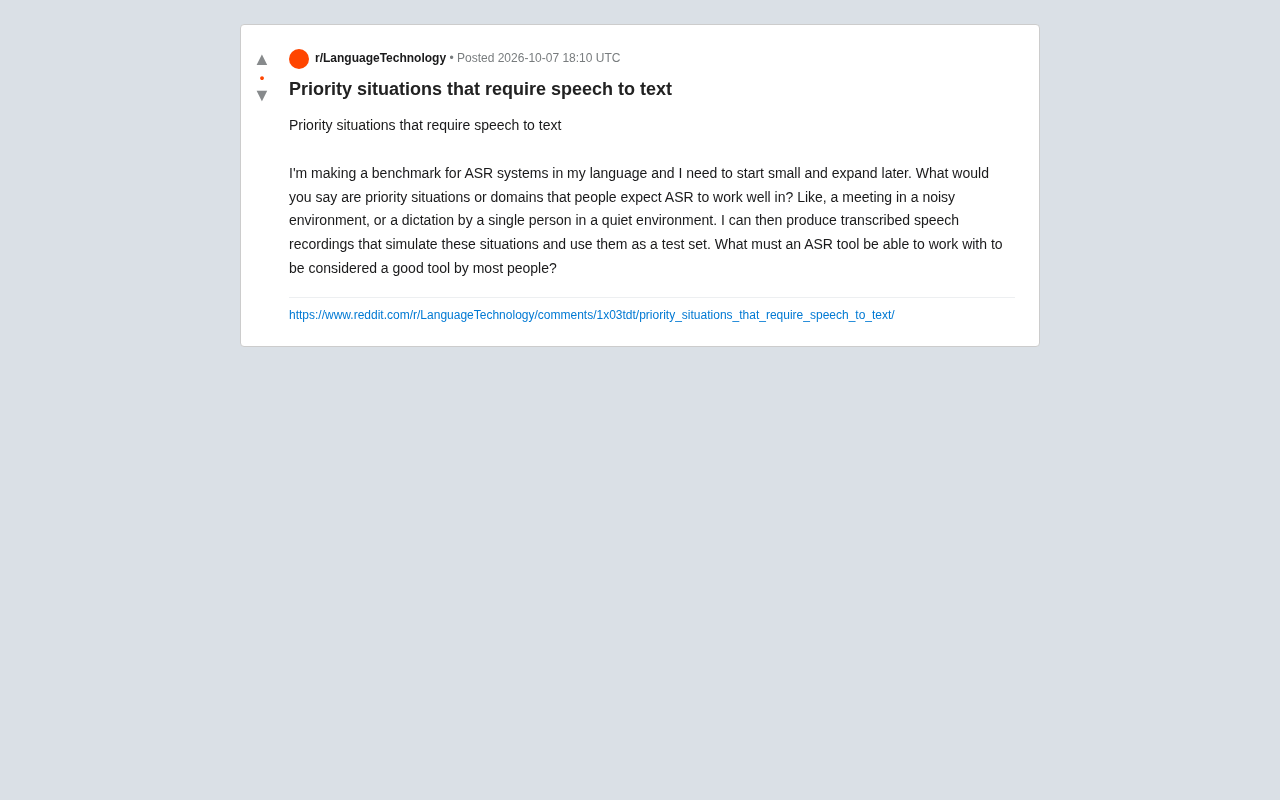
When building an evaluation benchmark for an Automatic Speech Recognition (ASR) system, a common question arises: faced with an endless variety of real-world speech scenarios, where do you even begin? A Reddit developer building an ASR benchmark for their native language posed exactly this core question — they wanted to start small and scale up gradually, but weren't sure which scenarios users actually expect ASR to handle well.
The question seems straightforward, but it cuts to the heart of speech recognition product design: Whether an ASR tool is "good" isn't determined by a single average Word Error Rate (WER) metric — it depends on whether the system performs reliably in the scenarios users care about most. A system that works perfectly in quiet environments but falls apart in noisy meetings is still considered inadequate by most users.
High-Priority Speech Scenarios in the Real World
From a user needs perspective, ASR use cases can be broken down along two dimensions: environmental complexity and number of speakers. Different combinations present very different technical challenges.
Single-Speaker Dictation in Quiet Environments
This is the most fundamental ASR scenario — and the one users have the least tolerance for failure. A single person dictating emails, notes, or documents in a quiet room expects near-perfect transcription quality. The technical challenge here isn't noise, but rather punctuation prediction, proper noun recognition, and long-sentence coherence. For any new benchmark being built, this should be the first scenario covered — it defines the system's quality floor.
Word Error Rate (WER) is the most commonly used evaluation metric in ASR. It's calculated by aligning the recognition output with a reference transcript, then dividing the total number of substitutions, deletions, and insertions by the total number of words in the reference. However, WER has a blind spot in quiet single-speaker scenarios that's easy to overlook: it treats all words equally, but users have far less tolerance for errors on names or critical numbers than on function words. As a result, some evaluation frameworks supplement WER with weighted WER or proper noun error rates to more accurately reflect user-perceived quality.
Meeting Transcription in Noisy Environments
Multi-person meetings are ASR's toughest challenge — and also the domain with the highest enterprise demand. These scenarios layer multiple difficulties on top of each other: background noise, speaker overlap (cross-talk), signal attenuation from far-field microphones, and the need for speaker diarization. Users have relatively higher tolerance for transcription errors in meetings, but still expect key information to be captured accurately. Building test sets for this type of scenario requires deliberately introducing samples with varying signal-to-noise ratios and multiple alternating speakers.
Speaker Diarization refers to the technology that automatically segments an audio stream and labels "who spoke when," typically running as a standalone module before or after ASR. The core difficulty lies in overlapping speech segments (two people speaking simultaneously) and speakers with similar voice profiles (e.g., same gender or same accent group). The standard evaluation metric is DER (Diarization Error Rate), which combines missed speech, false alarms, and speaker confusion errors. In meeting scenario benchmarks, DER and WER should be reported together — even if the transcript is accurate, a meeting summary is useless if speaker attribution is wrong.
Mobile and Outdoor Scenarios
Mobile voice input, in-car voice assistants, and outdoor interviews introduce non-stationary noise — wind, traffic, sudden sounds. These scenarios test the system's robustness to dynamic environments and are a key indicator of whether an ASR system can perform outside the lab.
Core Criteria for Judging Whether an ASR Tool Is "Good"
Going back to the developer's ultimate question: what does an ASR tool need to do for most users to consider it a good tool?
Based on the scene-priority framework, several key evaluation dimensions emerge:
- Accent and dialect adaptability: Pronunciation variation within a language is often more disruptive than external noise, especially for languages with fewer resources than English.
- Noise robustness: Whether the system can maintain usable transcription quality at moderate signal-to-noise ratios is the dividing line between a "toy" and a "tool."
- Speaker diarization capability: In multi-speaker scenarios, who said something matters just as much as what was said.
- Domain terminology coverage: Recognition accuracy for specialized vocabulary in medical, legal, technical, and other vertical domains directly determines adoption among professional users.
- Punctuation and formatted output: There's a massive user experience gap between raw word streams and readable text.
Practical Advice for Building a Benchmark
For developers looking to build an ASR evaluation set from scratch, the "start small, scale gradually" strategy is the right approach. A recommended progression:
Phase 1: Prioritize recording and transcribing single-speaker quiet dictation samples to establish a quality baseline. This data is the easiest to annotate and most effective at exposing fundamental model weaknesses.
Phase 2: Introduce controlled noise conditions — by layering different types and intensities of background noise onto clean recordings to simulate real environments. This semi-synthetic approach is low cost and makes it easy to quantify how system performance degrades across different SNR levels.
Phase 3: Expand to multi-speaker and natural conversation scenarios, covering meetings, interviews, and other complex settings, and gradually incorporate dialect and accent variations specific to the target language.
It's worth emphasizing that for lower-resource languages, data diversity matters more than data volume. A small benchmark that covers key scenarios, accents, and noise conditions far better reflects a system's true capabilities than a large but homogeneous dataset.
Signal-to-Noise Ratio (SNR) is the core parameter for quantifying audio environment complexity, measured in decibels (dB). A general rule of thumb: SNR above 20dB is near-quiet, 10–20dB is light noise, 5–10dB is moderate noise, and below 5dB most ASR systems show significant performance degradation. In the semi-synthetic noise-mixing approach, developers can use open-source tools (such as Sox or pyroomacoustics) to mix background noise from standard libraries (like MUSAN or FreeSound) into clean recordings at precisely controlled SNR levels — systematically mapping performance degradation curves without collecting additional data. This method is especially useful for low-resource languages, where annotated data from real noisy environments is extremely difficult to obtain.
Conclusion
The value of an ASR benchmark lies in how honestly it reflects users' real expectations. Rather than trying to cover every possible scenario, it's better to anchor on the two extremes — single-speaker dictation and noisy meetings — and expand incrementally toward the middle and edges from there. For any developer looking to build a speech recognition evaluation system, understanding "in which scenarios users have the least tolerance for failure" is the true starting point for designing your priorities.
Related articles

Gaussian Process Bandit Optimization: Exploration Strategies and Inference Regret Guarantees
Cumulative regret guarantees in Bayesian optimization fail to reflect final recommendation quality. This article examines a new study that provides inference regret guarantees for Gaussian process bandit optimization through exploration query strategies and fill distance analysis, validated on hyperparameter optimization and control tasks.

The Most Detailed Codex Guide on Bilibili: From Installation to Real-World Practice
The most detailed Codex guide on Bilibili: from app store installation to daily work mode configuration, with a real coffee shop project demonstrating file organization, data extraction, dashboard creation, and other practical tasks. Learn to use Plan Mode and desktop pets to leverage Codex efficiently.

Appearance Compensation in Volume Rendering: Why RGB Accuracy Cannot Guarantee Density Correctness
Volume rendering research reveals that volumetric data perfectly reproducing external RGB views may still contain density errors: appearance compensation can double central density and keep external rays unchanged even when L2 error exceeds 14.52%. Density recovery depends on appearance capacity, spatial resolution, and measurement design.