Astra 6.2 and Sol 6.2 Unexpectedly Flop on Simple Bench

Astra 6.2 and Sol 6.2 performed poorly on the Simple Bench common-sense reasoning test, prompting scrutiny of models' true capabilities.
Astra 6.2 and Sol 6.2 underperformed on the Simple Bench benchmark, and the Hacker News activity (179 points, 165 comments) reflects community doubts about the models' true reasoning abilities. Simple Bench is known for everyday common-sense questions requiring multi-step reasoning, exposing weaknesses in models that rely on pattern matching rather than genuine understanding. The article analyzes why a "simple" benchmark is actually harder, discusses the limitations of benchmarks and the "simple question trap" in model iteration, and emphasizes the importance of multi-dimensional evaluation and generalization capability.
Event Recap: Why Two Highly Anticipated Models Faltered on Simple Bench
According to a trending discussion on Hacker News (179 points, 165 comments), two models named Astra 6.2 and Sol 6.2 performed poorly on the Simple Bench benchmark, raising questions in the community about their true reasoning capabilities. Simple Bench (simple-bench.com) is known for questions grounded in everyday common sense, and it often exposes the gap between a model's complex reasoning and surface-level fluency. The original post only provided a link and discussion activity, without specific scores or failure cases, but judging from the title "flop" and the strong community reaction, the results were clearly below expectations.
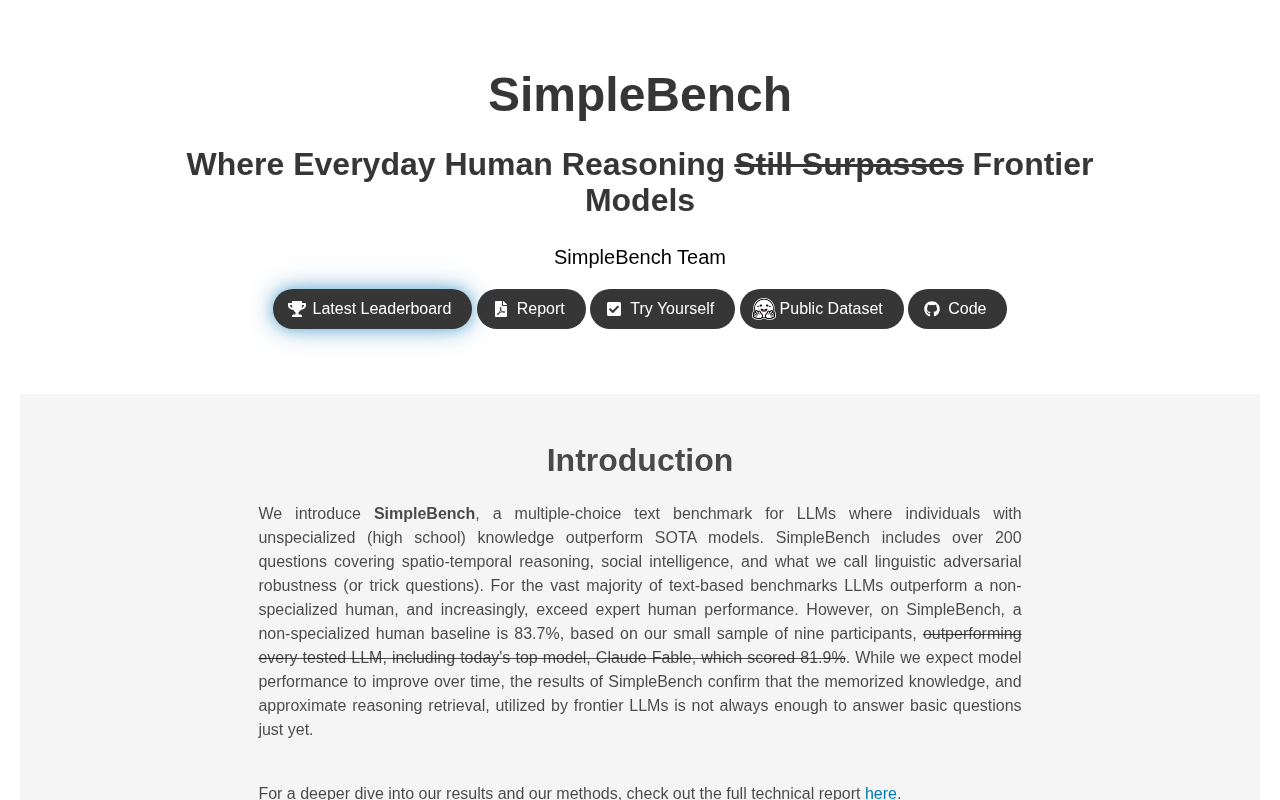
Simple Bench is designed to have models answer questions that humans find "simple" but that require common sense and multi-step reasoning. As such, it is often used to test whether a model truly understands a question rather than relying solely on pattern matching. The flop of Astra 6.2 and Sol 6.2 means both models have clear weaknesses in generalizing to tasks outside the training distribution.
The Testing Logic Behind Simple Bench and What a "Flop" Means
Why a "Simple" Benchmark Is Actually Harder
Simple Bench questions are often common-sense problems that humans can answer at a glance, but for language models they require stepping outside statistical associations and performing genuine causal or spatial reasoning. When models rely on high-frequency patterns in training data, they are prone to errors on questions that require recombining knowledge. The failures of Astra 6.2 and Sol 6.2 likely fall into this category: they perform reasonably on standard benchmarks but reveal fragility in simple scenarios that demand flexible reasoning.
Distribution shift is a key concept for understanding this phenomenon. It refers to differences in statistical characteristics between test data and model training data, causing models to perform well on the training set but degrade on the test set. Simple Bench questions often require combining common-sense relationships that are rare in training, thus constituting an out-of-distribution (OOD) test for models. High scores on standard benchmarks (such as MMLU) may stem from heavy overlap between those questions and the training corpus; Simple Bench deliberately avoids such overlap, forcing models to perform genuine reasoning rather than retrieval. The "flop" of Astra 6.2 and Sol 6.2 is a typical manifestation of distribution shift: the models cannot flexibly transfer learned knowledge to new combinations.
Community Reaction and Discussion Focus
The 165 comments on Hacker News indicate that developers care not only about scores but also about failure modes. Discussion likely centered on whether the models are overfitting, whether the evaluation methodology is fair, and how reliable these two models are in real-world applications. Although the original post did not elaborate on the specific comments, the high activity itself shows that the industry remains vigilant about the gap between models' "surface capabilities" and "substantive capabilities."
Benchmark contamination is a common concern raised in community discussions. It refers to evaluation questions or their variants having already appeared in model training data, leading to inflated scores that do not reflect true generalization ability. Because Simple Bench questions are close to everyday common sense, they are more likely to be inadvertently included in training corpora (for example, from forums and Q&A sites), weakening their discriminative power. Hacker News comments may revolve around this point: the poor performance of the two models on Simple Bench might suggest they did not "memorize the questions," but more likely exposes their fragility on novel reasoning tasks they have not seen. Understanding benchmark contamination helps explain why some models shine on public leaderboards yet falter on simple common-sense questions.
Implications for Model Capability Evaluation
The Limitations of Benchmarks Are Highlighted Once Again
This incident reminds us that a single benchmark score cannot represent a model's overall capabilities. The failure of Astra 6.2 and Sol 6.2 on Simple Bench may indicate systematic deficiencies in specific types of reasoning tasks. For developers and enterprise users, model selection requires evaluation across multiple dimensions, especially tests that closely reflect real-world usage scenarios.
The "Simple Question Trap" in Model Iteration
As model scale grows and training data coverage widens, models can still make mistakes on simple common sense. This may stem from data bias, broken reasoning chains, or excessive alignment. The cases of Astra 6.2 and Sol 6.2 show that capability improvements are not linear, and some seemingly simple tasks become insurmountable obstacles.
Alignment tax and over-refusal are two mechanisms that explain the "simple question trap." Alignment tax refers to performance degradation in certain original capabilities after alignment training such as reinforcement learning from human feedback (RLHF); over-refusal refers to models refusing to answer simple questions they could normally handle due to safety alignment, or adding unnecessarily cautious wording that disrupts the reasoning chain. Astra 6.2 and Sol 6.2 may have sacrificed some direct reasoning ability in pursuit of safety and helpfulness, leading to hesitation or errors on questions that require decisively giving common-sense answers. This phenomenon reminds developers that a delicate balance is needed between alignment objectives and reasoning capabilities.
Conclusion and Outlook
The performance of Astra 6.2 and Sol 6.2 on Simple Bench has prompted the community to re-examine models' true reasoning capabilities. Although the original information is limited, this incident once again emphasizes the importance of multi-dimensional evaluation. In the future, model developers need to pay more attention to generalization and common-sense reasoning rather than merely pursuing benchmark scores. For users, maintaining a critical understanding of model capabilities is essential for making more reliable choices in practical applications.
One-line Summary
Astra 6.2 and Sol 6.2 performed poorly on the Simple Bench common-sense reasoning test, prompting scrutiny of models' true capabilities.
Paragraph Summary
Astra 6.2 and Sol 6.2 underperformed on the Simple Bench benchmark, and the Hacker News activity (179 points, 165 comments) reflects community doubts about the models' true reasoning abilities. Simple Bench is known for everyday common-sense questions requiring multi-step reasoning, exposing weaknesses in models that rely on pattern matching rather than genuine understanding. The article analyzes why a "simple" benchmark is actually harder, discusses the limitations of benchmarks and the "simple question trap" in model iteration, and emphasizes the importance of multi-dimensional evaluation and generalization capability.
Related articles

Win a Car for Getting Close to 50 Pounds? The Whatnot Marketing Behind a YouTube Challenge
An analysis of the YouTube challenge "Get Close to 50 Pounds and Win a Car," exploring how it drives traffic to livestream platform Whatnot and why weight-guessing content attracts viewers and converts commercially.
The Binding of Isaac Developer Removes AI Music, Steam Review Bombing Subsides
The Binding of Isaac: Repentance+ faced Steam review bombing over AI music, and the developer has removed the tracks. This article reviews the incident, analyzes player anxiety about AI replacing human creation, and explores transparency and trust costs around AI content in the game industry.

Why Data Centers Have Become the Center of Big Tech's Backlash
Tech journalist Paris Marx's book Hyperscale reveals how data centers became the flashpoint for Big Tech backlash—from resource costs and environmental impacts to policy battles.