Asụsụ Ọma: Learn Igbo for Free with Native Speaker Voiceovers and Games

Asụsụ Ọma is a free Igbo learning app with native voiceovers and gamified lessons bridging the digital language gap.
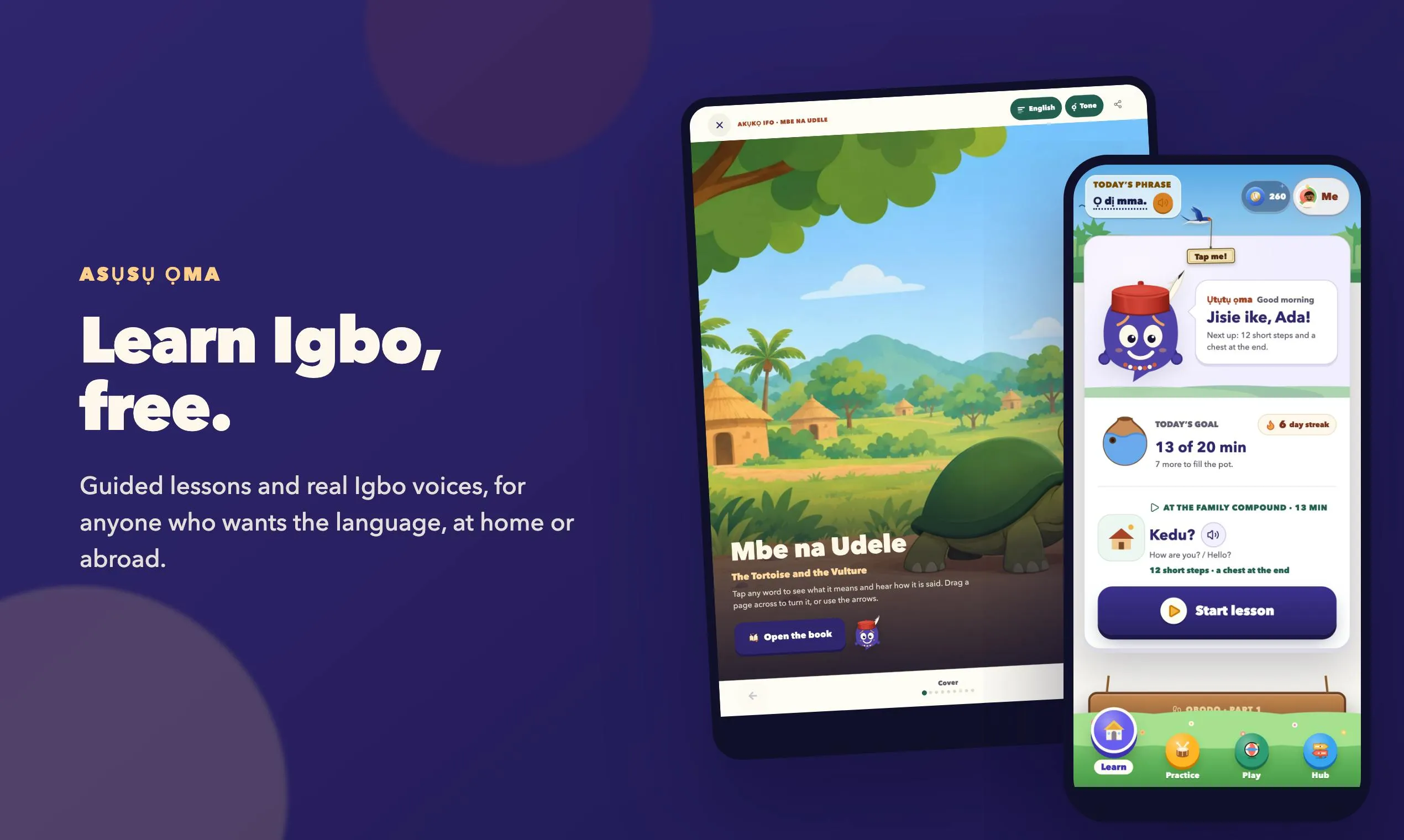
Asụsụ Ọma is a free Igbo language learning app developed by Ebenezer Don, built for a community of roughly 45 million speakers that has long lacked quality digital learning resources. It offers structured lessons, gamified exercises, and folktales, with every phrase recorded by a native speaker to ensure authentic pronunciation for this tonal language. Unlike mainstream language apps that rely on subscriptions, it is entirely free with no ads or paywalls — closer to a cultural preservation project than a commercial product. Its existence is a reminder that mobile technology and native recordings can serve linguistic diversity just as effectively as mainstream markets.
A Language Learning App That Fills a Real Gap
Igbo is spoken by tens of millions of people worldwide, primarily in southeastern Nigeria, making it one of the most important languages in West Africa. Yet despite its large speaker base, finding a systematic way to learn Igbo is remarkably difficult. That's exactly the problem Asụsụ Ọma aims to solve.
Developed by Ebenezer Don, this free app has a clear mission: to provide a complete, authentic, and zero-barrier learning solution for the Igbo language. It recently launched on Product Hunt, where it was listed under the Android, Education, and Language categories.
Core Features: More Than Just Vocabulary Drills
Based on the product description, Asụsụ Ọma is built around several key pillars:
Guided Lessons
The app offers structured guided lessons that allow complete beginners to build their Igbo skills step by step. This approach mirrors mainstream language learning apps and significantly lowers the barrier to self-study.
Native Speaker Voiceovers
The app's standout feature is that every phrase is recorded by a native speaker. For a tonal language like Igbo, accurate pronunciation is critical — synthetic text-to-speech voices often fail to capture the natural cadence and tone of real speech. Native recordings give learners access to authentic accents and natural phrasing, something that's missing from many minority language learning tools.
Igbo belongs to the Niger-Congo language family and is a classic tonal language: the same syllable can carry entirely different meanings depending on its tone. Igbo has two primary tones (high and low), with some analyses also identifying a downstep variant. This means tone isn't just a phonetic feature — it's a core carrier of lexical meaning. For example, two words with identical spelling can mean "money" and "snake" depending on their tones. For learners whose native languages are non-tonal, relying solely on written text or synthetic audio is a recipe for misunderstanding. Native recordings are therefore an irreplaceable resource for learning tonal languages.
Gamification and Cultural Content
Beyond standard lessons, the app also includes games and folktales. Gamification mechanics help boost engagement and retention, while folktales weave cultural heritage into the learning experience — so learners don't just memorize vocabulary, they also gain insight into the cultural context behind the language.
Completely Free, No Paywalls
At a time when most language learning apps default to subscription models, Asụsụ Ọma takes a radically different approach: no ads, no subscriptions, and no content locked behind a paywall.
This fully free model positions the app less as a commercial product and more as a cultural preservation and language revitalization effort. For members of the global Igbo diaspora looking to pass on their mother tongue, as well as anyone curious about West African languages and cultures, this zero-cost approach removes every barrier to entry.
Why Products Like This Matter
Across the globe, many widely spoken languages remain severely underserved when it comes to digital learning resources. Mainstream platforms tend to prioritize languages with higher commercial value, leaving languages like Igbo chronically overlooked.
Asụsụ Ọma demonstrates what's possible: with a mobile app, native voice recordings, and gamified design, an independent developer can build a high-quality learning tool for a specific language community. The project may not have set Product Hunt on fire (it earned 4 upvotes and ranked 18th), but its social and cultural significance is hard to overstate.
For the tech community, this is also a reminder: AI and mobile technology don't have to serve only mainstream markets — they can be powerful tools for protecting linguistic diversity and preserving minority cultures.
The digital language gap is especially acute across the African continent. According to UNESCO, roughly 40% of the world's population lacks access to education in their native language. Of Africa's 2,000-plus languages, fewer than 100 have made it onto digital learning platforms. This "digital language divide" not only limits learning opportunities for native speakers but also accelerates language extinction — approximately one language disappears globally every two weeks. Igbo, despite having around 45 million speakers, faces real pressure from younger generations shifting toward English, a trend compounded by urbanization in Nigeria and the dominance of English-medium education. Mobile learning tools offer a new pathway for language preservation — one that is low-cost and highly accessible.
Wrapping Up
Built on the principles of being free, authentic, and easy to use, Asụsụ Ọma offers a systematic entry point into a language that has long lacked adequate learning resources. It may not be the flashiest product on Product Hunt, but for the Igbo community, an app with no paywall and real native speaker audio fills a gap that genuinely exists.
Related articles

WorkBuddy Agent Complete Guide: From Beginner to Automation in 7 Days
Based on Bilibili's 256-episode WorkBuddy masterclass, this systematically breaks down Tencent's AI office workbench core capabilities: Agent principles, Skill encapsulation, cross-platform connectors, scheduled automation, knowledge bases, and zero-code development, with learning path recommendations.

8 AI Accounts, 7 Failed: An Honest Review of Using AI to Get Work Done
Only 1 of 8 AI-run Bilibili accounts succeeded. We break down the real difference between "performing AI" and "using AI to get work done."

DeepSeek Harness Step-by-Step Installation Guide: Core Principles and Building Automated AI Applications
Based on Bilibili creator Pan Ge's DeepSeek Harness tutorial, this guide covers Node.js installation, npm global directory and cache configuration, environment variables, and the core principles of Harness with Agents.