Asynchronous Flow-Map Language Models: A New Paradigm for One-Step Generation

aFMLMs use tokenwise schedules to define asynchronous flows, internalizing prediction order into one-step parallel generation.
The newly proposed Asynchronous Flow-Map Language Models (aFMLMs) aim to solve the problem of how to exploit token prediction order in one-step parallel generation. They introduce tokenwise schedules to control each token's denoising progress, encode order as an asynchronous flow, and compress multi-step flow behavior into a single forward pass via flow-map distillation. The paper formalizes a general class of asynchronous flows supporting both prespecified and learned adaptive schedules and proves they define valid flow maps. On two order-sensitive tasks—Sudoku solving and GSM8K code generation—aFMLM achieves new best performance under the one-step generation setting. Public discussion currently comes mainly from the paper itself, independent reproduction is lacking, and task coverage and efficiency comparisons await further verification.
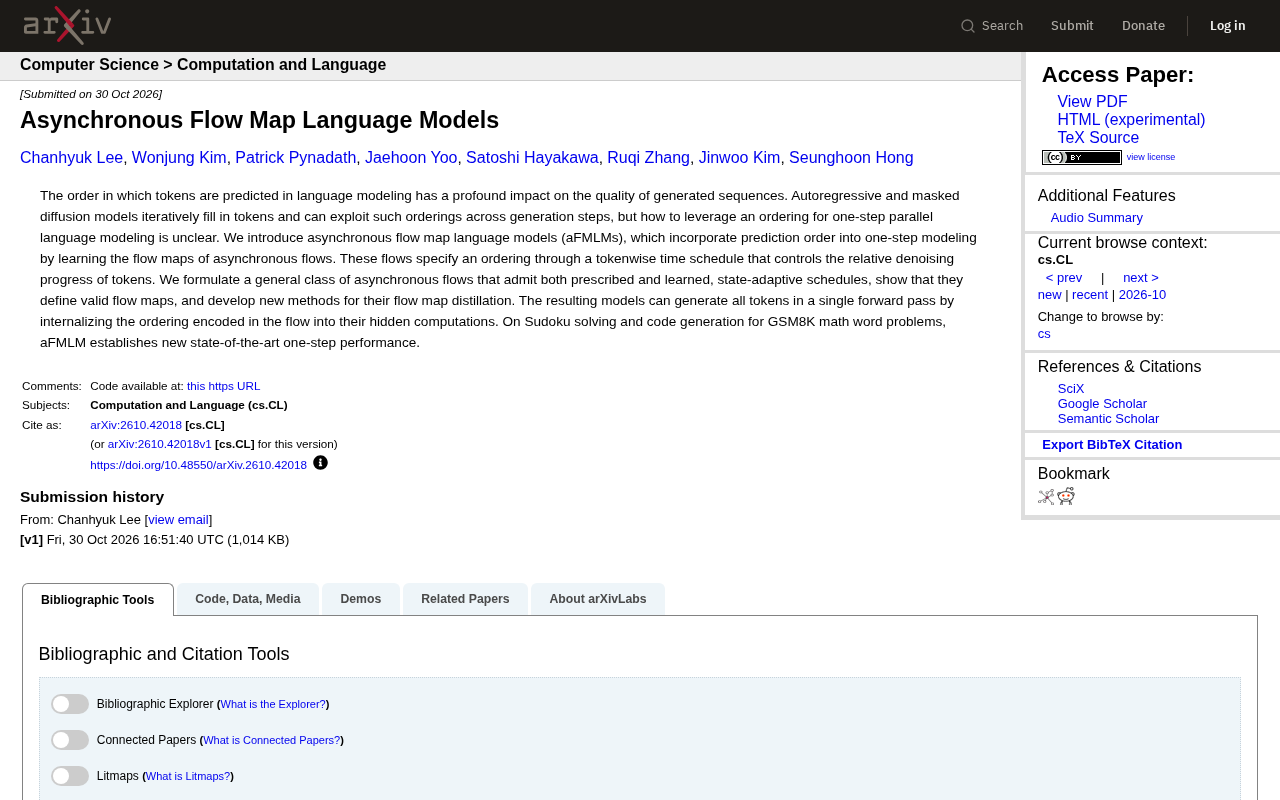
The order in which a language model generates tokens profoundly affects the quality of the final sequence. Autoregressive models and masked diffusion models can exploit this ordering across multiple generation steps by iteratively filling in tokens; however, if one wants to use one-step parallel generation, it has remained unclear how to make use of the ordering information. The newly proposed Asynchronous Flow-Map Language Models (aFMLMs) attempt to fill this gap: they encode the prediction order into the further generation process by learning the flow map of an asynchronous flow.
Why Order Matters: From Iterative Generation to One-Step Parallelism
Autoregressive models generate token by token, with each step conditioned on the previously generated content, so order is inherent. Masked diffusion models can fill in at arbitrary positions and gradually refine the sequence through multi-step denoising, so ordering can likewise be reflected during iteration. The problem is that one-step parallel generation requires the model to produce all tokens simultaneously in a single forward pass, and traditional approaches struggle to inject a preference for "which token to predict first and which later." The idea behind aFMLMs is not to change the parallel form of one-step generation, but to have the model internalize an ordering within its hidden computation.
Asynchronous Flows and Tokenwise Schedules
The researchers introduce an asynchronous flow, assigning each token a tokenwise schedule that controls the relative speed of each token's denoising progress. The schedule defines an ordering: tokens with faster progress are effectively determined first, while slower ones lag behind. This design turns "order" from a discrete arrangement of generation steps into a difference in progress along a continuous time axis.
Asynchronous flow draws on the idea of flow matching in continuous-time generative models. In standard flow matching, all dimensions share the same schedule, and evolution from noise to data proceeds synchronously; "asynchronous" means that each token (or each dimension) has an independent time axis, allowing different positions to complete denoising at different rates. This asynchrony is implemented mathematically by defining a monotonically increasing time reparameterization function for each dimension, thereby expressing discrete generation order within a continuous-time framework. A tokenwise schedule can be understood as: assigning a function τ_i(t) to the i-th token in the sequence, such that the faster τ_i grows, the earlier that token is "determined." This provides a differentiable way to encode order for one-step generation.
The Mathematical Framework of Asynchronous Flows and Flow-Map Distillation
The paper formalizes a general class of asynchronous flows that supports both prespecified schedules and schedules learned from data and adaptively adjusted with the state. The authors prove that such flows can define valid flow maps and present a new flow-map distillation method.
From Flows to One-Step Generation
The goal of flow-map distillation is to compress the behavior of a multi-step asynchronous flow into a single forward pass. The model does not need to simulate the full time evolution at inference time; instead, it directly learns the output of the flow map, thereby generating all tokens in one step. According to the original text, aFMLM generates all tokens in a single forward pass by internalizing the order encoded in the flow into its hidden computation.
Flow-map distillation is a distillation technique that compresses a multi-step generation process into a single step. Its core idea is to learn a mapping that directly predicts the correspondence from initial noise to the final sample, without numerically integrating the entire flow at inference time. In the asynchronous flow framework, the flow map must simultaneously capture the progress differences among tokens, so the distillation objective includes not only the final output but also the ordering structure implied by the schedule. Compared with one-step distillation methods such as consistency models, flow-map distillation places more emphasis on explicit modeling of order, which is also the key to aFMLMs' ability to internalize order into hidden computation.
Experimental Results: Sudoku and GSM8K Code Generation
The paper evaluates aFMLM on two tasks: Sudoku solving and code generation for GSM8K math word problems. The results show that aFMLM establishes new state-of-the-art one-step performance on both tasks.
Task Characteristics and Order Sensitivity
Sudoku solving is highly sensitive to order: which cells are filled first and which later directly affects the efficiency of constraint propagation. Code generation likewise involves structural dependencies of precedence, such as variable declaration and use, and the nesting order of control flow. These two tasks are well suited to testing whether "order internalization" truly brings benefits. The original text does not disclose specific numerical metrics, but it explicitly positions the results as a new best level under the one-step generation setting.
Sudoku solving is a typical constraint satisfaction problem, where each filling step propagates constraints and shrinks the candidate space. If the filling order is inappropriate, it may lead to extensive backtracking or dead ends; a reasonable order (such as prioritizing the cell with the fewest candidates) can significantly improve efficiency. Therefore, Sudoku is naturally suited to evaluating whether a model has learned a prediction order that is "easy first, hard later" or "strong constraints first, weak constraints later." GSM8K code generation, in turn, requires the model to understand the structural dependencies of programs: variables must be declared before use, and control flow has nested levels. Incorrect order leads to syntax errors or semantic errors. Together, these two tasks test whether order internalization yields practical benefits.
Multi-Source Perspectives and Limitations
Currently, public discussion of aFMLMs comes mainly from the paper itself, and independent third-party reproductions or comparative analyses are still lacking. In terms of methodological positioning, it is a new member of the "one-step parallel generation" line, contrasting with autoregression and masked diffusion: the former has inherent order but requires multiple steps, while the latter can be parallel but does not directly exploit order. The contribution of aFMLMs lies in endowing one-step generation with order-modeling capability.
Questions to Watch
- The paper reports only two tasks; whether it is equally effective on broader natural language generation tasks remains to be verified.
- The schedule learning strategy and distillation cost: the original text does not provide a detailed efficiency comparison with baseline methods.
- The specific magnitude of the "new state-of-the-art one-step performance" is not given in the abstract and requires consulting the full-text data.
Summary
aFMLMs bring the long-standing issue of "prediction order" in language modeling into the new setting of one-step parallel generation: tokenwise schedules define asynchronous flows, and flow-map distillation compresses order into a single forward pass. Results on Sudoku and GSM8K code generation indicate that the preliminary effectiveness of this line of work deserves attention. For researchers and engineering teams interested in one-step generation and diffusion-style language models, this is a direction worth following.
Related articles

64 Releases in 40 Days: How Strata Uses Release Velocity to Define Its AI Local Inference Roadmap
Strata shipped 64 releases in 40 days with 460k+ characters of notes. From 0.1.0 to 0.2.10, a three-step path: make it run, make it fast, make it trustworthy.
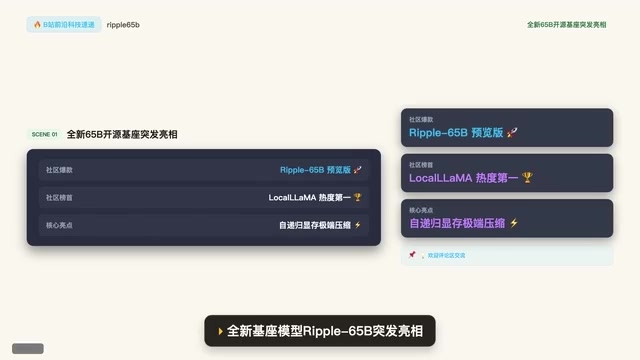
Ripple-65B Open-Source Model Tops Community Charts
Ripple-65B open-source LLM debuts atop community charts, using a self-recursive architecture to slash long-context KV cache for low-latency hundred-billion-scale inference on ordinary GPUs, with preview weights, quantized files, and one-click Olema & VLM deployment.

Deploy Open-Source Video Model MiniMax H3 Locally in 5 Minutes and Skip Cloud Generation Fees
Bilibili creator tests local deployment of open-source video model MiniMax H3: three-step ComfyUI install, 5-minute setup, no coding. Same prompt generates in 2 minutes locally vs 4 minutes online with queuing, saving about 30 RMB per 15-second 720P video. Includes VRAM requirements and RTX 5080 test results.