Audio LLMs Can Hear but Can't Tell Time? Attention-Head Decoding Completes Temporal Localization

Research finds audio LLMs internally encode sound timing but fail to express it; training-free head-guided decoding significantly boosts timestamp accuracy.
Audio LLMs can tell whether a sound occurs but often cannot accurately say when. A new study analyzes internal attention mechanisms and finds that a few attention heads track sound event locations; removing or blocking them harms timestamp performance. Researchers propose "head-guided decoding": training-free, it preserves the model's sound-presence judgment and uses attention-head priors to re-score candidate timestamps, selecting more reasonable intervals. Across three audio LLMs, it improved timestamp quality, raising mIoU from 0.07–0.36 to 0.48–0.56 on unseen recordings. The study shows poor temporal localization partly stems from expression failure, not perception failure, offering a training-free, transferable path to better temporal understanding.
Audio LLMs can tell whether a sound occurs, but they often cannot accurately say when it happens. This "can hear but can't say precisely" phenomenon may stem not from a perceptual failure but from an expression failure. A new study analyzes the model's internal attention mechanisms, identifies specific attention heads that can track sound events, and proposes a training-free "head-guided decoding" method that significantly improves timestamp prediction accuracy.
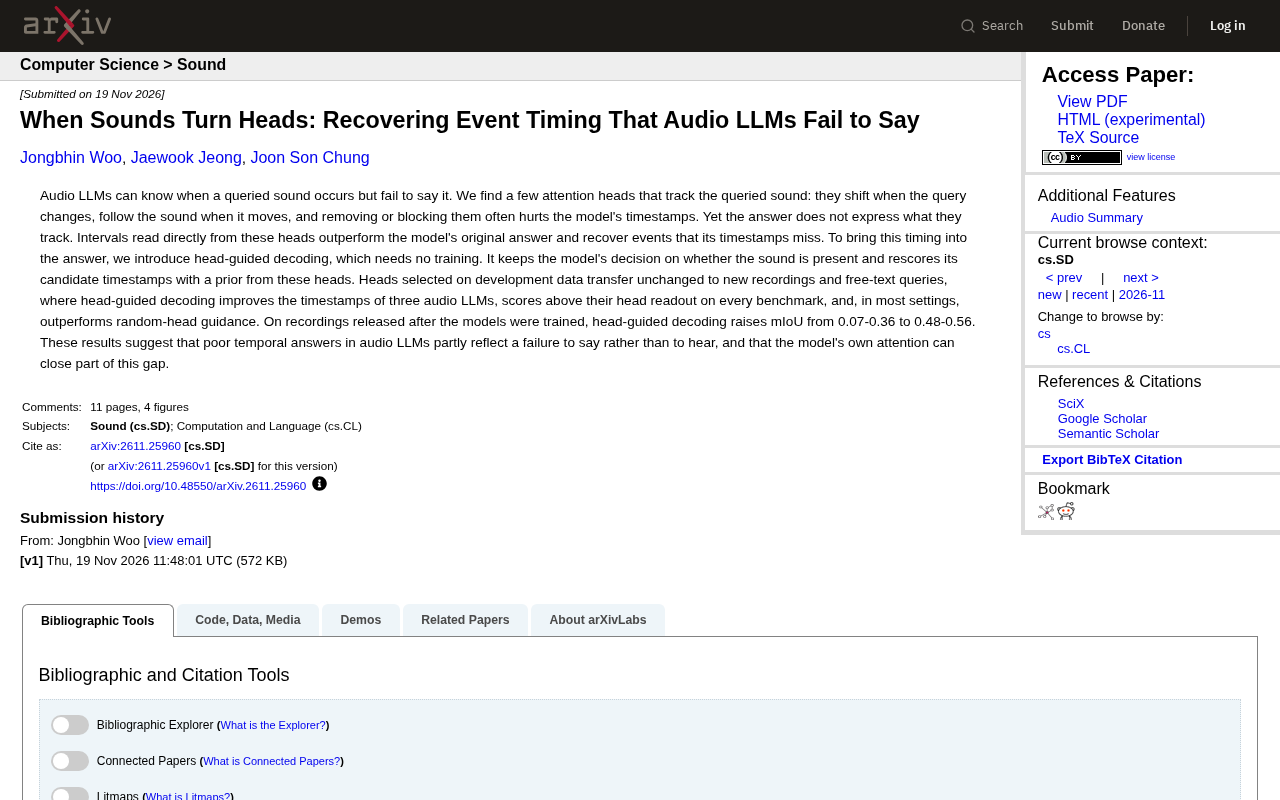
The Problem: The Model Knows the Time but Can't Say It
The study points out that when audio LLMs handle the task of "querying when a certain sound occurs," they actually encode temporal information about the event internally, yet the final output timestamps are often inaccurate. This mismatch of "knowing but not saying" suggests a disconnect between the model's perception layer and its expression layer.
To test this hypothesis, the researchers analyzed the model's attention patterns and found that a small number of attention heads shift as the queried sound changes and can follow the location of sound events. When these attention heads are removed or blocked, the model's timestamp accuracy typically drops, confirming that they do participate in temporal localization.
The Method: Reading Time from Attention Heads, Decoding with Head Guidance
The researchers attempted to read event intervals directly from these attention heads and found that the resulting intervals were more accurate than the model's original timestamp outputs, and could even recover events that the model's timestamps had missed. This further demonstrates that temporal information is accessible inside the model—the problem lies in how to translate it into the final output.
To bring this internal temporal information into the answer, the researchers proposed "head-guided decoding." This method requires no training: it preserves the model's judgment about whether a sound exists, then uses the priors provided by these attention heads to re-score candidate timestamps, thereby selecting more reasonable time intervals.
Attention Head is a fundamental computational unit in the Transformer architecture. In multi-head attention, the input sequence passes through multiple independent sets of linear transformations, each called a "head," which separately compute attention weights for Query, Key, and Value to capture dependencies between different positions in the sequence. Different heads tend to focus on different patterns—some on locally adjacent tokens, some on long-range dependencies, and some on specific semantic or syntactic features. The "temporal tracking heads" identified in this study are exactly one such special type: when a query involves a sound event, their attention weights shift with the event's position along the timeline, forming a readable event interval. Understanding this helps grasp the core logic of "head-guided decoding": since the attention distribution of specific heads already encodes the time range in which an event occurs, extracting the interval directly from this distribution is equivalent to reading the model's internal "temporal map."
Experiments: Generalization Across Models and Datasets
Attention heads selected on development data can be transferred without modification to new recordings and free-text queries. Head-guided decoding improved timestamp quality across three audio LLMs, scoring higher than direct head reading in all benchmarks, and outperforming random attention-head guidance in most settings.
In particular, you may not have noticed that on recordings released after model training, head-guided decoding raised mIoU from 0.07–0.36 to 0.48–0.56. This magnitude of improvement indicates that the method can effectively handle data distributions unseen by the model and has practical deployment potential.
mIoU (mean Intersection over Union) is a core metric for evaluating the quality of temporal interval predictions. For each queried sound event, the intersection length between the predicted interval and the ground-truth interval is divided by the union length to obtain the IoU for that event; then the average across all events gives the mIoU. Its value ranges from 0 to 1, with values closer to 1 indicating higher overlap between predicted and ground-truth intervals. mIoU is sensitive to both positional shifts and length errors: predicted intervals that are too wide lower the IoU, and intervals that are too narrow or shifted also reduce the score. Therefore, an mIoU improvement from 0.07–0.36 to 0.48–0.56 means predictions went from "largely missed or severely misaligned" to "substantially overlapping with the true event"—a significant advance in temporal localization tasks.
Implications: The Gap Between Perception and Expression
This study reveals an important insight: audio LLMs' poor performance on temporal localization tasks is partly due to "expression failure" rather than "perception failure." The model has already captured event timing internally but fails to accurately convey it to the output.
By leveraging the model's own attention mechanisms, head-guided decoding narrows this gap without additional training. This offers a new approach to improving audio LLMs' temporal understanding—rather than retraining the model, it is better to dig deeper into its internal representations and let the model "say what it already knows."
The method's training-free nature also means lower computational cost and stronger adaptability, and it may be extended to more temporal tasks in the future.
One-line Summary
Research finds audio LLMs internally encode sound timing but fail at output; a training-free head-guided decoding method significantly improves timestamp accuracy.
Paragraph Summary
Audio LLMs can tell whether a sound occurs but often cannot accurately say when. A new study analyzes internal attention mechanisms and finds that a few attention heads can track sound event locations; removing or blocking them harms timestamp performance. Based on this, researchers propose "head-guided decoding": training-free, it preserves the model's judgment about sound presence and uses priors from these attention heads to re-score candidate timestamps, selecting more reasonable intervals. Across three audio LLMs, the method improved timestamp quality, raising mIoU from 0.07–0.36 to 0.48–0.56 on recordings unseen by the model. The study reveals that poor temporal localization partly stems from "expression failure" rather than "perception failure," offering a training-free, transferable new path for improving audio LLM temporal understanding.
Related articles

ChatGPT Plus Subscription Pitfall Guide: Go/Plus/Pro Tier Comparison and Quick Activation
A complete ChatGPT Plus subscription guide based on a Bilibili tutorial: from registering an account, comparing Go/Plus/Pro tiers, to the practical steps for quickly completing your subscription.

GPT-6.2 Sol/Astra Released! A Step-by-Step ChatGPT Plus Subscription Guide and Tier Comparison
GPT-6.2 Sol/Astra is out—here's a ChatGPT Plus subscription guide: register an account, compare Go/Plus/Pro tiers, and subscribe in a minute.

Comparing Three Channels for Subscribing to GPT Plus in China: Is Website Top-Up the Easiest?
How to subscribe to GPT Plus in China? This article compares website top-up, credit card, and mobile top-up channels—process, cost, and risk—with steps and tips to help you choose wisely.