Aurora Targets 30,000 Driverless Trucks by 2030 — CFO Says It's No Pipe Dream
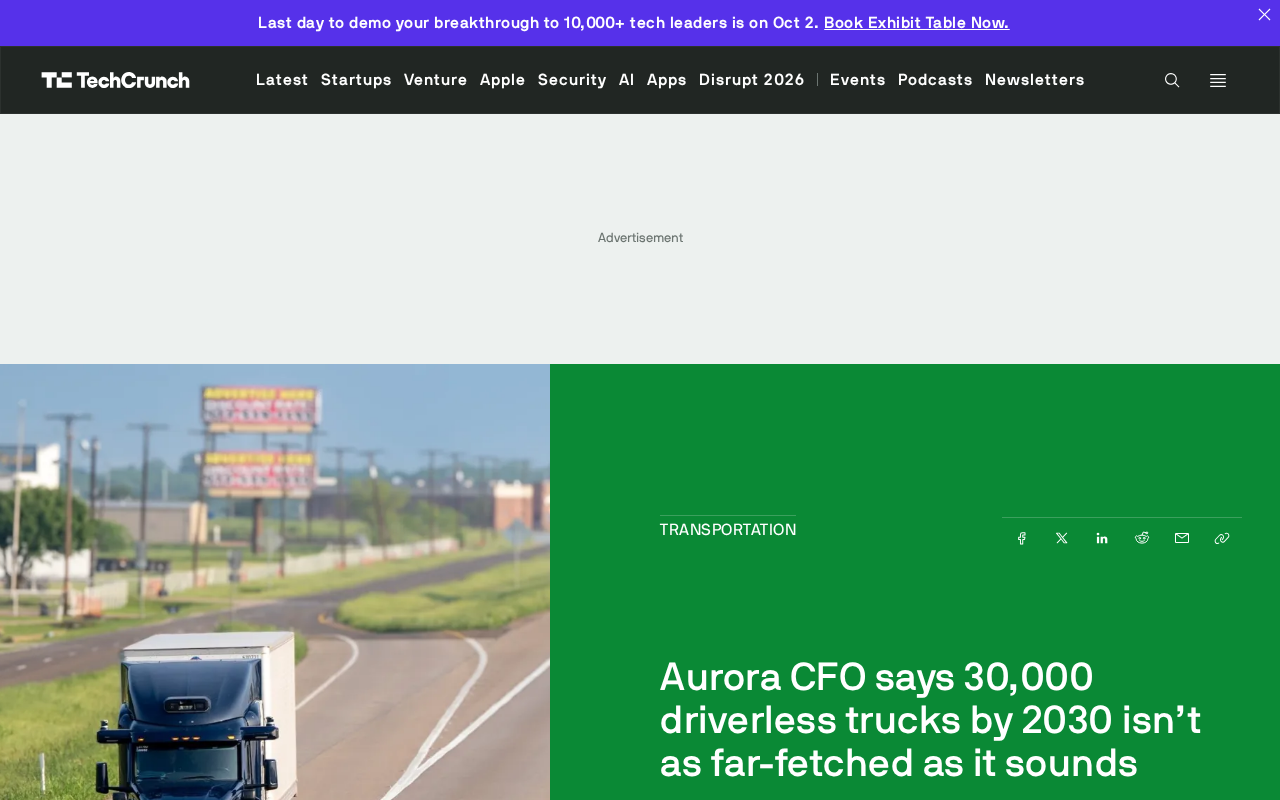
Aurora's CFO publicly backs a 2030 goal of 30,000 autonomous freight trucks, framing it as a financially modeled operational target.
Autonomous trucking company Aurora has announced plans to deploy 30,000 driverless trucks on U.S. highways by 2030, with its CFO stepping forward to call it a commercially grounded operational goal rather than aspirational talk. Freight autonomy is seen as more commercially viable than Robotaxi due to structured highway environments and clear paying customers. The 30,000-unit figure represents meaningful but non-disruptive market penetration, balancing ambition with executability. Scale is essential to making unit economics work, but technical safety, cross-state regulation, and shipper acceptance remain key hurdles. The move signals the industry's formal transition from technical validation to scaled commercialization.
Aurora's Ambitious Target: 30,000 Driverless Trucks
Autonomous trucking company Aurora recently unveiled a plan bold enough to make the entire logistics industry take notice: deploying 30,000 driverless trucks on U.S. highways by 2030. The number sounds like the kind of inflated vision Silicon Valley is known for, but Aurora's CFO has been explicit — these targets are not "aspirational" talking points left on paper, but operational goals backed by a concrete path to execution.
At a time when the autonomous driving sector is broadly contracting and capital has grown cautious, Aurora's decision to publicly announce such a specific, quantified milestone is itself a signal. It reflects the company's confidence in both its technology maturity and commercialization timeline — and sends a message to investors that this isn't just a money-burning storytelling exercise.
Why the CFO Is the One Making the Case
What's worth noting is that it's the CFO — not the CEO or a technical lead — who stepped up to endorse this target. That choice of spokesperson is deliberate. A chief financial officer typically represents the most cautious voice in the room when it comes to cash flow, unit economics, and the costs of scaling. When a CFO publicly states that 30,000 trucks "doesn't sound as crazy as it might seem," the subtext is clear: this scale is financially modelable, not a pure technological gamble.
From an industry logic standpoint, autonomous trucking holds several natural advantages over Robotaxi. Highway environments are relatively structured and predictable, long-haul freight routes are highly repetitive, and commercial cargo transport comes with clear, willing payers. These characteristics have led many in the industry to view freight autonomy as a more viable near-term path to a sustainable business loop than urban passenger transport. Aurora's decision to bet on this comparatively "easier" road lends the 30,000-truck target a degree of practical credibility.
Aurora's current commercialization model is built around what it calls the "Autonomous Freight Network" — prioritizing deployment along fixed long-haul corridors (such as the Dallas–Houston route in Texas) rather than a nationwide rollout. This "corridor-first" strategy is a defining difference between freight autonomy and Robotaxi: by limiting operations to high-frequency, low-complexity fixed routes, the company can rapidly accumulate real commercial mileage data while concentrating safety redundancy investment where it matters most. Aurora completed its first commercial transaction in 2024 and began charging freight customers — giving its CFO the confidence to frame targets in financial rather than technical language. Whether the unit economics hold up depends on whether per-vehicle daily revenue can cover depreciation, remote monitoring, maintenance, and insurance costs. The corridor model is the shortest path to validating that equation.
What 30,000 Trucks Actually Means
Placing 30,000 trucks within the context of the U.S. freight market helps clarify both the ambition and the restraint behind that number. The U.S. long-haul heavy truck fleet is measured in the millions — 30,000 represents a meaningful but far from industry-disrupting penetration rate. Aurora's planning is ambitious enough to attract capital and partners, while remaining executable through a gradual rollout across select highway corridors.
From a business model perspective, scale is the essential prerequisite for profitability in autonomous freight. With high per-vehicle R&D and operating costs, only when a fleet reaches a certain size can the amortized unit cost truly beat traditional human-driven transport. The CFO's assertion that the target is achievable is, in essence, an argument that this "scale-drives-profitability" economic model can be validated by around 2030.
Challenges and Uncertainties
Behind the optimistic projections, real execution risks remain. Achieving fleet-scale deployment of tens of thousands of autonomous trucks before 2030 requires clearing three simultaneous hurdles: technical safety redundancy and the ability to handle edge cases; regulatory approval for cross-state commercial operations; and commercial acceptance from shippers and insurers. A delay in any one of these could drag on the overall timeline.
Furthermore, several autonomous freight companies have struggled with funding or scaled back operations over the past few years, repeatedly testing the market's patience with long-cycle, capital-intensive projects. Aurora's decision to publicly set a quantified target at this moment is both a display of confidence and a public commitment that must be honored. Whether the CFO's words ultimately translate into 30,000 real wheels rolling on real highways remains to be seen.
The regulatory complexity deserves its own examination. There is no unified federal regulatory framework for autonomous commercial trucks in the United States. State-by-state attitudes vary significantly — Texas, Arizona, and others have relatively permissive policies and have already permitted commercial testing without safety drivers, while other states require a human supervisor in the cab, directly undermining the cost advantage of "driverless" operation. Long-haul interstate routes naturally cross multiple legal jurisdictions, meaning Aurora must navigate state-by-state policy advocacy or wait for a federal framework to emerge. The setbacks of prior players like Embark Trucks and TuSimple illustrate how funding pressure, internal governance crises, and slow regulatory progress tend to arrive simultaneously, creating systemic risk. While Aurora has gained a degree of first-mover advantage as competitors have exited, the broader regulatory environment remains one of the most unpredictable variables standing between today and the 2030 target.
Conclusion
Aurora's roadmap reflects a broader shift in autonomous freight — from the "can it be done" phase of technical validation to the "can it scale profitably" phase of commercialization. The CFO personally endorsing the target is a footnote in the industry's growing maturity. As for whether the 30,000-truck vision will be realized on schedule, the answer will be written in the traffic flowing along America's highways in the years ahead.
Related articles

WorkBuddy Full Tutorial: Build an AI Office Automation Agent from Scratch
A complete WorkBuddy tutorial: installation, three working modes, multimodal picture book video practice, expert team agent building, and workflow configuration for low-cost AI office automation.

WorkBuddy Agent Complete Guide: From Beginner to Automation in 7 Days
Based on Bilibili's 256-episode WorkBuddy masterclass, this systematically breaks down Tencent's AI office workbench core capabilities: Agent principles, Skill encapsulation, cross-platform connectors, scheduled automation, knowledge bases, and zero-code development, with learning path recommendations.

8 AI Accounts, 7 Failed: An Honest Review of Using AI to Get Work Done
Only 1 of 8 AI-run Bilibili accounts succeeded. We break down the real difference between "performing AI" and "using AI to get work done."