Autoencoders Replace Attention: A More Compute-Efficient Architecture for Masked Language Modeling

Low-rank bottleneck autoencoders replace attention in MLMs, cutting FLOPs 1.9× while nearing BERT performance.
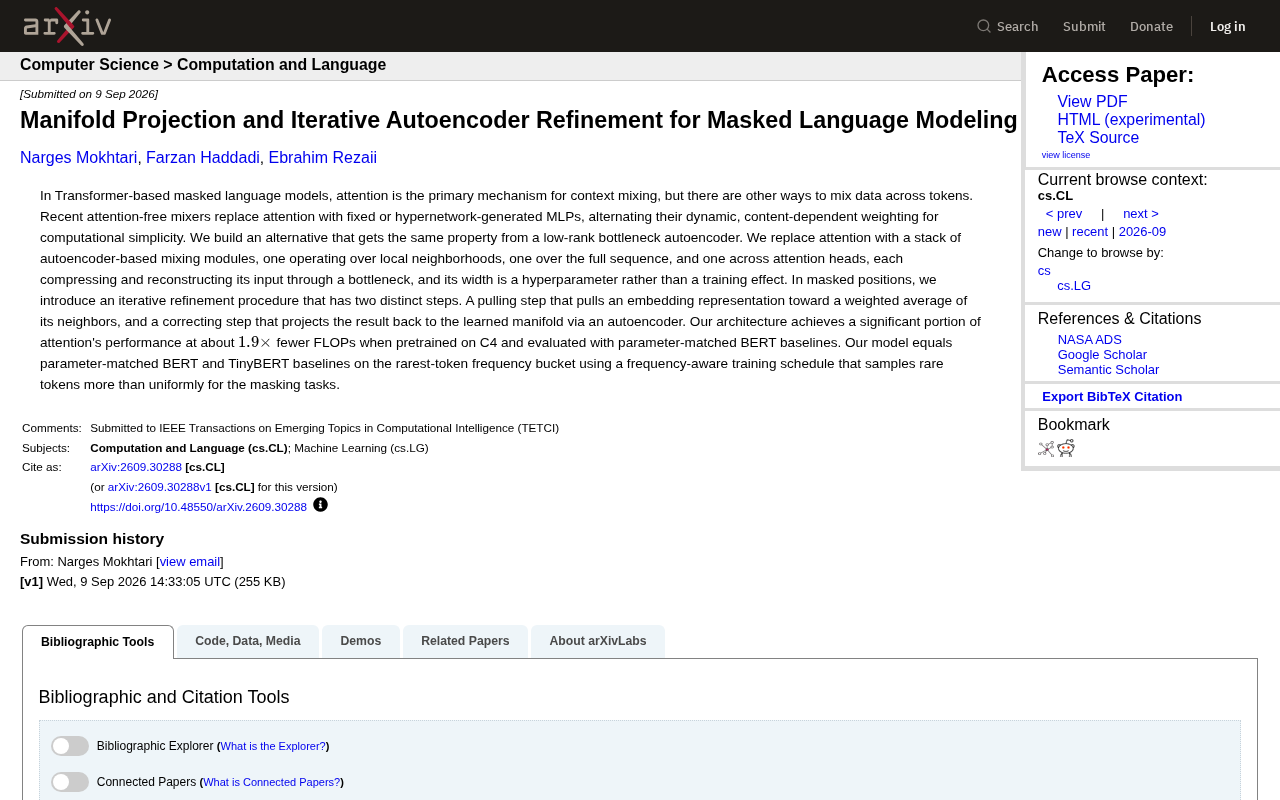
This paper proposes replacing the attention mechanism in Transformers with a low-rank bottleneck autoencoder for masked language modeling. The mixing module operates at three levels — local neighborhood, full sequence, and cross-head — with an explicitly controllable bottleneck width. For masked positions, an iterative "pull-correct" refinement alternately draws token embeddings toward neighbors and re-projects them onto the learned semantic manifold. Experiments on C4 show ~1.9× fewer FLOPs with near-BERT performance, and a frequency-aware training schedule closes the gap on rare tokens, matching BERT and TinyBERT in the rarest frequency bucket.
Background: Context Mixing Beyond Attention
In Transformer-based Masked Language Models (MLMs), the attention mechanism has long been the cornerstone for mixing information across tokens. But attention isn't the only option. In recent years, a wave of "attention-free mixers" has attempted to replace attention with fixed or hypernetwork-generated MLPs, seeking computational simplicity by approximating attention's behavior through alternating dynamic, content-dependent weighting schemes.
A new arXiv paper (arXiv:2609.30288) proposes a different path: using a low-rank bottleneck autoencoder to achieve context mixing capabilities similar to attention, while significantly reducing computational overhead.
Core Method: A Three-Level Autoencoder Mixing Module
The researchers replace attention with a set of autoencoder-based mixing modules, each of which compresses and reconstructs its input through a bottleneck structure. The entire mixing process is decomposed into three levels with different scopes:
- Local neighborhood mixing: Information exchange within a token's local neighborhood;
- Full-sequence mixing: Information flow spanning the entire input sequence;
- Cross-attention-head mixing: Fusion across different attention heads.
A key distinction in this design is that the bottleneck width is an explicitly configurable hyperparameter, rather than something that emerges implicitly during training as in standard attention. This makes capacity control more direct and interpretable.
Why a Bottleneck Autoencoder?
The compression-reconstruction process of an autoencoder naturally filters information. The low-rank bottleneck forces the model to retain the most useful contextual information within a limited number of dimensions, functionally approximating attention's "content-dependent weighting" while avoiding the quadratic computation required by attention matrices.
A linear algebra perspective on "low-rank": If you stack the hidden states of all tokens in a sequence into a matrix, standard attention essentially applies a data-dependent full-rank transformation to that matrix — a computation that scales quadratically with sequence length. The low-rank bottleneck forces this transformation to be decomposed into two steps: "first compress to r dimensions, then expand" — where r is much smaller than the original hidden dimension. This parallels truncated singular value decomposition: retain only the directions corresponding to the top r singular values and discard noisy components. The difference here is that the "compress-expand" parameters are learned end-to-end rather than truncated post hoc. This means the model is forced to learn which cross-token dependencies truly matter, forming compact contextual representations in the lower-dimensional bottleneck space. Unlike standard autoencoder denoising objectives, the bottleneck here primarily serves dimensionality control rather than reconstruction fidelity — making the bottleneck width r a precise knob for tuning the upper bound of cross-token information the mixer can transmit.
Iterative Manifold Refinement: Pull and Correct
Perhaps the most distinctive part of the paper is an iterative refinement procedure designed for masked token positions. It consists of two alternating steps:
- Pulling step: Moves an embedding representation toward the weighted average of its neighbors, allowing masked positions to gradually absorb surrounding contextual information.
- Correcting step: Uses the autoencoder to project the pulled result back onto the learned manifold, correcting any deviation introduced during the pulling step.
This "pull-correct" cycle is essentially iterative positional repair along the semantic manifold. Compared to one-shot prediction, it gives the model the opportunity to progressively converge toward the true distribution — which is the origin of the paper's title terms "Manifold Projection" and "Iterative Autoencoder Refinement."
What is a manifold here? In this context, the manifold refers to a low-dimensional surface that the model has learned within the high-dimensional embedding space: all "reasonable" token representations don't distribute uniformly across the entire space but cluster near this surface. This assumption draws from the classical manifold hypothesis, which has broad empirical support in image, speech, and NLP representation learning.
A masked position typically lies off the manifold at initialization (since its true semantics are unknown). The Pull step drags it toward plausible regions via neighbor-weighted averaging, but linear interpolation doesn't guarantee the result stays on the manifold — just as pixel-averaging two face images tends to produce ghosting artifacts. The Correct step uses the autoencoder to re-project the drifted point back onto the manifold, akin to finding the nearest point on a curved surface. Iterating these two steps is equivalent to gradient-descent-style positional repair along the manifold surface, rather than a one-shot solution in flat Euclidean space. This design is philosophically aligned with diffusion model denoising iterations and the "simulate-correct" cycle in MCTS: trading quality through multiple coarse-to-fine alternations rather than a single precise prediction.
Experimental Results: Fewer FLOPs, Near-BERT Performance
Pretrained on the C4 dataset and compared against parameter-matched BERT baselines, the architecture demonstrates clear efficiency advantages:
- It achieves "a substantial portion" of attention performance while using approximately 1.9× fewer FLOPs;
- When paired with a frequency-aware training schedule — which samples rare tokens for masking more often than uniform sampling — the model matches parameter-matched BERT and TinyBERT baselines in the rarest token frequency bucket.
Rare words are typically a weak spot for language models. Matching BERT/TinyBERT in this bucket suggests the approach isn't merely cheating on common words — it's competitive across the long-tail distribution as well.
On frequency-aware training schedules: The motivation comes from the long-tail distribution of language: natural language word frequencies follow Zipf's law, where a handful of high-frequency words account for the vast majority of token occurrences, while a large number of low-frequency (rare) words carry rich semantic information. Standard uniform masking gives the model abundant gradient signal from high-frequency words while severely under-training on rare words. Frequency-aware scheduling compensates for this distributional skew by raising the probability that rare tokens are selected as masking targets — analogous to oversampling minority classes in classification tasks. This adjustment adds no model parameters and doesn't change inference-time computation, making it a low-cost, training-side-only improvement. Its effect is most pronounced in the rarest frequency buckets — precisely the blind spot of standard BERT training — which explains why the model can match or tie stronger baselines there, even while overall metrics still lag behind.
Significance and Outlook
This work continues the recent research thread of "reconsidering whether attention is truly irreplaceable." Its answer is: through carefully designed low-rank autoencoder mixing modules combined with iterative manifold refinement, it's possible to retain most of the capability of masked language modeling while significantly reducing compute.
For teams focused on inference costs, edge deployment, or large-scale pretraining efficiency, this class of attention-free (or attention-light) architectures offers a direction worth tracking. Of course, as a newly released preprint, its conclusions still require validation at larger scales and across more tasks — there remains a gap between "a substantial portion of performance" and "full parity." But the trade-off thinking around efficiency and rare-word performance is genuinely thought-provoking.
Note: This article is based on the arXiv preprint abstract. For specific implementation details and complete evaluations, please refer to the original paper.
Related articles

Random Pruning of the DPO Computation Graph: 1.4x Training Speedup and Lower Peak Memory
DPO training too slow and memory-hungry? This paper proposes a random pruning framework for the DPO computation graph, sampling independently across position, sequence, and branch dimensions; branch pruning achieves a 1.426x step-time speedup and cuts training time by about 30%, with in-depth attribution of memory and time gains.

Why Does JEPA Underperform MLM in Longitudinal EHR Representation Learning?
New study compares JEPA and MLM for longitudinal EHR representation learning on MIMIC-IV: three JEPA variants train stably without collapse but underperform MLM; target size, not heterogeneity, drives prediction error.

Transfer Learning + Visible Light Communication: A New Approach to Energy-Efficient Indoor Positioning
A study proposes a transfer learning-based visible light communication indoor positioning method, achieving 47% accuracy improvement on the BOSCH factory dataset, 67.5% model efficiency under high noise, and introducing the ME composite metric for energy-efficient positioning in energy-constrained industrial IoT scenarios.