Autonomous Mathematical Discovery by AI: How Multi-Agent Open Worlds Are Reshaping the Research Paradigm

Multi-agent open-world AI systems aim to autonomously conjecture and prove math, reshaping scientific discovery.
This article examines research on autonomous mathematical discovery in open-world multi-agent environments. It explores how AI agents can move beyond solving predefined problems to autonomously generating conjectures, evaluating their significance, and constructing formal proofs. By simulating the collaborative dynamics of human mathematical communities through specialized agent roles, and leveraging formal verification tools like Lean and Coq, these systems represent a paradigm shift from AI as a tool to AI as an autonomous scientific explorer.
Introduction: Can AI Autonomously Make Mathematical Discoveries?
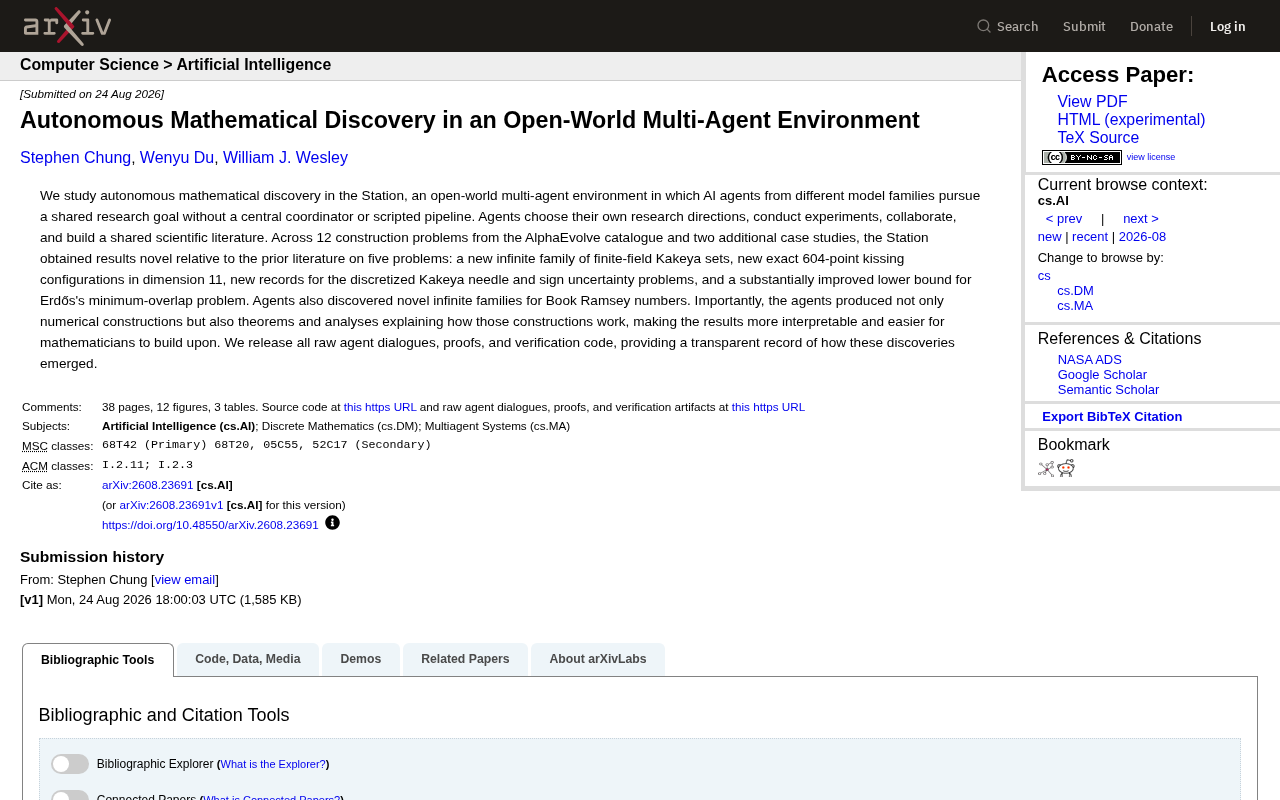
For a long time, mathematical research has been regarded as one of the highest expressions of human intelligence. It requires not only rigorous logical reasoning but also intuition, creativity, and the ability to identify "meaningful" propositions within a vast space of possibilities. A recent study that sparked discussion on Hacker News — Autonomous Mathematical Discovery in an Open-World Multi-Agent Environment — attempts to answer a key question: Can AI systems autonomously explore, conjecture, and prove mathematical propositions without human-predefined goals?
The study received 69 upvotes and over a dozen comments, reflecting the tech community's sustained interest in the direction of "autonomous scientific discovery by AI." It represents an important exploration in the evolution from "AI as an assistive tool" to "AI as an autonomous researcher."
What Is the Open-World Setting: Breaking Free from Closed Problem Spaces
Traditional Automated Theorem Proving (ATP) systems typically operate within a closed problem space: given a clear set of axioms and a target proposition, the system's task is to find a proof path from premises to conclusion. While rigorous, this setup limits the system's "discovery" capability — it can only prove things that humans have already proposed.
The history of automated theorem proving dates back to 1956, when Allen Newell and Herbert Simon developed the Logic Theorist, considered the first automated reasoning program, which successfully proved 38 theorems from Principia Mathematica. Later, J.A. Robinson's Resolution method, proposed in 1965, became a cornerstone for automated reasoning in first-order logic. Modern ATP systems such as Vampire and E Prover can operate efficiently within specific domains. However, these systems have always faced a fundamental limitation: they are systems for "answering questions," not for "asking questions." The exponential growth of the search space (the so-called combinatorial explosion problem) also makes fully automated proving extremely challenging for complex propositions.
The "Open-World" environment completely breaks these boundaries. In such systems, the AI is no longer given fixed proof targets. Instead, it must autonomously:
- Generate new mathematical conjectures, rather than waiting for human queries
- Determine which propositions are worth exploring, establishing intrinsic value assessment criteria
- Construct proofs and verify their correctness, ensuring logical rigor
- Continue expanding the knowledge frontier based on existing discoveries, achieving a continuous exploration loop
This more closely resembles how real mathematicians work — mathematical progress often comes not from answering known questions, but from posing good questions that no one had previously imagined.
Multi-Agent Collaboration Mechanisms: Simulating the Mathematical Community
Another core aspect of the research is its "Multi-Agent" architecture. Unlike a single model reasoning alone, a multi-agent system advances mathematical exploration through multiple AI agents with different roles or strategies that collaborate, compete, or divide labor.
The theoretical foundations of Multi-Agent Systems (MAS) trace back to distributed artificial intelligence research. The core idea is that multiple agents with local knowledge and capabilities can produce collective intelligence exceeding the sum of individual abilities through interaction — a phenomenon known as "Emergence." Within a game-theoretic framework, the collaboration and competition among agents can be analyzed using concepts like Nash equilibrium. In recent years, with the development of large language models (LLMs), LLM-based multi-agent frameworks (such as AutoGen, CrewAI, MetaGPT, etc.) have become research hotspots. These frameworks use role-playing, Chain-of-Thought reasoning, and structured dialogue protocols to enable different agents to effectively divide labor on complex tasks.
This design draws partial inspiration from how the human mathematical community operates: different researchers propose conjectures, review proofs, and challenge and complement each other. In AI systems, the following division of roles typically exists:
- Conjecture generators: Responsible for proposing mathematical propositions to be verified
- Proof searchers: Attempt to construct rigorous proof paths for conjectures
- Verifiers: Review the logical completeness and correctness of proofs
Through this multi-role collaboration, the system can produce emergent discovery capabilities that a single agent would struggle to achieve — this is the unique value of multi-agent architectures in the field of AI mathematical discovery.
From Proving to Discovering: The Critical Leap in AI Mathematical Capability
Beyond Formal Verification and Problem-Solving
In recent years, systems like AlphaProof and AlphaGeometry have demonstrated near-top-human-level performance on International Mathematical Olympiad-caliber problems. AlphaGeometry combines a neural language model with a symbolic reasoning engine, achieving near-gold-medalist performance on IMO geometry problems. AlphaProof integrates AlphaZero's reinforcement learning approach with the Lean formal language, generating proofs through self-play. At the 2024 International Mathematical Olympiad, these two systems jointly solved 4 out of 6 problems, earning a score equivalent to a silver medal. However, these systems are still fundamentally "solving problems" — the problems are given by humans, and their "creativity" remains constrained by predefined problem frameworks.
The "autonomous discovery" this research points toward goes a step further. It aims to let AI systems independently judge value and set direction during the exploration process. The core technical challenge of this transition lies in: How do you define what constitutes an "interesting" or "valuable" mathematical object? In an open environment without human feedback, the system needs some form of intrinsic evaluation mechanism to guide exploration and avoid falling into meaningless combinatorial explosions.
This question touches on profound meta-mathematical and philosophical dimensions. G.H. Hardy, in his classic work A Mathematician's Apology, proposed that excellent mathematics should possess three characteristics: "unexpectedness," "inevitability," and "economy." Paul Erdős often used the phrase "proofs from The Book" to describe the most elegant mathematical arguments. At the computational level, Kolmogorov complexity theory provides a formalized approach to measuring "interestingness": if a proposition's description length is much shorter than its proof length, or if it can unify multiple seemingly unrelated conclusions, then it is more likely to be "interesting." However, encoding such intuition into a computable evaluation function remains an open challenge.
Formal Verifiability: Mathematics as the Ideal Testing Ground
Compared to other scientific discoveries, mathematics has a unique advantage: the correctness of conclusions can be rigorously verified through formal proofs. This means that even if the conjectures or proof strategies generated by AI are "black boxes," their final products can still be mechanically checked by formal proof systems.
The two most influential Interactive Theorem Provers (ITP) today are Lean and Coq. Lean was initiated by Leonardo de Moura at Microsoft Research in 2013, and its community-maintained Mathlib library has formalized over 150,000 mathematical theorems, covering core areas such as analysis, algebra, and topology. Coq originated from France's INRIA research institute, based on the Calculus of Constructions. Its notable applications include the complete formal proof of the Four Color Theorem. The core principle of these systems is built upon the Curry-Howard correspondence — a deep correspondence between mathematical proofs and computer programs: a proposition corresponds to a type, and a proof corresponds to a program satisfying that type. Every proof step is mechanically verified by a type checker, ensuring there are no gaps in the logical chain.
This property makes mathematics the ideal testing ground for verifying "autonomous scientific discovery by AI" — discovery is free, but correctness is decidable. This is also why an increasing number of cutting-edge studies choose mathematics as the entry point for autonomous AI exploration.
Community Discussion: Opportunities and Challenges Coexist
In the Hacker News discussion, the tech community generally held a cautiously optimistic attitude toward this type of research. Supporters believe that the multi-agent open-world framework provides a viable path for AI to participate in genuinely original research, while skeptics focused on several practical issues:
- How to define the "significance" of a discovery: AI may generate a large number of propositions that are formally correct but mathematically trivial or valueless. How to filter out truly meaningful results remains a core challenge.
- High computational costs: The search space for open-world exploration is enormous, and multi-agent collaboration further increases resource consumption.
- Reproducibility challenges: The randomness and emergent nature of autonomous discovery processes may create difficulties for reproducibility and objective evaluation of research.
These discussions remind us that despite the exciting direction, AI autonomous mathematical discovery still has a long way to go before producing major results widely recognized by the mathematics community.
Outlook: AI's Transformation from Tool to Scientific Collaborator
The deeper significance of this research may not lie in how many theorems it can currently prove, but in its exploration of an entirely new research paradigm: AI transitioning from a passive tool to an explorer with a degree of autonomy.
If this path proves viable, we can foresee its migration to other verifiable domains — program verification, physical modeling, materials design, and more. Mathematics is just the first stop, because it has the clearest boundaries for "correctness."
For researchers, the real value may lie in "human-AI collaboration": AI handles large-scale exploration and filtering, while humans judge significance and distill insights. This division of labor leverages machines' computational advantages while preserving humans' irreplaceable role in value judgment. Regardless of how far this ultimately goes, such open-world multi-agent systems provide a valuable experimental platform for understanding the boundaries of "machine creativity."
Key Takeaways
Related articles

Bilibili's Hit Dify Tutorial: A Practical Guide to Building 20+ AI Apps from Scratch
A distilled guide to Bilibili's top-rated Dify tutorial: Windows + Docker deployment, MySQL connection, five app types, model integration strategy, and publishing.

Agent Skills Beginner's Guide: From Concepts to Multi-Agent Collaboration in Practice
A comprehensive guide to Agent Skills: core concepts, components, the importance of Description, standardization, beginner learning paths, and multi-agent collaboration.

One Neuron Detects Both Cats and Cars? We Reproduced It and Found a New Explanation
The cat-car neuron reinterpreted: researcher Cammarata argues it distinguishes pointy from round, not cats from cars. We reproduced the experiment and found the new explanation holds on most inputs—but cars are the exception. The interpretability debate continues on language models.