Autonomous Vehicle Route Planning Needs 'Social Awareness' to Coexist with Human Drivers

Adding a marginal cost social component to AV reward functions improves travel times for human drivers, overall traffic, and AVs themselves.
This study addresses a neglected problem in mixed-autonomy traffic: selfish AV routing externalizes congestion onto human drivers. Researchers propose embedding a 'marginal cost' social component into AV reward functions — quantified via counterfactual simulation — and training with MARL. Experiments on real networks in Ingolstadt and Provins show that social routing reduces travel time increases for human drivers, improves system-wide efficiency, and even shortens AV travel times compared to selfish routing. The study also finds that excessively high social weights hurt performance, and proposes computing marginal costs only for the most influential vehicles to reduce computational overhead.
When AV Fleets Only Look Out for Themselves: The Overlooked 'Externality' Problem
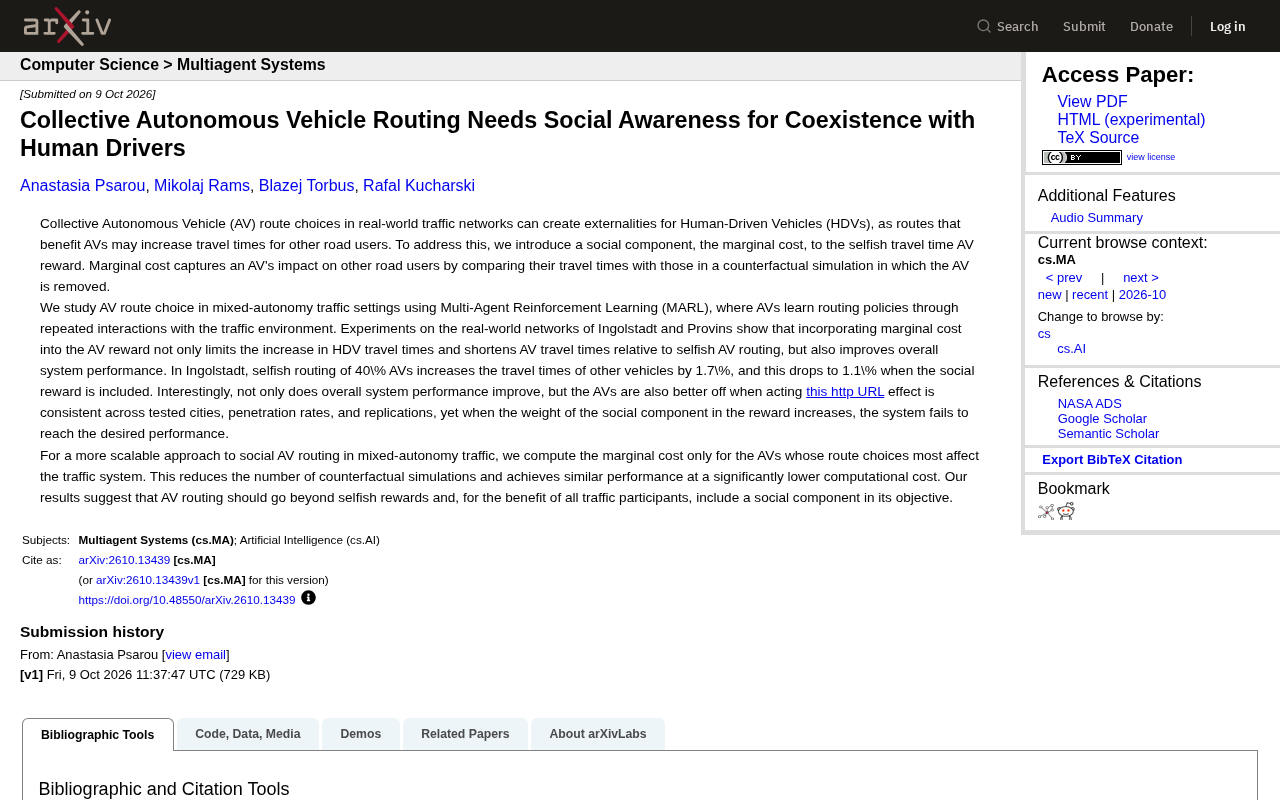
As autonomous vehicles (AVs) gradually enter real-world roads, a long-overlooked problem is coming to the surface: when fleets of AVs choose routes with "self-interest maximization" as their goal, they impose negative effects on human-driven vehicles (HDVs). Researchers call this phenomenon "externality" — routes that benefit AVs often increase travel times for other road users.
In other words, if every autonomous vehicle only optimizes its own travel time, the overall traffic system may not improve at all — it may simply shift congestion onto surrounding human drivers. This research, published in an academic venue, addresses exactly this pain point in mixed-autonomy traffic scenarios.
Core Idea: Adding a "Marginal Cost" Component to the AV Reward Function
The research team's proposed solution is elegantly conceived: beyond the AV's original "selfish travel time reward," they introduce a social component — marginal cost.
The way marginal cost is measured is intuitive: by constructing a "counterfactual simulation" — hypothetically removing a given AV from the traffic network, then comparing other vehicles' travel times with and without it. This difference represents the actual impact that AV has on other road users.
Once this marginal cost is incorporated into the reward function, AVs making routing decisions no longer focus solely on their own travel time — they begin to "consider" the cost they impose on the broader system. This effectively injects a layer of social responsibility into the decision-making logic of autonomous driving.
Multi-Agent Reinforcement Learning as the Training Framework
On the technical side, the research employs Multi-Agent Reinforcement Learning (MARL). Under this framework, multiple AVs learn their own routing strategies through repeated interaction with the traffic environment. This setup more closely mirrors the real-world dynamics of large numbers of autonomous vehicles simultaneously competing and learning.
The core distinction between MARL and single-agent reinforcement learning is that multiple agents are learning simultaneously, and each agent's behavior affects the "environmental state" perceived by others. This fundamentally turns the system into a non-stationary problem — as each agent optimizes its own strategy, the strategies of other agents are also changing in parallel. In traffic routing, this characteristic is especially critical: when one AV chooses a particular route, it not only changes its own congestion experience but directly affects the road conditions faced by other AVs and human drivers. MARL can capture this interdependency, allowing trained strategies to more closely approximate the game-theoretic equilibrium seen in real deployments. Common MARL algorithms include Independent PPO and QMIX, each with different approaches to information sharing and team reward allocation. By embedding the social marginal cost into each agent's individual reward, this research applies a "reward shaping" strategy that guides the agent collective toward a more socially beneficial equilibrium without modifying the underlying MARL algorithm architecture.
Real-World Network Validation: Social Routing Delivers a Triple Win
The research was conducted on two real urban road networks — Ingolstadt in Germany and Provins in France — and the results are compelling.
Taking Ingolstadt as an example: when AVs at 40% penetration rate use selfish routing, other vehicles' travel times increase by 1.7%; once social rewards are incorporated, this increase drops to 1.1%. More critically, the research uncovered a counterintuitive finding:
- Human drivers benefit: The increase in HDV travel times is significantly suppressed;
- The overall system improves: The performance of the entire traffic network is enhanced;
- AVs themselves do better: Compared to selfish routing, AVs that adopt socially aware behavior actually achieve shorter travel times themselves.
This means "altruism" and "self-interest" are not at odds here — when AVs account for others' interests, they ultimately achieve better outcomes for themselves. The researchers emphasize that this effect holds consistently across different cities, different penetration rates, and repeated experiments.
More Social Weight Is Not Always Better
One important boundary condition worth noting: when the weight of the social component in the reward function is tuned too high, the system fails to reach the expected performance. This shows that "social awareness" requires careful calibration — overemphasizing altruism can harm overall efficiency, and designers must find the right balance between self-interest and social consideration.
Scalability Optimization: Only Compute Marginal Cost for the Most Influential Vehicles
Calculating marginal cost relies on counterfactual simulation, and running a full "removal" simulation for every single AV is computationally prohibitive and difficult to scale.
To address this bottleneck, the research proposes a more pragmatic approach: only compute marginal costs for the AVs whose routing decisions have the greatest impact on the traffic system. By focusing on key vehicles, the number of counterfactual simulations is dramatically reduced while still achieving performance close to the full approach — with significantly lower computational cost.
This optimization is critically important for real-world deployment — it moves "social routing" from a theoretically ideal solution toward something that is actually engineerable.
The computational complexity of counterfactual simulation scales linearly or even super-linearly with fleet size: in a naive approach with N AVs in the network, N complete traffic simulations must be run, and each simulation itself involves microscopic behavioral modeling of large numbers of vehicles — nearly infeasible in large urban networks. Common approaches for identifying the "most influential" vehicles include: ranking by road segment congestion (AVs traveling on high-load segments have greater system impact), statistical ranking based on historical marginal costs, or using methods like graph neural networks to predict the system-level impact of routing decisions. This "importance sampling" optimization approach has precedents in both reinforcement learning and operations research. Its core logic is to concentrate computational resources on the subset with the highest marginal returns while keeping precision loss manageable — compressing the algorithm's effective complexity from O(N) to O(k), where k is much smaller than N.
Implications for the Autonomous Driving Industry
This research sends a clear signal: AV route planning should not stop at selfish reward objectives. During the extended transition period in which human drivers and autonomous vehicles coexist, AV decision logic needs to proactively account for other traffic participants.
From a broader perspective, this touches on a critical social issue: when machines begin participating at scale in the allocation of public resources (such as roads), the design of algorithmic objective functions carries ethical and fairness implications. The research results demonstrate that in the transportation domain, injecting "social awareness" into algorithms is not only morally sound but also efficient — providing a valuable reference direction for the coordinated scheduling of large-scale autonomous driving in the future.
Related articles

Amphibious Transforming Drone: Beyond 100x Power Savings, What Are the Real Needs?
Is the amphibious transforming drone just a gimmick? Starting from the 100x power difference of the M4 Morphobot, explore real application scenarios and thesis topic ideas, analyzing boundary conditions where pure drones and pure ground robots both fail.

Warhound Raises $200 Million: Genetically Engineered "War Dogs" Paired with Anduril Gear
Warhound raises $200M, backed by Ben Lamm and Palmer Luckey, to genetically engineer dogs for military and law enforcement use and equip them with Anduril gear. This article analyzes its technology direction, funding logic, and ethical controversy.

Claude API Comes to Google Cloud: IAM Integration and SDK Access Guide
Anthropic hosts the full Claude API on Google Cloud with IAM-controlled permissions and unified billing. This guide covers the Vertex AI and Anthropic-hosted entry points, IAM role configuration, and SDK access.