Aven App Agent: Using AI to Guide Users and Lower the Barrier to App Adoption
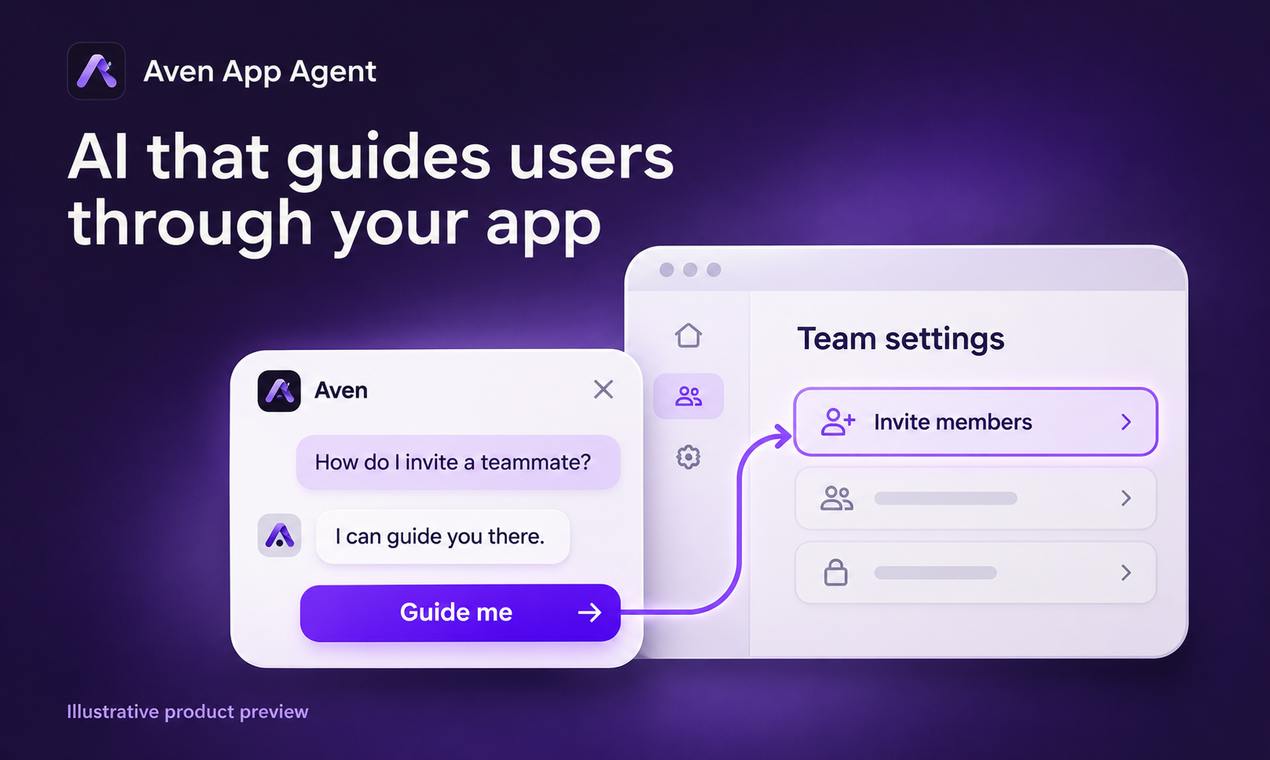
Aven App Agent uses natural language plus interface highlighting to guide users, exploring AI-powered in-app guidance.
Aven App Agent, with 80 upvotes and 12th place on Product Hunt, tries to solve new-user confusion in complex apps with AI. Users ask in natural language, and instead of returning text, the AI highlights the correct controls to guide them step by step. Its core design is "controlled scope": teams pre-define guidable tasks and controls, page transitions stay with the app, and AI doesn't take over logic. This reduces integration risk and avoids hallucinations, but coverage is limited to preset tasks. The article analyzes its value for activation and retention, and notes fierce competition in in-app guidance, with accuracy and degraded experience for undefined tasks as key uncertainties.
Title
Aven App Agent: Using AI to Guide Users and Lower the Barrier to App Adoption
Meta Description
Aven App Agent is an AI guidance tool launched on Product Hunt. Users ask questions in natural language, and the AI highlights the correct controls on the app interface to help them complete tasks. Teams can define the guidance scope, while the app handles navigation.
Article Content
Apps are becoming increasingly complex, and new users often get lost in the menus. Aven App Agent tries to solve this problem with AI: it lets users ask questions in natural language, then highlights the correct controls on the interface to guide them step by step. The product received 80 upvotes on Product Hunt, ranking 12th for the day, in the categories of User Experience, Developer Tools, and Artificial Intelligence.
Product Positioning: Turning "Help Docs" into Interactive Guidance
The core idea behind Aven is not to build a chatbot, but to embed AI into the app's operational flow. When a user asks "how do I export a report," Aven doesn't dump a block of text—it directly circles the correct button on the interface and guides the user to click it.
According to the Product Hunt page description, Aven allows development teams to define the scope of what the AI can guide, while the actual page transitions and navigation are still handled by the app itself. This means the AI doesn't take over the app logic—it only "points the way," reducing integration risk.
What Problem It Solves: Activation and Retention for Complex Apps
SaaS and tool products generally face a contradiction: the more features there are, the harder it is for new users to get started. Traditional help centers, tooltips, and video tutorials are either static or require users to leave the current interface to search. Aven tries to bring the support entry point forward to the user's actual workflow.
This direction isn't entirely new, but Aven's differentiator is "controlled scope"—teams can limit the AI to answering only pre-configured tasks, avoiding model hallucinations or guiding users to non-existent paths. For teams worried about AI going off the rails, this is a pragmatic design choice.
User activation is a key stage in the SaaS growth model, typically referring to the process of a new user completing a core value action for the first time (such as creating their first project or exporting their first report). Activation rate directly determines subsequent retention and paid conversion, so product teams invest significant resources in optimizing new user onboarding. User retention measures the proportion of users who continue using the product in subsequent periods. Aven targets friction in the activation stage: the more features there are, the longer the path for users to find key actions, and the higher the activation failure rate. In-app guidance shortens the distance from "encountering a problem" to "completing a task" by providing contextual hints within the actual interface, and is a common means of improving activation and retention.
Developer Perspective: Integration Approach and Boundaries
Based on the product description, Aven's integration has two layers: teams define guidable tasks and corresponding controls in the backend, while the app side handles actual page navigation. The AI's role is to understand user intent, match it to defined tasks, and trigger highlight prompts.
The benefit of this division of labor is clear accountability: the AI doesn't directly manipulate app state, nor does it rely on full access to the codebase. The cost is that coverage is limited to what teams have pre-configured; when encountering undefined tasks, the AI may not be able to provide guidance. The Product Hunt comment section has only 13 discussions, so there's currently no specific developer feedback on integration difficulty.
Market Observation: Competition and Uncertainty in AI Guidance
In-app guidance is a genuine need, but competition is also significant. Traditional product adoption and digital adoption platforms have already established themselves in the enterprise market, and Aven needs to prove that the flexibility brought by AI outweighs the integration cost.
Another uncertainty is accuracy. Natural language understanding performs well when task boundaries are clear, but users phrase questions in vastly different ways, and the degraded experience when matching fails will directly affect trust. Aven's publicly available information is currently limited, and actual performance still needs verification from more users.
For developers looking for differentiated user experiences, Aven offers a direction worth watching: let AI be a guide, not an all-purpose assistant.
Digital Adoption Platform (DAP) is a category of enterprise software specifically for in-app guidance, training, and process automation, with representative vendors including WalkMe, Whatfix, and Pendo. DAPs typically inject overlay layers through browser extensions or SDKs, supporting no-code configuration of guidance flows, tooltips, and automation scripts, and have formed a mature ecosystem in the mid-to-large enterprise market. Aven's difference from DAPs lies in its focus on natural language understanding and task matching rather than relying on pre-orchestrated fixed flows. However, DAP vendors are also rapidly integrating AI capabilities, so Aven's competition isn't just from similar startups but also from these mature platforms with enterprise customer bases and integration experience.
One-line Summary
Aven App Agent guides users through natural language plus interface highlighting, exploring AI-powered in-app guidance.
Paragraph Summary
Aven App Agent is a product that received 80 upvotes and ranked 12th on Product Hunt, attempting to use AI to solve the problem of new users getting lost in complex apps. Users can ask questions in natural language, and instead of returning text explanations, the AI directly highlights the correct controls on the interface, guiding users step by step. Its core design is "controlled scope": development teams pre-define the tasks and controls the AI can guide, page transitions are still handled by the app itself, and the AI doesn't take over app logic. This division of labor reduces integration risk and avoids model hallucinations, but coverage is limited to preset tasks. The article analyzes its value for user activation and retention, and points out that the in-app guidance market is highly competitive, with accuracy and the degraded experience for undefined tasks remaining key uncertainties.
Related articles

Hands-On with the Genie 4 World Model: Directing Worlds in Real Time Like a Puppeteer
Google DeepMind's Genie 4 world model in depth: Special Guest X's hands-on demo of real-time scene direction via prompts, custom interactive apps in Project Genie, and prompts-as-seeds reproducibility.

Nvidia RTX Spark Mini PCs Go on Sale, Asus, Dell, and MSI Lead the Launch
Nvidia's RTX Spark N1X chip expands to desktops, with Asus, Dell, and MSI launching the first mini PCs, followed by Acer, Gigabyte, HP, and Microsoft's Surface Dev Box, accelerating the desktop AI PC ecosystem.

If Jensen Huang Steps Down, What Happens to Nvidia's AI Empire?
Is Nvidia's AI dominance overly dependent on Jensen Huang? This article analyzes Silicon Valley's CEO personality cult phenomenon, explores Nvidia's technical moat and organizational risks, and why the AI industry must shed the savior narrative.